


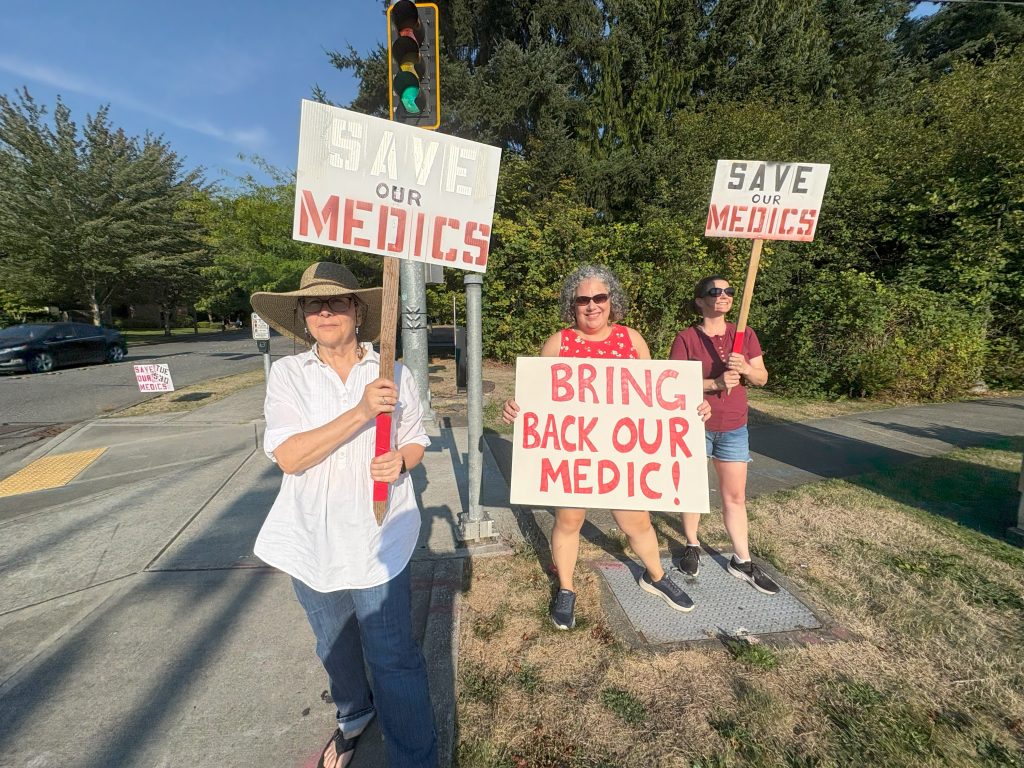
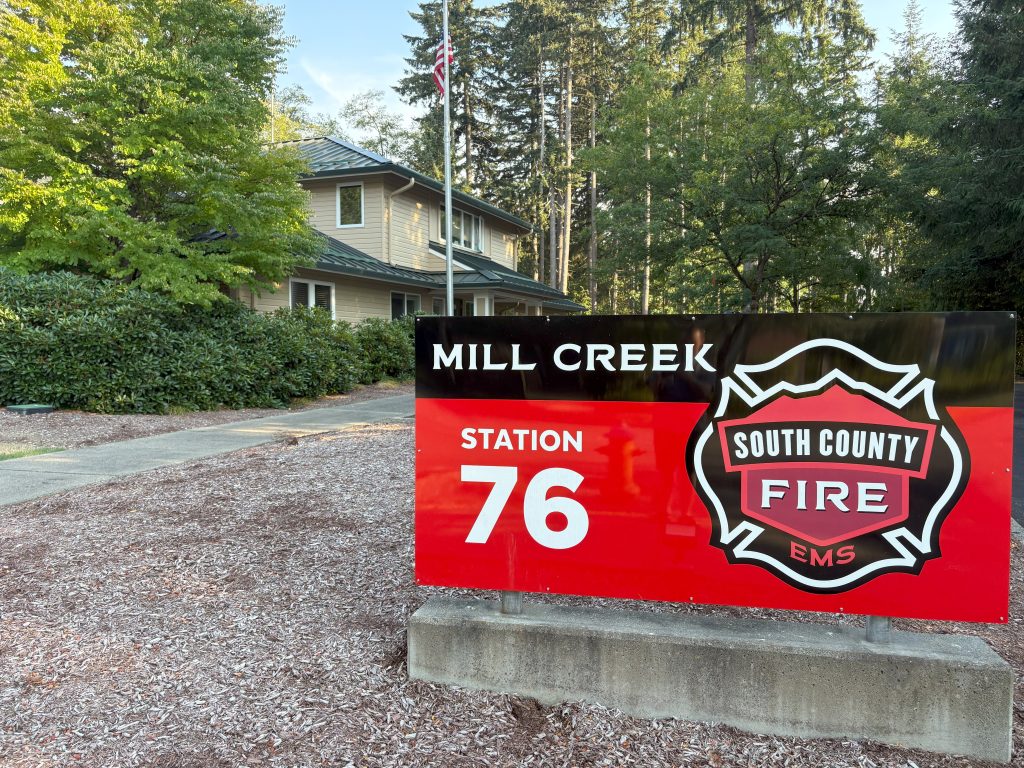
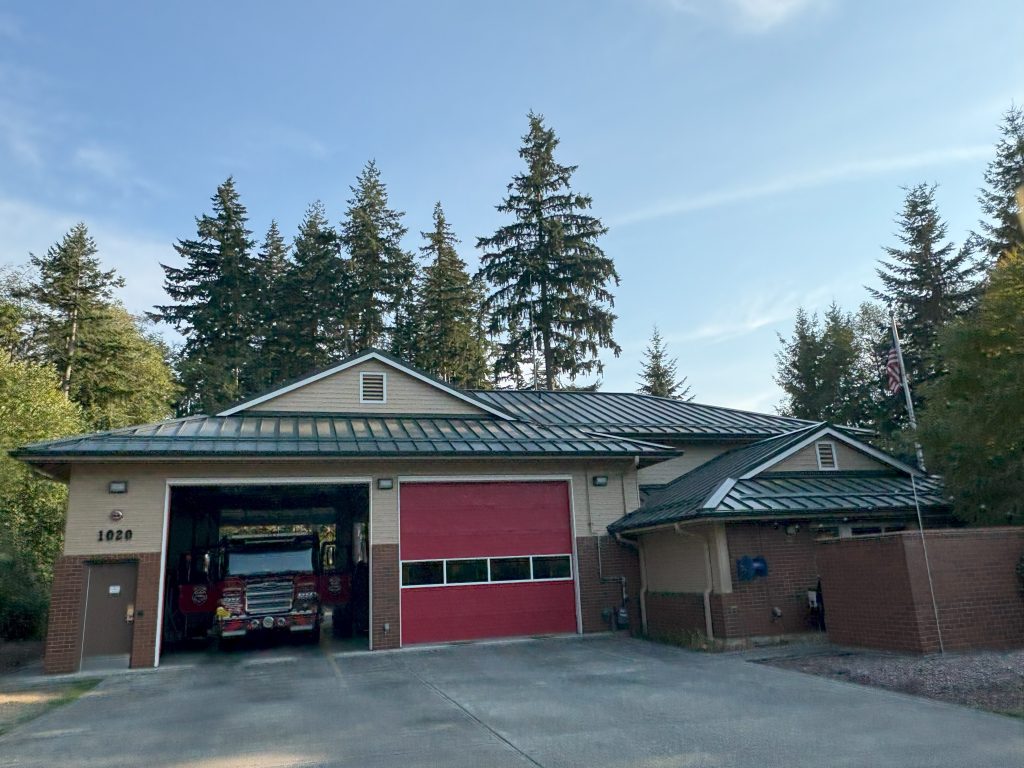
MILL CREEK—Outraged Mill Creek residents gathered at Station 76 in Mill Creek Tuesday, August 26, to protest South County Fire’s contentious decision to transfer out paramedic staffing from Mill Creek to Station 21 in Martha Lake in Lynnwood.
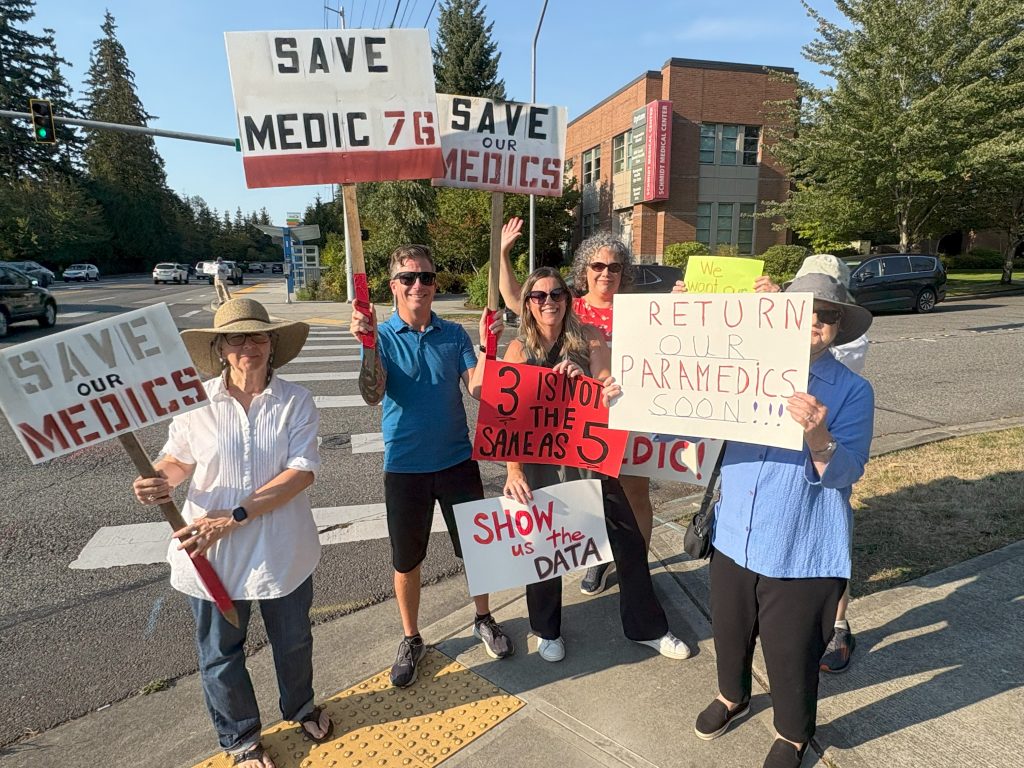
“I don’t understand the rationale for moving them [paramedic] out. It sounds like they’re chasing a data point of being able to get a paramedic to the site of an emergency fastest and that’s the data point they keep driving home, but that doesn’t mean that patient gets transported to a hospital sooner,” sign waver Tannis Golebiewski, Mill Creek resident of 22 years and Mill Creek City Council candidate, told the Lynnwood Times. “So not only have they moved a medic, because they’ve transferred them to somewhere else, but they’re saying that’s okay because there’s paramedics stationed all around you…but they’re coming one at a time on a fire engine and the paramedics themselves are saying they prefer to come two at a time on a medic unit.”




The protest comes just one week after the Fire Authority’s Board of Commissioners failed to return service to the Mill Creek Fire Station with a tied vote, criticism of a lack of transparency and communication, and amid new allegations of potential Open Public Meetings Act violations.
Among those Board Members, Commissioners David Chan and Micah Rowland were present at Tuesday’s protest, not as active participants – they made clear – but to answer any questions the public may have about the staffing changes.



When the City of Mill Creek’s contract with SRFR (Snohomish County Regional Fire and Rescue) expired in 2021 it weighed its options whether to renew the contract or look for other fire services. It ultimately decided annexing into South County Fire would be the best decision for residents and several City Staff recommended voters to approve a proposition on their ballots in 2022 to do so. That ballot measure passed with 76% of the vote.
One of the major reasons City Staff recommended this decision, and many voters voted in favor of it, was the promise that South County Fire would continue current staffing levels at Mill Creek’s one, and only, fire station.

Despite this promise, and without any public outreach or communication with the City, South County Fire transferred the on-site paramedic from Station 76 to Station 21 in Martha Lake as part of its newly adopted redeployment strategy.
Feeling betrayed, residents and elected officials alike have voiced their concerns since; in the form of public comments, an open letter authored by Mill Creek Mayor Brian Holtzclaw demanding staffing levels return at risk of potential legal action, and now protests.
“When we annexed into the fire district a few years back they promised the same level of service and removing a paramedic is not the same level of service. They did it in the dark of night and dismissive of our concerns and our City Council’s participation,” Jeff Miller, seven-year Mill Creek resident and sign waver Tuesday, told the Lynnwood Times.
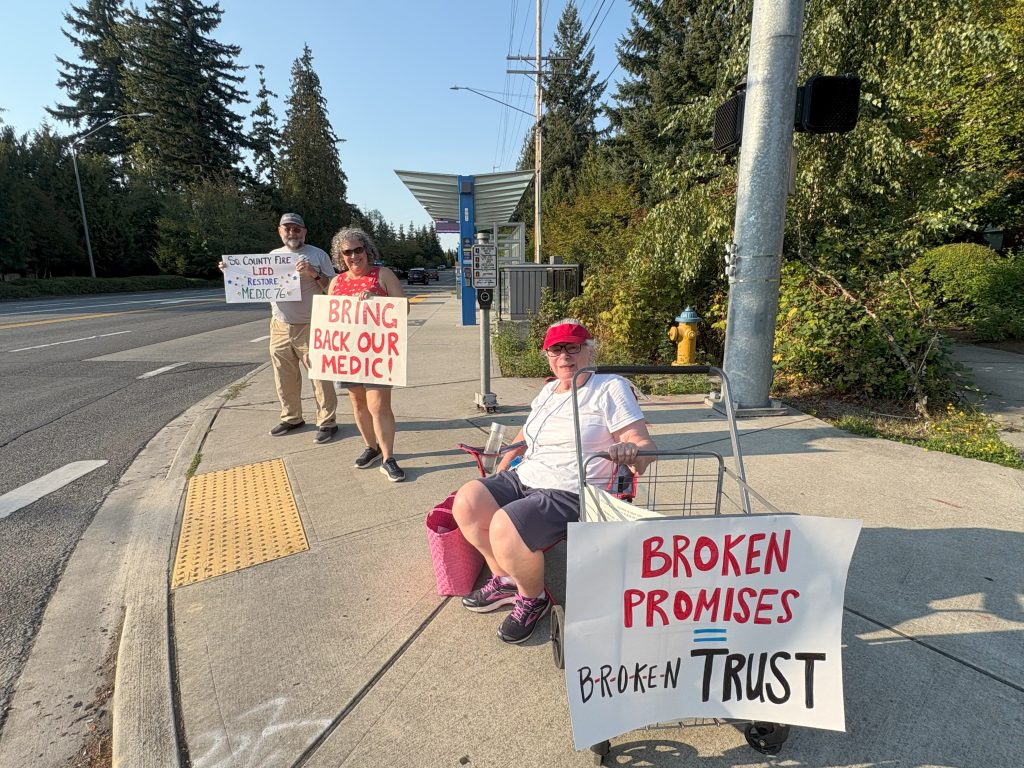
Miller, who lives near Station 76, shared his daughter had a medical emergency before the staffing changes and required paramedic services. The response times were immediate, he shared, but now he fears that waiting 15-20 minutes for a paramedic to arrive from Martha Lake could pose life-or-death circumstances for him and his family.
Tuesday’s sign-waving event was organized by Mill Creek City Council candidate Scott Harder, who previously worked for South County Fire as Public Information Officer and was the City of Mill Creek’s Communications Manager during the time annexation went to a vote.
“Just how this all played out didn’t jive. I knew a grassroots effort needed to happen, so it wasn’t just City Council members demanding change, it’s community members demanding a change,” Harder told the Lynnwood Times. “This is so the Board understands that the people want this back the way it was.”
South County Fire Board fails to restore staffing to Station 76 with a 3-3 tied vote
Following the City of Mill Creek’s vocal opposition to the current staffing at Station 76, and in response to Mill Creek Mayor Brian Holtzclaw’s open letter, The South County Fire Board of Commissioners voted to restore service levels at its meeting on August 19…but the motion failed by a tie of 3-3 and one abstention.

Prior to that discussion Mill Creek Mayor Pro-Tem Stephanie Viganl, joined by Mill Creek City Council member John Steckler, spoke on behalf of the city.
“The most important thing that you have is your trust and your integrity. When you put the RFA on the ballot for a vote you promised us, and the residents of Mill Creek, and made a commitment to them, that you would maintain the five-person staffing and service levels at Station 76,” said Vignal. “We strongly ask you to return the staffing that you promised and that you put on the ballot and that our voters actually voted for, and honor that leadership, integrity, trust, respect, and excellence that you have behind you.”
Fire Commissioner Ed Widdis, who wasn’t on the Board during the initial redeployment plan discussions but was a Mill Creek resident who voted in favor of Proposition 1, defended the staffing changes at 76 stating the “promise made” to Mill Creek residents was to “protect people and property,” adding that the interlocal agreement staffing promise does not directly refer to staffing residing within a singular building, but staffing levels able to respond to any given area.
Widdis claimed the City of Mill Creek “doesn’t understand” fire services and has “never held someone’s hand while they die.” He continued they’re driven by “misinformation,” given Mill Creek’s borders go to 132nd and East Seattle Hill Road, which Medics stationed at 76 cannot get to in time, but Station 21 can.
Commissioner Micah Rowland disagreed with Widdis stating the southwest quadrant of the city, where Station 76 currently resides, is difficult to get to from Station 21 especially during rush hour when traffic bottlenecks, motorists sometimes don’t pull over properly, and the lack of a shoulder in some roads makes it difficult for them to do so.
IAFF 1828 Union President, Pat Moore, who was originally denied the request to comment given he was on an emergency call during his allotted time during the meeting, chimed in to urge the board to “listen to the City of Mill Creek” and “restore staffing.”
Moore continued that the RFA’s presentation of the data wasn’t entirely accurate. The Engine response times given, for example, fails to show how many times the medical unit was with those engines which is inaccurate because engines always deploy before a medical unit in any given scenario, according to him.
“I understand we have all of this data, that’s one piece to it, but there’s also the human element of those who do this job, day in and day out, have worked this current system, can see the holes in the data that the data doesn’t show to you, but there seems to be an unwillingness to listen to us and I’ve heard comments as of last week that a bunch of us are uninformed and have hairbrained ideas,” said Moore. “It’s disheartening to the people who work here in this organization.”
Fire Commissioner Chris Teofilak asked President Moore if he believed the previous staffing model for Station 76 was better than the current redeployment model. President Moore replied that he believes, for the City of Mill Creek, it was.
“We have ALS Engines and while we show there’s a bunch of medics around them those engines are first out to BLS calls and all other hazards, leaving, a lot of times, those paramedics unavailable to actually respond to an ALS as is indicated on that map,” said Moore. “I’m not saying it’s a bad model, where we went, but when I was asked in the middle of the meeting and I hadn’t even seen the final presentation during the June workshop, I did support components of this. But the one I was vocal about and wasn’t supportive of was decreasing the staffing levels at 76. I didn’t think that was a good idea.”
Commissioner Micah Rowland supported restoring staffing to Station 76, at least short-term, given the fact he believed the Board didn’t fully consider certain information or properly engage their partners and stakeholders. Additionally, he noted that his request for data highlighting the potential impacts of staffing restoration has not been fulfilled. He made a motion to restore staffing to Station 76, seconded by Commissioner David Chan, but that motion was delayed by Commissioner Mark Laurence until after the board broke away from the public lens in Executive Session.
When the Commissioners returned from Executive Session Rowland renewed his motion, but it died due to lack of a second.
Commissioner Widdis then made a motion to move one paramedic to Station 76 from another station. The motion was seconded by Commissioner Chan.
Commissioner Laurence called the motion an attempt to qualm a “political storm caused by a couple of individuals” at risk of impacting service to the rest of the RFA – of which the City of Mill Creek only encompasses 7%.
Commissioner Michael Fearnehough supported Commissioner Widdis’ motion stating, simply put, Station 76 had five staff members, now has three, and wants five returned. While he believed the redeployment plan better serves the region, given the data on-hand, he understood the “symbolic” relevance of the staffing return.
Chair Kenny noted that returning staffing to Station 76 trivializes the redeployment experiment and the Board must form their decisions on data rather than political motives.
The vote was 3-3 with Commissioners David Chan, Michael Fearnehough, and Edward Widdis voting in favor and Commissioners Jim Kenny, Mark Luarence, and Chris Teofilak voting in opposition. Commissioner Rowland abstained from the vote before renewing his original motion again to restore two paramedics to Station 76 for a period of 90 days…but that motion also failed due to a lack of a second.
The reasoning behind the temporary, 90-day, staffing return, Rowland later informed the Lynnwood Times, was a “compromise” with the City of Mill Creek and the RFA’s redeployment plan. By returning staffing the Board would adhere to the City’s demands, but the 90-day period would allow the Board to update its data and work with the city to figure out what works best for the region.
“I couldn’t vote yes in good conscious to something that was done completely unethically,” Rowland told the Lynnwood Times. “The citizens deserve to hear the pros and cons of having two paramedics and one paramedic and one fire fighter. They deserve to know the difference between aid cars and a paramedic car. They deserve to know why commissioners didn’t want to do two paramedics; they wanted to do this compromise instead. They deserve to hear all that stuff that was discussed behind closed doors. This whole thing started with a lack of transparency and it’s hypocritical to try and solve it with the exact same problems.”
Commissioner Micah Rowland alleges Board violated Open Public Meetings Act
During that same meeting, Commissioner Rowland reportedly stormed out of the Executive Session believing the Board was violating the Open Public Meetings Act by discussing how it would vote, instead of discussing with legal counsel regarding Mayor Holtzclaw’s implied legal action – which was its intended purpose.
Though the Board’s attorney, Richard Davis, was present during the Executive Session (albeit virtually), and was monitoring the proceedings for OPMA violations, according to Chair Kenny, Rowland claims counsel was not consulted – a claim later denied by Chair Kenny who noted that Rowland was not present during the full Executive Session and therefore could not speak on what happened during it.
Rowland informed the Lynnwood Times the Board did not discuss litigation but how it would vote for restoring staffing to Station 76, as well as how involved a city should be when making those decisions. At that point he felt the session was in violation of OPMA rules and left.
“I looked at the attorney and said you were supposed to stop us if we were in violation and all he would say is ‘well you guys are definitely on the line,” said Rowland. “At that point I said I’m done. I will not be complicit in this violation.”
The Lynnwood Times reached out to Chair Kenny but he did not provide comment stating the proceedings taking place during Executive Session are to remain confidential.
“We had our Executive Session pursuant of the law, we had our attorney present to make sure we were abiding by the law, so there was no violation of the Open Public Meetings Act or violation of the law,” Chair Kenny told the Lynnwood Times. “Executive Sessions are confidential, and Commissioner Rowland is bound by that confidentiality, as am I. I can’t comment about the substance of that session only the process.”
Though discussions held in Executive Session are typically confidential from the public, pursuant of Washington State Law RCW 42.30.110, according to the Municipal Research and Services Center (MRSC): “information shared from an executive session that previously has been publicly discussed would not be considered confidential, nor would any information discussed at the executive session which fell outside the meeting scope.”
Under the state’s Open Public Meetings Act, a governing body is only allowed to enter executive session for specific reasons such as potential litigation or reviewing the performance of a public employee.
When the Board returned from Executive Session Rowland said he was told not to renew his motion to restore staffing because “Commissioner Widdis has a motion that we can pass.”
Prior to the meeting on August 19, Rowland also informed the Lynnwood Times that a fellow Commissioner asked him how he would be voting that evening which Rowland said he declined to oblige him on.
“From outward appearances, and my experience in the room, that Executive Session was abused to conduct deliberation and discussion outside of public view,” said Rowland.
Commissioner Rowland called for a Special Session to revisit the Mill Creek issue for Tuesday, August 26, but that request was denied given a lack of a vote from the rest of the Board. Chair Kenny told the Lynnwood Times it didn’t make sense to discuss the topic ahead of their upcoming September 2 meeting given it’s already on their agenda.
“These things can take time to resolve. Being too hasty can cause its own problem,” Chair Kenny told the Lynnwood Times.
The South County Fire Board of Commissioners is scheduled to revisit the Mill Creek paramedic issue at its upcoming September 2 meeting. Whether that meeting results in another motion to restore paramedic staffing to Station 76, Chair Kenny informed the Lynnwood Times he couldn’t say.

Author: Kienan Briscoe





One Response
Why is it such a surprise that Commissioner Jim Kenny — the same person who chaired the Con Committee and led the “Vote No on Proposition 1” campaign to fight Mill Creek’s annexation into South County Fire — is now at the forefront of efforts to cut staffing at Station 76?
As a resident, I’ve taken the time to watch the meeting videos and read the minutes. What stood out to me was not just the decisions being made, but how condescending, manipulative, and unprofessional some Fire Commissioners were toward staff and toward one another. That kind of behavior doesn’t reflect the respect our community deserves.
What’s especially frustrating is Commissioner Kenny’s own words. During the annexation discussions with commissioners and staff, he consistently emphasized the need for transparency. Yet, now, as the current Board Chair, he and the board, along with Chief Eastman and Chief Isotalo, have chosen not to be transparent with city staff or us, as residents, about staffing changes that directly affect our city’s safety. If the situation were reversed, I have no doubt he would be outraged. Instead, it seems like his resentment over not being included in the annexation process has been carried over into decisions that affect the safety of Mill Creek.
I also did some checking: the fire station nearest to Commissioner Kenny’s own home has a paramedic on staff, with no plans for change. Meanwhile, our city is asked to accept less. That doesn’t feel fair, and it doesn’t feel like he’s representing our best interests.
Fire Commissioners are elected to serve all of us. However, from what I’ve seen, Commissioner Kenny appears to be serving his own agenda rather than representing the needs of a growing city like Mill Creek. As citizens, we need to pay closer attention to who we elect, because these are our tax dollars at work — and this isn’t the best use of our money or anyone’s time.
In November 2025, we’ll have the chance to choose better representation. For me, that means voting NO on Jim Kenny for Fire Commissioner of our District. It’s time we held our elected officials accountable to represent our best interests, not their own.