
Late Saturday night, U.S. Rep. Carlos A. Gimenez (FL-R28), a Cuban-American, posted to X a cryptic message stating, “Dictator Nicolás Maduro’s narcoterrorist drug cartel is about to get annihilated. America, #Venezuela, & the entire hemisphere will benefit enormously from the destruction of the Cartel de los Soles.”
Rep. Gimenez also posted 5 minute earlier, “Soon we will see each other in a Caracas free from communist narcodictatorship. Long live María Corina Machado! Long live Edmundo González! Long live the United States! Long live Free Venezuela!”
When asked on Thursday, August 28, if President Donald J Trump were planning a military operation against Venezuela, White House Press Secretary Karoline Leavitt stated she did not want to “get ahead of the president.”
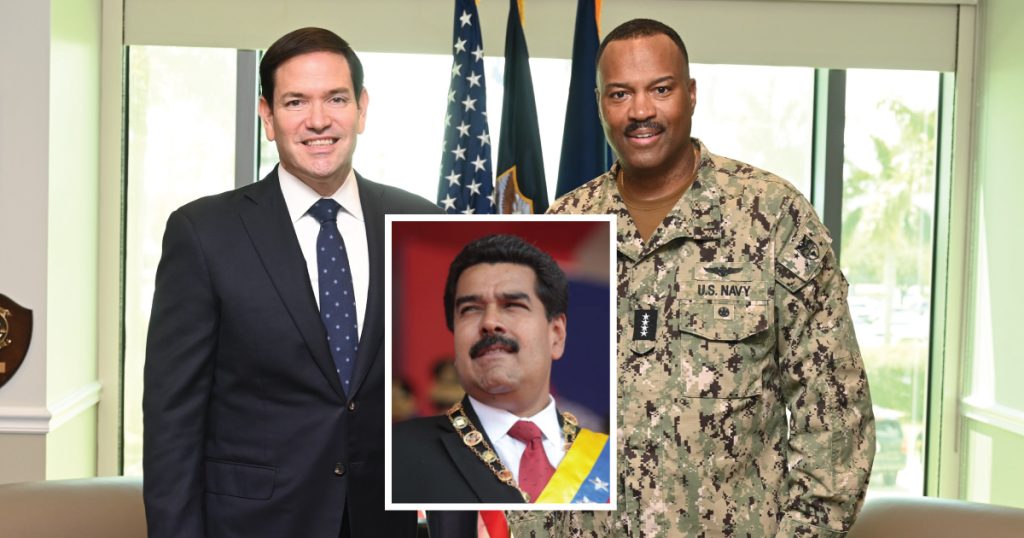
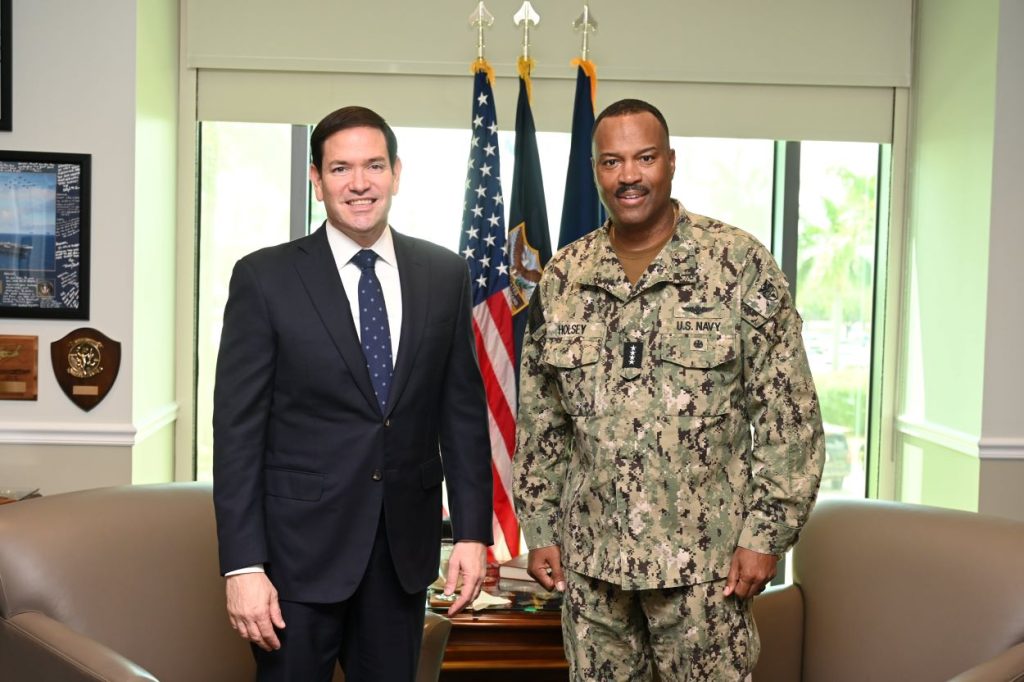
On Friday, August 29, State Dept Secretary Marco Rubio visited the headquarters of U.S. Southern Command which oversees U.S. military activities in Latin America and the Caribbean. Secretary Rubio met with SOUTHCOM Commander Adm. Alvin Holsey and command leaders to discuss security in Latin America and the Caribbean and U.S. priorities in the region.


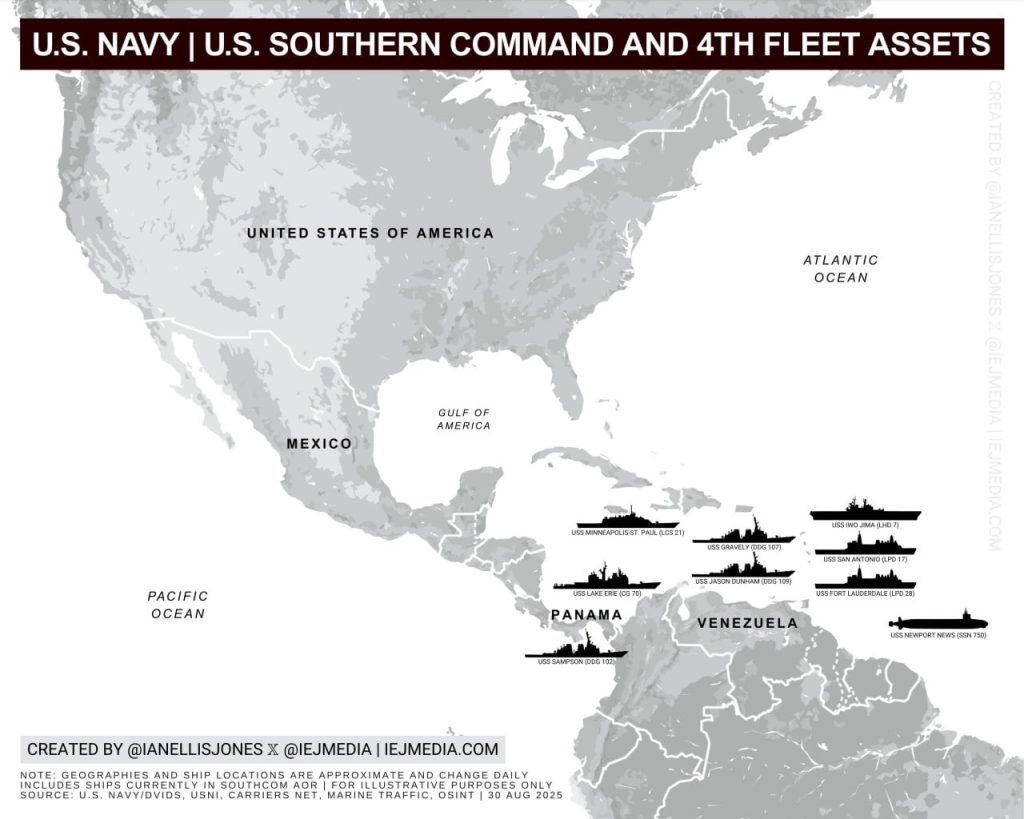
Since mid-August 2025, the U.S. has deployed a substantial naval force to the Southern Caribbean and Venezuelan waters.
Reports indicate the deployment includes three Arleigh Burke-class guided missile destroyers (USS Gravely, the USS Jason Dunham and the USS Sampson), an amphibious ready group with the USS San Antonio, USS Iwo Jima, the USS Lake Erie (CG-70) and USS Fort Lauderdale, carrying approximately 4,500 personnel, including 2,200 Marines. Additionally, a nuclear-powered fast-attack submarine and Boeing P-8A Poseidon surveillance aircraft are involved, capable of intelligence gathering and targeted strikes, if authorized.


This buildup was triggered by the Trump administration’s renewed focus on disrupting narcotrafficking networks, with Venezuela identified as a key hub.
The U.S. designated the Sinaloa Cartel, Tren de Aragua, and the Cartel of the Suns as global terrorist organizations in February 2025, expanding military authority to target these groups. On August 25, Ismael Zambada Garcia also known as El Mayo, 75, of Sinaloa, Mexico, pled guilty to being a principal leader of the Sinaloa Cartel (the Cartel), one of the most violent and powerful drug trafficking organizations in the world.
On August 7, the U.S. Department of State placed a $50 million bounty on Nicolás Maduro Moros, the President of Venezuela, due to his alleged leadership of the “Cartel of the Suns,” a drug trafficking network linked to the Venezuelan government. The U.S. Treasury Department designated the Cartel of the Suns as a Specially Designated Global Terrorist organization on July 25, 2025.
The Maduro’s regime is allegedly linked to narcotrafficking, money laundering, and support for terrorist groups, such as Hezbollah and the ELN (National Liberation Army) in Colombia.
In response to the US building up, Maduro has reacted strongly, announcing on August 21, 2025, the mobilization of over 4.5 million militia members to defend against perceived U.S. aggression.
Venezuelan President Maduro stages a show of force as US warships deploy near Venezuela.pic.twitter.com/5LtAwKHrPv
The only other South American leader to be indicted for operating a narcoterrorism operation was former dictator of Panama, Manuel Noriega, in the late 1980s for drug trafficking racketeering, and money laundering.
Noriega was convicted on July 10, 1992, to serve 40 years in prison which was reduced to 17 years for good behavior. He was released on September 9, 2007, but his incarceration was extended due to extradition requests from other countries. Noriega was ultimately extradited to Panama, where he faced additional charges but died in 2017 while serving his sentence there.
Venezuela’s elections have been marred by allegations of fraud, particularly since Nicolás Maduro’s rise to power following the death of Hugo Chávez’s in 2013.
The most notable instance occurred during the July 28, 2024, presidential election, where Maduro was declared the winner with 51.2% of the vote, despite widespread evidence suggesting otherwise. The opposition, led by Edmundo González and María Corina Machado, collected 81.21% of ballot tally sheets, indicating González won with 67% against Maduro’s 30%. The regime-controlled National Electoral Council (CNE) delayed result announcements, interrupted data processing, and failed to provide credible evidence, prompting the Organization of American States (OAS) to declare the results untrustworthy on July 30, 2024.
Historical fraud includes the 2018 election, boycotted by the opposition due to candidate bans and media censorship, and the 2005 parliamentary election, where opposition parties withdrew amid accusations of manipulated vote counts.
Tactics like voter intimidation, the use of the “Tascón List” to punish dissenters, and control of Smartmatic voting machines have been cited as tools to rig outcomes, eroding democratic integrity.
Venezuela pioneered electronic voting in Latin America, adopting Smartmatic systems in 2004 under Chávez to replace manual voting. Founded in 2000 by Antonio Mugica and others, Smartmatic provided machines for 14 national elections, featuring biometric authentication and printed ballots for verification.
The 2004 recall referendum saw a 0.1% discrepancy between electronic and paper results, deemed minor by the Carter Center, though critics like Dr. Tulio Alvarez argued for deeper scrutiny due to alleged CNE-Smartmatic collusion.
By 2005, technicians reportedly bypassed random storage protocols, compromising secrecy. The system’s integration with regime-loyal CNE officials fueled suspicions of manipulation, notably in the 2013 and 2024 elections, where delayed tallies and unverifiable data reinforced fraud claims.
Smartmatic withdrew from Venezuela in 2017 amid international backlash, but its legacy continues to taint electoral credibility. The DOJ on August 8, 2024, announced federal charges against executives of Smartmatic and former Chairman of the Commission on Elections (COMELEC) of the Republic of the Philippines for an alleged bribery and a money laundering scheme related to the 2016 Philippine elections.
Venezuela, located on South America’s northern coast, gained independence from Spain in 1811 and was characterized by military rule for much of its post-independence history, with 24 constitutions by 1956.
The 20th century saw a transition to democracy in 1958, led by parties like Democratic Action (AD) and Copei, fostering relative stability until economic crises in the 1980s eroded trust.
Hugo Chávez’s 1998 election marked a shift to socialist populism, initiating democratic backsliding with measures like media censorship and electoral manipulation. After his death, Maduro consolidated power, transforming Venezuela into an authoritarian state which saw hyperinflation reaching 1,698,488% in 2018, and a mass exodus of over 7 million people as of 2025.

Author: Mario Lotmore