

OLYMPIA — Washington Secretary of State Steve Hobbs responded to the U.S. Department of Justice’s (DOJ) request for all fields of Washington’s voter registration data today, September 21, but only the publicly disclosable information permitted under state law.
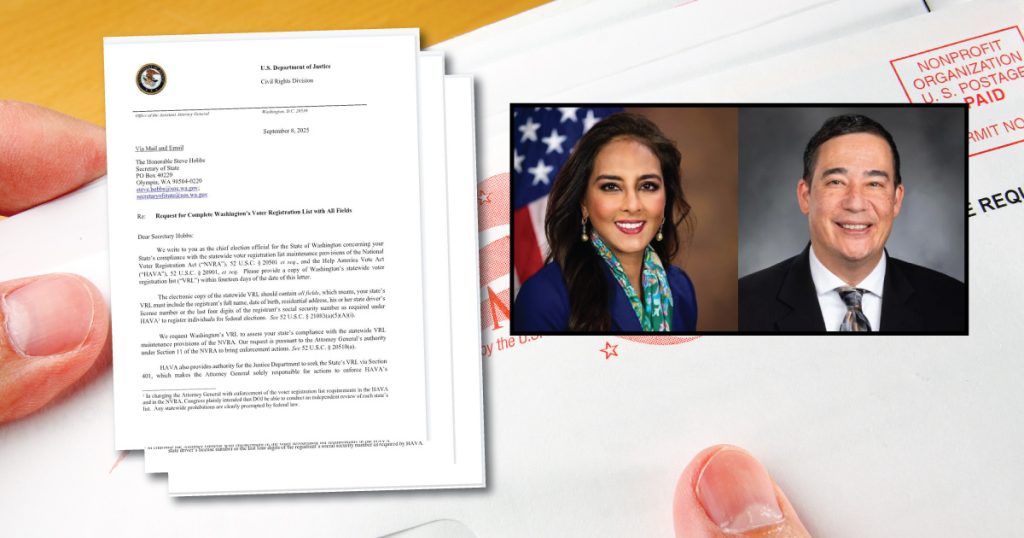
Earlier this month, on September 8, the Washington State Secretary of State’s Office received a letter from the U.S. Department of Justice (DOJ) requesting a full copy of the Washington state voter registration data within 14 days. At that time Washington Secretary of State Hobbs, and his office, assessed the request and ultimately decided they would not release the information until the DOJ specified what they plan to do with the data.
This request, which was signed by Assistant Attorney General Harmeet Dhillon, specified that the copy must include sensitive information including: the registrant’s full name, date of birth, residential address, and state driver’s license number or the last four digits of the registrant’s Social Security number.
Under Washington state law (RCWs 29A.08.710 and 29A.08.720), full date of birth, driver’s license number, and the last four digits of an individual’s Social Security number are protected information. These are not included in the publicly available voter registration database.
“As Washington state’s chief elections officer, I take my duty to protect voters and the sensitive information they entrust to the state very seriously,” said Secretary Hobbs. “While we will provide the DOJ with the voter registration data that state law already makes public, we will not compromise the privacy of Washington voters by turning over confidential information that both state and federal law prohibit us from disclosing.”
The DOJ letter cites sections of the National Voter Registration Act and Help America Vote Act in their September 8 request for confidential data, but nothing in the provisions require that states provide that information, Hobbs said Tuesday continuing that the request also raises concerns about the DOJ’s “shifting explanations for why it seeks this information” such as using it to build a national database or share records with other agencies for unauthorized purposes.
Hobbs noted that such use could raise significant legal questions under the federal Privacy Act of 1974, which requires strict protections when creating or maintaining federal systems of records.
“Our office is committed to transparency and accountability in elections,” Hobbs said. “But transparency does not mean putting the personal information of every Washington voter at risk. The law is clear, and my responsibility is to the voters of this state.”



A copy of Secretary Hobbs’ letter to the DOJ is available on the SOS’ website.
Similar requests went out to at least 22 other states across the U.S. including Alaska, Arizona, California, Colorado, Connecticut, Florida, Illinois, Maine, Maryland, Michigan, Minnesota, Nebraska, Nevada, New Hampshire, New Mexico, New York, Oklahoma, Pennsylvania, Rhode Island, Utah, and Wisconsin.

It’s unclear whether other states not listed also received requests or, if not, why some states were addressed, and others were not.
On March 25, 2025, President Donald Trump signed an Executive Order titled “Preserving and Protecting the Integrity of American Elections.” Several provisions of this order aim to enhance existing laws prohibiting foreign nationals from participating in elections.
Also, withing that executive order it called for a comprehensive review of state voter registration rolls, to verify eligibility and U.S. citizenship.
The executive order also seeks to stop the counting of mail-in and absentee ballots as well as strengthen the enforcement of election laws and prosecution for election-related crimes.

Trump’s executive order effectively revoked a similar executive order signed by President Joe Biden in 2021 which promoted access to voting.
You must be a U.S. citizen to be eligible to vote in Washington state voters are required to be a U.S. citizen by law.
Washington’s voter registration process requires proof of identity such as a valid Washington driver’s license number, permit, state identification card number, or the last four digits of a Social Security number. This information is verified against records from the Washington Department of Licensing (DOL) and the Social Security Administration (SSA).
If a voter’s registration information does not match the records on file with DOL or SSA, they may be provisionally registered. However, their ballot will not be counted until they provide valid identification, according to the Secretary of State.
Trump’s executive order was met with legal challenges from 19 different states including Arizona, California, Colorado, Connecticut, Delaware, Hawaii, Illinois, Maine, Maryland, Massachusetts, Michigan, Minnesota, Nevada, New Jersey, New Mexico, New York, Rhode Island, Vermont, and Wisconsin.
Additionally, the states of Washington and Oregon filed separate lawsuits which was heard in the U.S. District Court for the Western District of Washington in June. Currently litigation is still ongoing.
“American democracy has given agency to the oppressed, hope to the weary, and belief that our society can work for everyone,” said Washington Attorney General Nick Brown. “These truths appeal to most people, but not to a bully and an authoritarian. Donald Trump fears what he can’t control. He only feels safe when he has our rights under his thumb.”
These lawsuits argued that Trump’s executive order is an unconstitutional overreach of presidential power and that the authority to regulate state-run elections rests with Congress and the states themselves.
Multiple federal courts have already issued preliminary injunctions blocking key parts of the executive order, siding with these challenging states that claim the order violates the U.S. Constitution and federal laws, including the National Voter Registration Act and the Help America Vote Act.

Author: Kienan Briscoe