


This is an interesting and challenging question to answer. So, I first want to explore how Academia defines homelessness based on my research, trying to understand the answer to this same question:
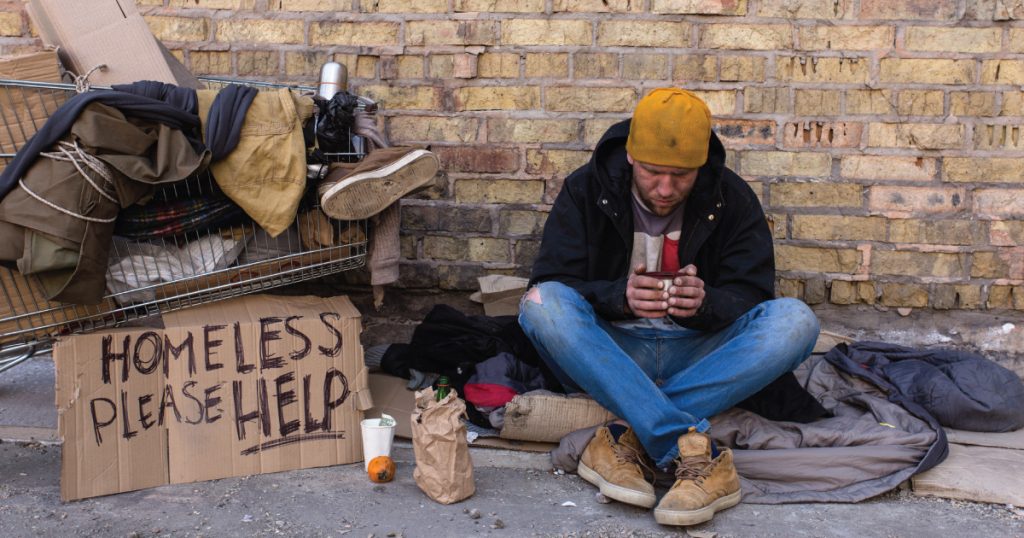
Academia has spent decades debating how to define homelessness. Whether to count only those literally on the streets and in shelters or include the 3.7 million (2022) Americans doubled up with family, the couch surfers invisible to official counts, those in cars or motels, or those a paycheck away from eviction. Scholars argue over typologies: transitional versus episodic versus chronic, roofless versus houseless versus insecure housing. They debate whether HUD’s narrow four-category framework or McKinney-Vento’s broader educational definition better captures the scope. Meanwhile, European researchers promote their ETHOS typology, which offers careful distinctions between rooflessness, houselessness, insecure housing, and inadequate housing.
These definitional battles matter for funding formulas and service eligibility, as they determine who is deemed deserving of help and who remains statistically invisible. However, these academic frameworks, while necessary for policy and resource allocation, overlook the more profound truth about who the homeless truly are.
Who do I see the Homeless population as after my 638 Interviews


They are J, who started Vicodin at 13 to block out his stepfather’s beatings. He still replays “you’re a failure, you destroyed your own life” so automatically that he doesn’t recognize he’s repeating what his stepfather told him. Currently resides in an emergency recovery house.
They are B, whose parents shifted from caregivers to drug companions when he was 15. He picks at his skin to make the “outside match inside,” blaming himself for his mother’s overdose death—current residence unknown.
They are F, a construction worker whose first memory is the SWAT team kicking in the door, arresting his father for running drugs. He tried to follow every rule, but is now sleeping in his truck, struggles with his temper because he feels like a failure since he can’t afford to rent a place and pay child support. Currently living in his truck.

They are D, a submarine engineer with Navy training, asking through psychosis in hour 30 of his ER wait: “Am I a good person?” His military precision couldn’t protect him from this— current residence unknown.
They are A, the special operator who never came home, carrying twenty years of nightmares about things he can’t unsay, bodies he can’t unsee. “It’s easier to sleep on cardboard using fentanyl than it is without,” he says, organizing his few possessions with military precision—current residence unknown.
They are J, whose mother had a severe mental illness. When J ran from the abuse at age 11, every adult she asked for help, including police, returned her to the same dangerous home, teaching her that the systems meant to protect children would only fail her, and she’d have to survive on her own—currently living in long-term recovery housing.
They are D, the contractor who lost his wife and two children when a drunk driver crossed the median. He walked away from the $300,000 in medical debt, from the house, from everything that reminded him they existed, choosing a tent over the silence of empty bedrooms—current residence unknown.


They are S, whose stepmother locked her out while her father stood silent. At thirteen, she found Vicodin and a 22-year-old who exploited her desperate need to matter to someone—current residence unknown.
They are D, walking away from significant medical debt and the house where his wife died of ALS after fourteen months. His father’s voice still echoes through his tapes, “Men don’t cry. Men don’t break. Currently living in long-term recovery housing.
They are T, shooting fentanyl in hospital bathrooms, chasing two-hour reprieves. His refugee parents worked three jobs each, leaving pills to raise their son. “Don’t shame the family. Don’t be weak, don’t dishonor our name.” Currently resides in an emergency recovery house.
They are C, who grew up with every advantage except the one that mattered, his father’s belief that he was enough. He’s destroyed every opportunity since, punishing himself for never measuring up, carrying shame so deep he can’t even claim the traumas that brought him here, only his own failure. Recently evicted from low barrier housing currently living in a shelter.
They are M, living in a hotel on vouchers for the past four years with her daughter, after surviving breast cancer and gallstones while trying to navigate immigration paperwork and working as a dishwasher at the Seattle Convention Center. Currently resides in a motel.
What Unites Them as a Group
What unites them as a group is not laziness or moral failure, but this: they carry internal prosecutors that never rest. Every homeless person I interviewed runs some version of the same self-annihilating program, installed through childhood trauma or adult catastrophe or both. The words differ, but the verdict stays the same. “You are worthless.” “You deserve this.” “You are inferior and inadequate.” The loop plays endlessly, each person using their own language to define failure. Guilt and shame fuel the machinery, turning isolated moments of pain into a permanent identity.
These aren’t occasional thoughts that surface during challenging moments. They are the background noise of existence, the constant hum beneath every decision, every interaction, every moment alone in the dark. The tapes don’t argue their case. They repeat until the prosecution becomes indistinguishable from the truth. This is the suffering that most people use drugs to escape, not the cold, not the hunger, but the relentless internal self-hatred that never grants parole.
The Neurobiology of Survival: When Development Becomes Destiny
To understand how these internal prosecutors are installed requires understanding developmental trauma. As Judith Herman writes, “Repeated trauma in adult life erodes the structure of the personality already formed, but repeated trauma in childhood forms and deforms the personality. The child trapped in an abusive environment is faced with the formidable tasks of adaptation. They must find a way to preserve a sense of trust in adults who are untrustworthy. Safety in a situation that is unsafe, control in a situation that is terrifying, unpredictable power in a situation of helplessness. Unable to care for or protect herself, she must compensate for the failures of adult care and protection with the only means at her disposal – an immature system of psychological defenses.” (Herman, 1992).
When a child’s brain is forming, when the architecture for trust, safety, and emotional regulation should be built, and the very people meant to provide protection become often sources of terror, something breaks that cannot be fixed with housing or job training or thirty-day detox programs. The brain built in violence becomes conditioned to chaos. Neural pathways carved by fear instead of love don’t just struggle to recognize healthy relationships, they’re magnetically drawn to what destroys them. What should signal alarm feels familiar. What should feel safe triggers suspicion. The body remembers what the mind tries to forget. As Gabor Maté explains, “The greatest damage done by neglect, trauma or emotional loss is not the immediate pain they inflict but the long-term distortions they induce in the way a developing child will continue to interpret the world and her situation in it” (Maté, 2008).
This is why the special operator organizes his possessions with military precision while living on cardboard. Why the young woman whose police returned her to abuse at eleven learned that asking for help guarantees betrayal. These aren’t character flaws. These are nervous systems calibrated to survive environments where safety was absent, and protection was a lie.
When we talk about “choices,” we reveal our fundamental misunderstanding. The human brain can only choose from options it perceives as available, and those options are determined by conditioning and what brought survival in the past. True choice requires vulnerability—the ability to pause, consider alternatives, trust that seeking help won’t result in exploitation.
But someone whose childhood taught them that vulnerability invites harm, that caregivers abandon you, that opening leads to more pain, they don’t have access to vulnerability. They have hypervigilance. They have threat detection. They have survival mode. Asking them to “just make better choices” is like asking someone to see colors they’re neurologically incapable of perceiving.
The System That Survives from Fragments
Understanding the neurobiology of trauma makes what comes next even more disturbing: we’ve built a system that actively works against this reality. We focus obsessively on behavior, the drug use, the missed appointments, the aggression, while systematically ignoring what happened to create those behaviors. We punish people for not developing the way we want them to, rather than asking what made normal development impossible.
The hypervigilance that once detected danger, the dissociation that made beatings bearable, the refusal to trust those who promise help, these mechanisms kept them alive. They learned through repeated pain that vulnerability invites exploitation, that caregivers abandon those who don’t fit the system’s requirements, and that opening up leads to more harm. We’ve built a machine that fragments humans into fundable categories: chronic, transitional, compliant, resistant. Yet it misses what treatment resistance actually is: a survival strategy forged in betrayal.
When a fourteen-year-old accumulates ten prostitution charges, the system sees criminal behavior. It doesn’t ask: who groomed this child? What happened at age five that made her vulnerable to trafficking? Why did two years in detention teach her to be a better criminal instead of healing the exploitation her stepfather inflicted? Maté reminds us: “The question is never ‘Why the addiction?’ but ‘Why the pain?'” (Maté, 2008).
This is the mentalist model of human behavior, the dangerous fiction that people’s actions result primarily from conscious choice and individual will. It ignores that behavior emerges from neurobiological systems shaped by experience, that the capacity for rational choice requires developmental prerequisites, that trauma fundamentally rewires how the brain processes information.
The Cost of What We’re Choosing
The economic case for addressing developmental trauma rather than managing symptoms is overwhelming. The ACE Study demonstrated that nearly 64% of participants experienced at least one adverse childhood experience, with 69% of those reporting multiple incidents. The lifetime cost per victim has been revised to $830,928, and the annual U.S. economic burden now ranges from $428 billion to $2 trillion (Peterson et al., 2018). We could provide intensive trauma-informed care for a fraction of what we spend cycling people through emergency rooms, jails, and brief hospitalizations.
Yet despite these staggering expenditures, the homeless population continues to grow. Where does the money go? Much of it flows through systems that treat homelessness as a housing problem rather than a trauma problem, funding approaches that ignore the neurobiological reality documented in every interview I conducted. We’ve created an infrastructure that survives on managing homelessness rather than resolving it, emergency shelters that cycle people through without addressing why they can’t maintain stability, Housing First programs that place traumatized individuals in apartments without the therapeutic support needed to prevent eviction, harm reduction models that prioritize immediate survival over the developmental healing required for actual recovery. The system fragments care into disconnected services, each addressing a symptom while the underlying trauma remains untouched, ensuring clients return again and again.
This isn’t compassion, it’s a business model. Organizations receive funding based on service delivery optics rather than outcome measures, on beds filled rather than lives transformed. Some nonprofits inflate their numbers to secure funding—as documented in United States v. Cody Benson (W.D. Wash. 2024), where a nonprofit executive submitted fraudulent invoices for training events that never occurred, defrauding Washington State of nearly $200,000. Survivors’ testimonials and trauma stories are funneled to fundraising teams, packaged to entice donors, while the people who lived those experiences remain trapped in instability. When systems profit from managing symptoms rather than healing trauma, we shouldn’t be surprised that $2 trillion in annual spending produces so little actual change.
The human being, the father, the soldier, the person who wants desperately to be “good again” hasn’t had a voice in years. What these individuals carry are not simply memories of bad things that happened. They carry altered brain architecture, dysregulated nervous systems, and internal prosecutors that never rest. Maté observes, “Not all addictions are rooted in abuse or trauma, but I do believe they can all be traced to painful experience. A hurt is at the center of all addictive behaviors” (Maté, 2008). The drugs, the missed appointments, the aggression, these are not the problem. These are symptoms of nervous systems shaped by environments where survival required hypervigilance, where vulnerability invited exploitation, where trust led to betrayal.
The Choice Before Us
The question is not whether these individuals can change. The question is whether we can build systems that recognize what change requires: not willpower or consequences, but the painstaking work of creating safety, building attachment, and installing the developmental capacities that trauma prevented from forming in the first place.
Reestablishing trust requires respect and action, not empty promises or bureaucratic processes, but consistent, tangible demonstrations that safety is real and help is genuine. For someone whose developmental experience taught them that vulnerability invites exploitation and that caregivers abandon you, trust cannot be demanded or expected. It must be earned through thousands of small moments where respect is shown and promises are kept.
Until we build systems designed to create safety rather than compliance, to address developmental trauma rather than punish its symptoms, we will continue to mistake survival strategies for moral failures and demand change from nervous systems that lack the neurobiological capacity to produce it.
Stop giving trauma a voice. Start giving humans treatment. Stop documenting deaths in the name of choice. Start preventing them in the name of life.
Choose now. They can’t.
Joe Wankelman is an accomplished leader merging military precision with corporate innovation, excelling in data analytics, machine learning, and large-scale operations. He has honed analytics at Amazon via TLG, audited startups at Keiretsu, championed mental health at KIKO during COVID-19, and advanced community leadership as Snohomish County Commissioner.
Pursuing a Master of Science in Data Analytics and Policy at Johns Hopkins University, Joe enhances data-strategy-policy intersections for impact. He seeks collaborations to leverage data for efficiency and growth in our resilient era. Let’s achieve new heights together.
COMMENTARY DISCLAIMER: The views and comments expressed are those of the writer and not necessarily those of the Lynnwood Times nor any of its affiliates.

Author: Lynnwood Times Contributor





One Response
This is one of the best analysis I’ve seen on the addiction, prison, homeless populations. So many abused, neglected children turn into lonely, tortured adults. Some may say, “grow a backbone”, or “get over it,” but who knows what is easier for one person’s psyche, and what would break another? We have got to move to a different mode of treatment because what we have now is not working. It only lines the pockets of Non-Profits who continue the decades-old, archaic treatment models that have failed so many.