


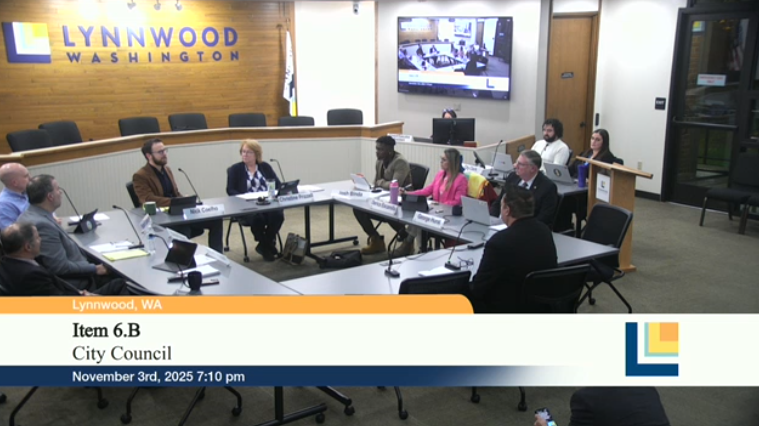
LYNNWOOD—The Lynnwood City Council tackled some of the city’s pressing financial and operational issues at its Work Session Monday, November 3, in addition to discussing a new farmers-market initiative at the Lynnwood City Center, and the city’s contract for prosecutorial services.
Budget Review and Tax Outlook
The bulk of Monday’s Work Session centered on the City’s mid-biennial budget review ahead of its forecasts budget shortfall due to reduced revenues (notably sales tax and permit income) and increased service costs. One of those budget items involved an increased property tax levy through 2026.
The City collects one regular property tax levy for general operations. The 2025-2026 Budget includes a general operating property tax levy of $7.2 million for 2025. The city has an available banked capacity amount of $3,852,517 meaning the 2026 levy, per state limits, could be as much as $11,052,518 (the capped amount) not including refunds from new construction.


If Lynnwood were to go with this maximum amount it is estimated to cost approximately .95 per $1,000 of assessed property value for the average home, or about $633 annually (or $53 a month), assuming a 5% home value increase.
Council member George Hurst was cautious of raising property taxes given the city has already raised property taxes 148% since 2021.

“The property taxes on my home have gone up $1,200 from 2021 through 2025. The City property tax, from 2024 to what is being proposed now goes from $309 to $655,” said Hurst. “These are really tremendous increases that we need to keep in mind. And home insurance rates are also going up tremendously due to all of the disasters going on around the country.”
Hurst added that the City of Lynnwood does not operate in a vacuum and must be consider that the state, and county, also raise costs which directly impact residents.
Washington state law requires cities that impose a property tax to certify their levy for the subsequent year by the end of November. A public hearing is required and is scheduled for November 10th.
Prior to the property tax levy discussion Finance Director Michelle Myer presented 85 proposed budget amendments to the 2025-2026 biennium budget including amendments to its General Fund for legal department contractual increases for prosecution and indigent defense, Police, PCRA, and Public Works, IT Department grant revenue, and cost allocation true up.

Also included in those proposed amendments are increasing expenditures for Lodging Tax contractual services by $10,000 from available fund balance, establish new fund to collect tax revenues within the city’s TIF, and amendments to the city’s criminal justice fund, opioid settlement fund, and technology replacement fund, to name a few.
The City of Lynnwood is currently faced with a $10.7 million (potentially up to $20 million according to some council members) budget deficit. Finance Director Myer returned later that evening to continue a discussion on revenue to make up for this, expanding upon conversations first beginning on the October 20th and September 17th Work Sessions.
Some of these included increased utility taxes (the City hasn’t increased its utility taxes since 2014), business license fees and development service charges (the city currently does not have a B&O fee), increasing vehicle tab fees, and so on.
Council President Nick Coelho shared that the City has to ultimately grow its sales tax next year but that requires a “crystal ball” and “making it a reality” to do so, adding that a farmers market could be a small fix, and the long-term District could be a large fix.
“In the moment the only other option I see is trying to get the Public Safety sales tax passed next year, which would add another $2 million but would put us at the top of the mountain of sales tax, as far as Washington State is concerned,” said Coelho. “Other than that, I really don’t see what else we can do other than gut public safety and that leaves us in a really bad position.”
Council member Hurst added, regarding increasing utility taxes, that, even though the city hasn’t raised its utility taxes since 2014, it has still raised the cost of rates. Water, for example, has increased 5% every year, sewer 21%, and stormwater 4.2%.
“We’re increasing the rates and now we’re talking about increasing the tax on the ever-increasing rates. I can tell you, in conversations I’ve had with residents over the last few months, the sticker shocks of utility bills is a constant discussion,” said Hurst. “It used to be residents paid $98 every other month, now we’re looking at $350 and we’re talking about increasing.”
Hurst concluded that the city needs to be aware of some of these issues that residents currently face adding that the city is on an upward trajectory as far as revenue – bringing in more revenue in 2025 than 2024 by about $2 million.
Hurst noted that he “doesn’t have any answers” but the city needs to look at other ways of increasing revenue other than relying on putting tax burdens on residents, a point echoed by Councilwoman Derica Escamilla who added that with everything going on with the federal government, and SNAP benefits, it’s an unfair ask of the public.
“I already see the burdens as a single mother and this scares me,” said Escamilla.
Mayor Frizzell added that the city has “some reckoning to do” because the City chose not to raise property taxes to offset some of the less-than-projected revenue forecasts back in 2022.
“We’re not in debt; we have a forecast that hasn’t panned out as anticipated. If council does nothing, we have a really big problem but we’re in it together,” said Frizzell. “I don’t have a plan. All I can do is manage the budget as given and that’s all any Mayor can do – manage the budget.”
Regarding business license fees, Finance Director Myer informed council Development of Business Services (DBS) will be returning to council later this month with more details.
City prosecutorial contract amendment
Lynnwood City Council members also heard from Prosecuting Attorneys James Zachor, Yelena Stock, and Chad Krepps on the need to amend the city’s prosecutorial contract to allow for one additional Prosecuting Attorney for 2026 due to increased caseloads and activity at Lynnwood Municipal Court.
For the year 2025 the Prosecutor’s Office was operating $60,000 under budget as Zachor, Stock, and Krepps were working under a state grant and giving the City of Lynnwood a $10,000 per month discount for six months.
The three Prosecuting Attorneys proposed adding an additional attorney for 2026, which would increase the City’s monthly payments from $56,040 to $67,468. If the City Council approves this amendment, they would also need to approve a budget amendment adding $111,100 to the prosecution budget to account for the new contract.
Another option, which was presented to council, is some policy changes at the Lynnwood Municipal Court which could save the city money in the long run. These policy changes could be hiring a Case Coordinator, for example, who would be reaching out to people for restitution, witness interviews, and such which would free up the existing Attorneys to handle more cases.
Lynnwood currently has 10 prosecutors who serve 12 total jurisdictions. Lynnwood is their largest and longest contract, which first began in 2001.
Farmers Market at City Center Station
Council also continued its conversation concerning adding a sustainable farmers market near Lynnwood City Center Station, a topic that has been ongoing for several years.
When the Sound Transit Link light rail opened in August of 2024, the City of Lynnwood thought it would be an ideal location due to its accessibility via light rail, Community Transit, and with several weekend parking options.
One month later, discussions began with Sound Transit representatives regarding a City Center farmer market’s feasibility. According to the city, these conversations were met with a “high level of enthusiasm and community support.”
Sound Transit spent months of site planning, ultimately concluding that they would allow the city of Lynnwood to use the property for a farmer’s market at no charge in exchange for sponsorship recognition. The agreement would also include access to station space for up to ten months per year, discounted advertising on trains and stations, and flexibility to host special events such as food truck areas and live performances.
However, to move forward, Sound Transit is requiring a $5,000 security deposit to initiative the formal site agreement and advance planning.
On the other hand, the farmers market is expected to generate economic activity, support local vendors, and enhance community engagements as Lynnwood’s new downtown continues to develop around the light rail.
The presentation Monday was conducted by Frank Percival, CEO and President of the Lynnwood Chamber of Commerce, where he shared the findings of community outreach.
With several other farmers markets in the region, Percival said a common public stipulation was that it needed to have adequate food and vendor options, as well as having local, and sustainable proteins and produce offered to truly be considered a “farmers market.”
The city would decide at a later date whether the farmers market would be on Saturdays or Sundays.

Author: Kienan Briscoe






One Response
Good job Lynnwood. You just elected a mayor who admits he “doesn’t have any answers.” No surprise. At least he forecasts an increase of 2 million in revenue so he won’t be asking any of you for more money. Farmers market??? Lynnwood?? Future looks bright.