


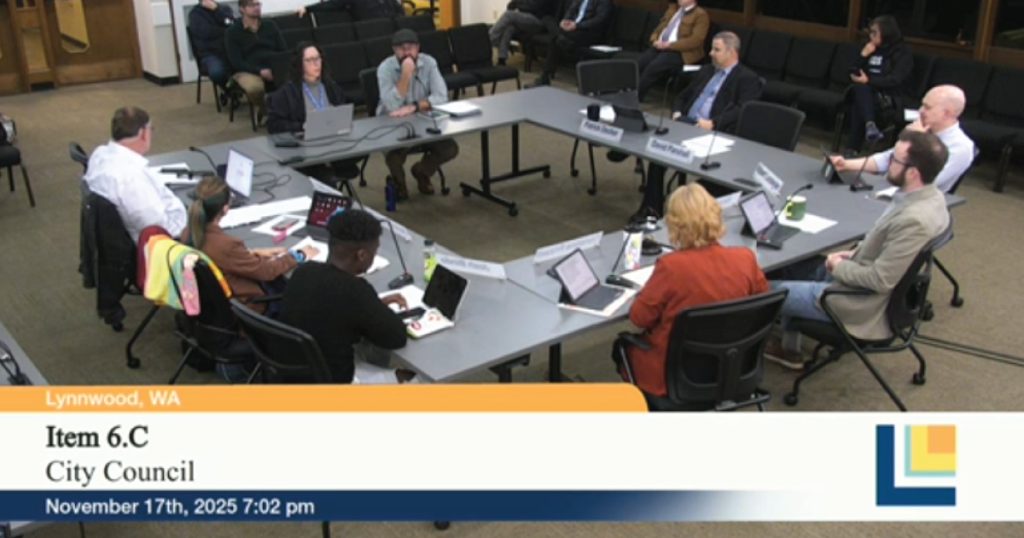
LYNNWOOD—The Lynnwood City Council continued its conversation on its Budget, which included 2025 mid-biennial budget amendments and a proposed 2026 property tax levy, in addition to municipal code changes, at its Business Meeting held Monday, November 17.
Mid-Biennium Budget Review Amendments




The first agenda item was to review mid-biennial budget amendments. As required by state law, all municipalities that have a biennial budget (such as Lynnwood) must conduct a “mid-biennial budget review” during the odd year when a budget has not been approved.
The complete list of amendments spans several lines, but in summary most of the proposed amendments have to do with fund transfers, clerical corrections, and performing true-ups on old projects to close them out (at least as far as the amendments council has not yet acted on).


This was the last opportunity the Lynnwood City Council had to adjust these amendments before finally taking action at its upcoming meeting next week.
As this was now the fifth time this agenda item has been discussed by council, no council members had any questions or comments.

Property Tax Levy increase
Second on the agenda, Council continued its conversation regarding a proposed Property Tax Levy increase ahead of taking action at its upcoming November 24 meeting.
A state law requires cities, who impose a property tax levy, to certify their levy for the following year by the end of November. In this case, council must take action at its November 24 meeting, at the latest, to meet this deadline.
The current ordinance on the table reflects the maximum amount the City of Lynnwood could levy. Council had the opportunity on Monday to finalize any adjustments before adopting the ordinance at its next meeting.
The City of Lynnwood currently levies approximately $7.2 million in property taxes, but the maximum allowable levy is a little over $11 million, per state law (without a vote by the public), which is taking the full amount of $8.5 million in banked capacity into consideration.
Lynnwood’s current property tax levy is set at $0.67/per $1,000 of assessed property value on average which amounts to about $7.2 million for the city, $424 annually or $35 a month for the average homeowner.
If Lynnwood were to approve the property tax levy hike, as drafted in the current ordinance, that rate would increase to $633 annually for the average homeowner, or $53 a month on average (assuming a 5% home value increase). This is roughly a .17 cent increase per $1,000 of assessed property value.
It’s an amount Council President Nick Coelho called “not nothing.”
“It is dramatic, but it’s also not 52% of people’s overall tax bill,” said Coelho. “It’s a Netflix subscription but is also goes towards really important services.”
By “services”, Coelho explicitly referenced the Lynnwood Police Department and the city’s looming $10.7 million deficit (some council members say it could be up to $20 million).
Coelho also noted that many Lynnwood residents, such as seniors and people with disabilities, qualify for property tax exemptions (in addition to reduced rates for utilities).
Council member Patrick Decker, on the other hand, stated (hypothetically) that if half of Lynnwood residents qualified for property tax exemption the city would still receive that, more than, $11 million in property taxes which, he continued, means the other half of Lynnwood residents could see a disproportionately much higher property tax than what was presented to council Monday.
Council member, and Mayor-elect, George Hurst had a different take, adding that “property tax is not the only thing that’s hitting people.”
“Home insurance has doubled,” said Hurst. “There are additional costs for home ownerships and if we keep tacking costs on and say, ‘oh it’s only $17 bucks it doesn’t matter’, it does matter. It matters a lot. I think we need to keep that into consideration when we talk about property tax.”
Council President Coelho, a renter who has experienced significant increases to his rent in recent years, stated that having a long debate on raising property taxes .17 cents to pay for essential services, when renters such as him have had to pay upwards of $4,000/a year in rent increases, is “frankly insulting.”
Council member Decker disagreed with Coelho, adding that it is “not insulting to have a difficult and long conversation around taxes when we’re talking about increasing taxes again in the City of Lynnwood.”
Decker’s comments seemed to directly refer to the passing of Lynnwood’s budget in late 2024, which called for a 52% property tax increase.
“Referring to this conversation as insulting, actually does a disgrace, a disservice, to our community and to members of this council. This is what we were voted to do. The worst thing we can do in this city is raise taxes, and if it’s insulting to fight for the people of this city, to keep taxes low, then I’m going to keep insulting until we get to the end of it,” said Decker adding that property tax increases, in turn, typically affect rent prices because landlords tend to increase rents when their property taxes go up.
Council member Robert Leutwyler chimed in to remind the public, and council, that the city currently does not have enough money to maintain its roads, parks, and other services and if council decides not to move forward with a property tax levy increase now, it could ultimately impact residents more in the long run as the price of services go up. An example he gave is the city’s Wastewater Treatment Plant, which due to aging and outdated infrastructure has increased its rates to offset to costs of improvements – rates that adversely affect residents.
“Rather than pay these obligations in the present day, if we say keep taxes as they are, that could be a problem for tomorrow,” said Leutwyler. “There’s a reason why there hasn’t been any credible solution to keeping the city going other than raising taxes. All I’ve heard is we can sell park land, we could cut an arbitrary number of more employees without considering quality of service impacts, we have a new jail that’s eating up $5 million from our budget, we have these obligations that we’ve inherited that we need to pay for.”
2025-2026 Budget discussion
Finance Director Myer continued a presentation on potential new revenue streams for the city which included the aforementioned property tax levy, in addition to increase business license fees, utility taxes on certain utilities, permit fees, recreation center service fees, and vehicle tab fees.
Even with Lynnwood Mayor Christine Frizzell’s budget plan, and its associated cuts, Myer noted that the City still needs to bridge a gap of $8 million to get the city within the state statutory financial requirements.
As for the remaining multi-million dollar deficit, the City will need to have a much longer discussion for its 2026 year at a later date, Myer added.
This was a continuation of an ongoing conversation on how the City will address its $10.7 million budget deficit. Myer said council will be receiving briefings this Wednesday, November 19, with additional information and the agenda item will return next week at council’s next meeting.
Lynnwood Municipal Code changes
In the wake of Councilwoman Derica Escamilla’s public backlash over her dog terrorizing her neighborhood, resulting in the injury several people, animals, and even the deaths of two dogs (by way of euthanasia, not a direct result of the bite), Lynnwood City Council President Nick Coelho reached out to the Lynnwood Police Department to review its current dangerous animal code.
Lynnwood Police Chief Cole Langdon’s findings was that Lynnwood’s current Municipal Code is sufficient to allow Animal Enforcement officers to respond to incidents of a dangerous, or potentially dangerous, animals.
The current LMC defines a dangerous animal as one who inflicts bites on humans or domestic animals on public or private property, or an animal or chases/approaches anyone on a public street in a menacing fashion or apparent attitude of attack.
Exclusions include whether the animal has potentially been tormented by someone in the past, or if the victim is currently in the process of committing a crime, to name a few.
Chief Langdon’s suggested edits were minor, just recommending a clear definition of what “severe injury” means, as well as adding a line that would consider whether an animal has previously caused injury to someone, or a domestic animal, when forming a dangerous animal designation.
Councilwoman Escamilla had her concerns regarding a mandatory six-foot fence for a “dangerous animal,” and conditional euthanasia requirement.
Council also discussed recodifying Title 13, of its Municipal Code, which relates to the City’s “Waterworks Utility” (water, sewer and surface water systems). The language changes include definitions, rates, and billing changes to better align with state requirements. The current code hasn’t been updated in some time, Director Myer said Monday, is in need of simple updates to reflect the current time and rate system.
Both proposed LMC changes discussed Monday were simply that, a discussion, with no action by council. These proposed changes are scheduled return for a vote in a future meeting.

Author: Kienan Briscoe




2 Responses
I Totally Agree with George Hurst. It’s Not Nothing!!! Our rising costs have taken a big toll on many. Many are struggling to get by as it is. My thoughts; Trim the Fat! 💜🙌
The City Council hasn’t considered the next budget cycle which begins in mid 2026. That cycle is for FY 27-28. If the Council raises the property tax to the max now, what happens in FY 27/28?
They will be capped at the current state law of a 1% increase which will seriously impact their ability to sustain the level of service they are considering. That will likely lead to asking the community to vote on a levy lid lift similar to what Edmonds just defeated. What this Council should do is ask each department to reduce their proposed budgets even further. It’s time to eliminate the tax and spend mentality that exists,