

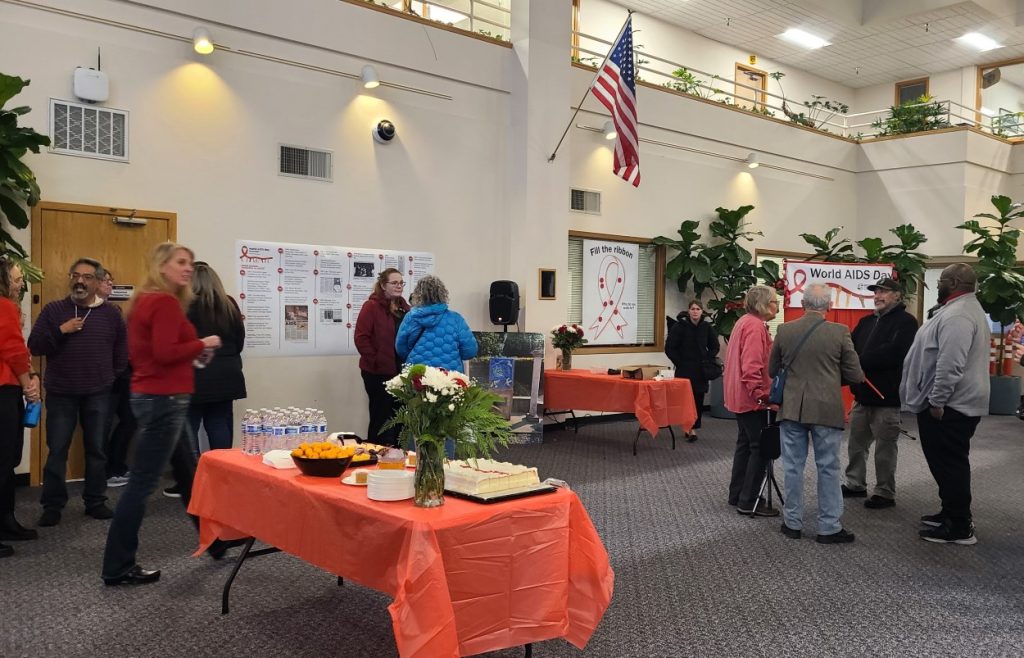
EVERETT—Community members, health officials, and elected officials gathered for a World AIDS Day event in Snohomish County on Monday, December 1, to honor those lost to HIV/AIDS and support those impacted by the virus. The commemoration was co-sponsored by Everett Pride, LifeLong, the AIDS Project Snohomish County, and Snohomish County’s Executive’s Office and Health Department.

The event included an open house at the Snohomish County Health Department, followed by speeches from Health Officer Dr. James Lewis, Health Department Director Kim Van Pelt, County Executive Dave Somers, Frank Busichio, President of AIDS Project Snohomish County (APSC), and Jeannine Fosca, treasurer of APSC who has lived with the virus for over 30 years. Snohomish County Councilwoman Megan Dunn also attended both the event and walk.
“World AIDS Day is observed internationally every year on December 1st,” said Dr. Lewis, “to honor those we’ve lost, support those living with HIV, and reaffirm our commitment to ending the HIV epidemic. This year’s theme is Rethink, Rebuild, and Rise.”
Since the county’s first HIV cases in 1984, where being diagnosed with HIV was a literal death sentence with an average life expectancy of just a few years after diagnosis, modern treatments have progressed to include antiretroviral therapy that enable a long and healthy lives.



Human immunodeficiency virus (HIV) attacks the body’s immune system, specifically white blood cells known as CD4 cells, destroying them and weakening immunity against opportunistic infections such as tuberculosis, fungal infections, severe bacterial infections, and some cancers. While there is no cure for HIV, access to effective prevention, diagnosis, treatment, and care has made it a manageable chronic condition. Options such as pre-exposure prophylaxis (PrEP) and post-exposure prophylaxis (PEP and the principle of U=U (undetectable equals untransmissible) are saving lives and removing stigmas Dr. Lewis added.
Jeannine Fosca, who has inspired many by openly sharing her story and helping remove stigma around HIV, spoke as a longtime survivor.

A social worker with Washington State’s Department of Children, Youth, and Families for nearly 30 years, Fosca joined the AIDS Project Snohomish County board in spring 2006. She contracted HIV during her Peace Corps service in Nigeria from 1991 to 1993 and detailed her experiences in her memoir, Trail of Compassion. Set to retire in August 2026, she hopes to volunteer with the Peace Corps again.
“I’m so grateful for medical [progress] because I’ve been living with HIV AIDS since 93 and I’m just grateful to be alive and I’m grateful that we have a community here who doesn’t forget and that we live in a state where people who are living with HIV can still get the care and treatment that they need,” Fosca said. “I’m just grateful that we all live here.”
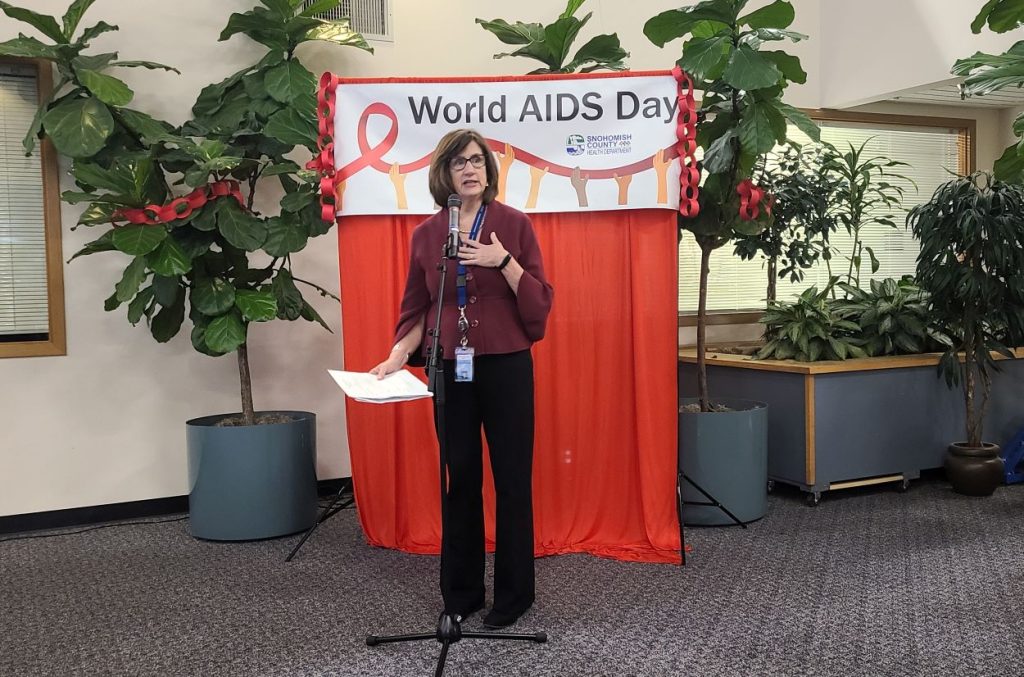
Health Department Director Kim Van Pelt read the County’s proclamation, adopted earlier in the month by the Snohomish County Board of Health, recognizing December 1 as World AIDS Day. She reminded everyone that over 40 million people worldwide have died from AIDS-related causes, while an estimated 39 million currently live with HIV.
Frank Busichio, president of the AIDS Project Snohomish County (APSC) and a founding board member alongside Dr. Dreyer in 1993, reflected on the epidemic’s enduring presence and the progress in treatment made over the decades. APSC is hosting an upcoming Friendship Meal on December 18 from 5:30 p.m. to 7 p.m. at Trinity Lutheran Church in Everett where all members of the public are invited to attend.

“400 people die every month of HIV in America still, despite our medications and so forth,” said Busichio. “And AIDS is like the junkyard dog. It bit us in the ass and it won’t let go. So it’s still here. It’s not gone away. It’s just not the soup du jour anymore.”
Approximately 5,000 people die of HIV-related causes each year in the U.S. according to the Centers for Disease Control and Prevention (CDC)—a 90 percent decrease since its peak at approximately 50,000 deaths per year in 1995. By 1994, AIDS had become the leading cause of death for all Americans aged 25–44 years old.
Busichio, who began his AIDS work in New York City in 1988 with the Gay Men’s Health Crisis and Community Research Initiative, later implemented HIV protocols in New Jersey methadone clinics before joining the Snohomish Health District as manager for HIV Prevention and Care Services. He helped establish programs such as needle exchanges, AIDS housing, Friend-to-Friend, and women’s services. After 18 years at the Snohomish Health District, he served as health care manager at the Monroe Correctional Complex for eight years.
During Monday’s event, Busichio reflected with attendees the harmful early medically prescribed treatments for HIV/AIDS patients, particularly AZT (azidothymidine)—the first antiretroviral drug approved by the FDA in 1987.
“In the beginning, because I started in 88, when people were infected, there was only two things we could offer them: support groups, and poison, AZT. That’s what they gave you. Anybody who took that damn medicine could have very dire outcomes,” Busichio said.
High doses of AZT caused severe side effects, including anemia, neutropenia, muscle fatigue, headaches, nausea, and heart problems, leading to resistance and limited long-term efficacy. The 2013 film Dallas Buyers Club, based on Ron Woodroof’s story, dramatizes these issues, portraying AZT as toxic and highlighting buyers clubs that smuggled alternative treatments to circumvent FDA restrictions. Today, HIV management has evolved to a combination antiretroviral therapy using lower AZT doses with other drugs for better outcomes and fewer side effects, alongside preventive tools like PrEP and PEP.
Busichio then led the walk to the Snohomish County AIDS Memorial on the courthouse grounds in downtown Everett. The site, was recently restored after vandalism in September 2025.
Joel Diaz, a facilities maintenance worker and boilermaker with Snohomish County for 12 years, led the 2025 restoration—the memorial’s third repair.
“So, we found it in over a thousand pieces,” Diaz told the Lynnwood Times. “It was made out of terracotta. So, they just busted it. And so, we put it all back together.”
In an interview with the Lynnwood Times, Diaz shared that he cast a silicone mold, repainted it and encased it in durable acrylic resin for protection.
“So, it’s nearly indestructible,” he said. “And this is a lot more durable [of a] material.”
The month-long project, funded by the County, was driven by his passion: “It’s been here longer than I have. And it’s just, I just didn’t want to see a piece of art go… down a toilet, really. You know, just be wasted and thrown out. It’s a travesty.”
Diaz mixed five custom colors to match the original, working from a small six by four-inch photo.
Originally dedicated on December 1, 2005, the Snohomish County AIDS Memorial was likely Washington state’s first and possibly the first in the Pacific Northwest.
The memorial’s history began in May 2000 at a kitchen meeting among friends Debby Stewart-Nielson, Nick Tipton, and Kevin McCollum-Blair, who formed the AIDS Memorial Project of Snohomish County (AMPS) at the Everett Underground gay bar. With the Gay Men’s Task Force, they selected artists David Lewis and George Little. Over five years, AMPS raised $15,000 through fundraisers such as raffles and spaghetti dinners. County Executive Aaron Reardon approved the site west of the courthouse.
Lewis and Little’s design included two columns flank a central stela with a willow branch relief (symbolizing resilience), two doves with a red ribbon (AIDS advocacy), and a bronze plaque that read: “AIDS MEMORIAL of Snohomish County. We remember our friends and family lost to AIDS. We honor your struggles, your lives, and your memory. We dedicate this memorial to all those lives touched by HIV and AIDS. WORLD AIDS DAY, 2005.”
Enhancements included 2010 landscaping by Steve Furnas and Travis Lenz, a retaining wall by Charles Fay and Eric Addams, floodlights, and donated plants from The Plant Farm, installed with help from Matt and John Tong.
Snohomish County Executive Dave Somers shared his personal connection to the memorial, having a close family member affected by HIV. He marked the 20th anniversary of the memorial’s dedication.
“The memorial came together thanks to the efforts of remarkable volunteers and advocates, community donations, and Snohomish County staff and officials who helped locate the memorial on the county campus,” said Somers.
Executive Somers thanked Diaz for restoring the AIDS Memorial this year.
“Joel got permission from the artist to replicate it,” said Somers. “He recreated the memorial design out of a material that is more shatter-resistant, and he approached the repairs with meticulous care and respect.”
Representatives from Everett Pride, including Kevin Daniels and Ashley Turner, reflected on respecting the lost generation of gay men and women to HIV/AIDS in a Lynnwood Times interview.
“The AIDS epidemic that occurred in the 80s and early 90s… wiped out a significant portion of the LGBTQ plus generation,” said Daniels. “We had lost entire… families, family groups, chosen family members. That is just completely lost to history. And it was the fault of that [Reagan] administration at the time that didn’t get enough support for them… Right now, I think it’s even better that we’re getting so close to finding a vaccine for AIDS and HIV. And now more than ever, we have to continuously remember because those were members of our community and we are part of that community.”

The loss of hundreds of thousands of LGBT people in the 1980s and 1990s created a “lost generation,” with cities like San Francisco becoming “ghost towns” as one in nine gay men was diagnosed, and 10% of those aged 25-44 died by 1995—a collective impact still affecting gay society today.
Current research into HIV vaccines has focused on eliciting broadly neutralizing antibodies (bnAbs) that can target multiple HIV strain with the IAVI G002 and G003 trials demonstrating the potential of mRNA-based platforms.
Functional remission—controlling HIV without daily antiretrovirals—is showing promise in small trials using immunotherapy combinations.
A UCSF Combination Therapy Study is combining therapeutic vaccines and antibody cocktails, enabling several participants to maintain low viral loads for extended periods post-ART cessation. Similarly, the FRESH and RIO trials utilizing long-acting bnAbs alongside immune stimulants like vesatolimod is achieving sustained suppression in subsets of participants for over a year. ViiV Healthcare’s ‘induce and reduce’ strategy, involving IAP inhibitors to flush out latent virus, along with gene-editing approaches like EBT-101, also is showing signs of hope for a possible cure.

Author: Mario Lotmore