
LYNNWOOD—Facing a structural budget deficit that is still short approximately $3.1 million, Lynnwood City Council members are wrestling with whether to grant non-represented (GSO) city employees the same 2.7% cost-of-living adjustment (COLA) the City is being asked to approve for its unionized AFSCME employees.
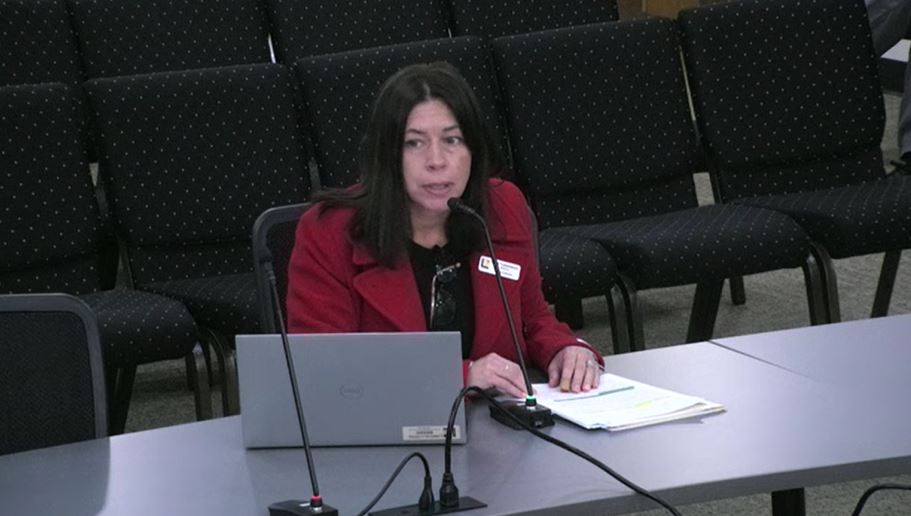
Human Resources Director Annie Vandenkooy urged the City Council on Monday, December 1, to approve a 2.7% cost-of-living adjustment (COLA) for the city’s 99 GSO employees in 2026, that was also budgeted in the adopted 2025-26 biennial budget. The 2.7% figure matches the 2026 COLA in the tentative AFSCME agreement, while police guilds are scheduled for a 4% increase and Teamsters 2.34%.




The proposed COLA, included in the draft 2026 Salary Schedule Ordinance, would align GSO staff with union-represented workers and prevent further salary compression and real-wage erosion due to inflation, Vandenkooy said.
“Cost of living increases aren’t raises; they are maintenance of value. A cost-of-living adjustment isn’t a reward, its preservation,” Director Vandenkooy told the Council. “When unions negotiate COLAs and the GSO group is excluded, those employees effectively experience a pay reduction in real dollars. Their grocery bills, rent, gas, and childcare all increase. But the pay remains flat.”


The proposed 2.7% COLA for GSO employees equate to approximately $329,000 according to Vandenkooy and is in line with the current Consumer Price Index for Urban Wage Earners and Clerical Workers (CPI-W) for the Seattle-Tacoma-Bellevue Metropolitan Statistical Area (MSA) level by the U.S. Bureau of Labor Statistics (BLS) of 2.8% for 2025.
“Providing parity in COLAs for GSO staff represents a small percentage of the overall payroll budget, often far less than 1% of total expenditures,” Vandenkooy said. “But the symbolic and practical impact is far greater. It shows that even in lean years, we value our workforce equally.”
Historical data obtained by the Lynnwood Times over the past four years—2022 through 2025—show City of Lynnwood’s GSO employees have received a total COLA increase of 21.04%, or an average annual increase of 5.26%, which is in line with the CPI-W over the last four years. The CPI-W for years 2022 through 2025 equated to 20.3%, or an average annual increase of 5.075%.
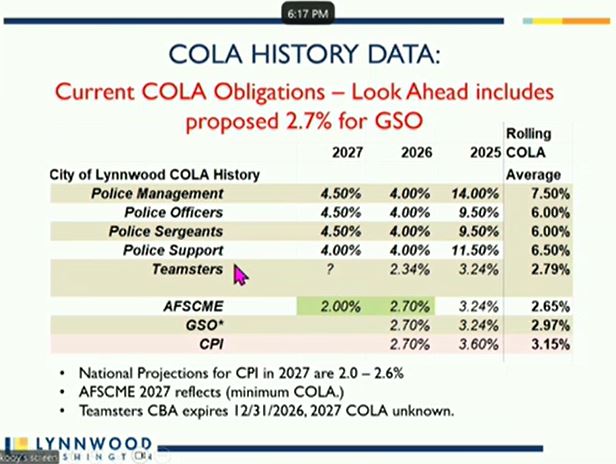
However, the average annual increase of 5.26% for City of Lynnwood’s GSO employees over the last four years excludes Salary Grades 626 and 627—Director Level Positions who are the highest paid GSO employees with starting salaries between $75.50 and $83.80 per hour in 2025.
At its December 12, 2022, meeting, the City Council approved the 2023 Salary Schedule to include an 8% increase for GSO employees with an amendment limiting 626 and 627 Salary Grades to 4%.
The 626 and 627 Salary Grades over the last four years have received a total COLA increase of 17.04%, or an average annual increase of 4.26%, which is 85% of CPI-W (approximately 16% annually below CPI-W).
Wages and benefits currently consume approximately 70% of General Fund expenditures with GSO and AFSCME employees together representing two-thirds of payroll obligations.
Council President Nick Coelho referenced the 2010 budget shortfall of $22 million, when the council—under then-President Ted Heichel—raised taxes and implemented across-the-board zero COLAs for most groups, except for public safety employees.
“No one’s being treated differently in that situation. Teamsters, AFSCME, GSO, they’re all getting 0%,” Coelho said referring to Vandenkooy chart of historic actuals.
Councilwoman Derica Escamilla expressed concern about staff morale and potential exodus, if the council adopted a zero percent COLA for GSO employees.
The Council is expected to vote on adopting the final 2026 Salary Schedule Ordinance at its December 8 Business Meeting.
After discussion with each councilmember, Director Vandenkooy will present at the December 8 meeting the following to aid in the Council’s decision:
- 3–5 years of voluntary turnover/attrition rates requested by Councilman Patrick Decker.
- Number and percentage of city employees who reside in Lynnwood requested by Councilwoman Escamilla.
- Current remote/hybrid work statistics and actual usage patterns requested by Mayor-elect Goerge Hurst.
- Informal tracking of increased responsibilities due to vacancies and layoffs requested by Councilman David Parshall.

Author: Mario Lotmore