
LYNNWOOD—The Lynnwood City Council on December 1, unanimously agreed to postpone consideration of a proposed 0.1% public safety sales tax ordinance and remove it from its December 8 agenda to be revisited in early 2026. The council would like to provide Lynnwood Police Chief Cole Langdon enough time to complete a full review of state-mandated eligibility requirements.
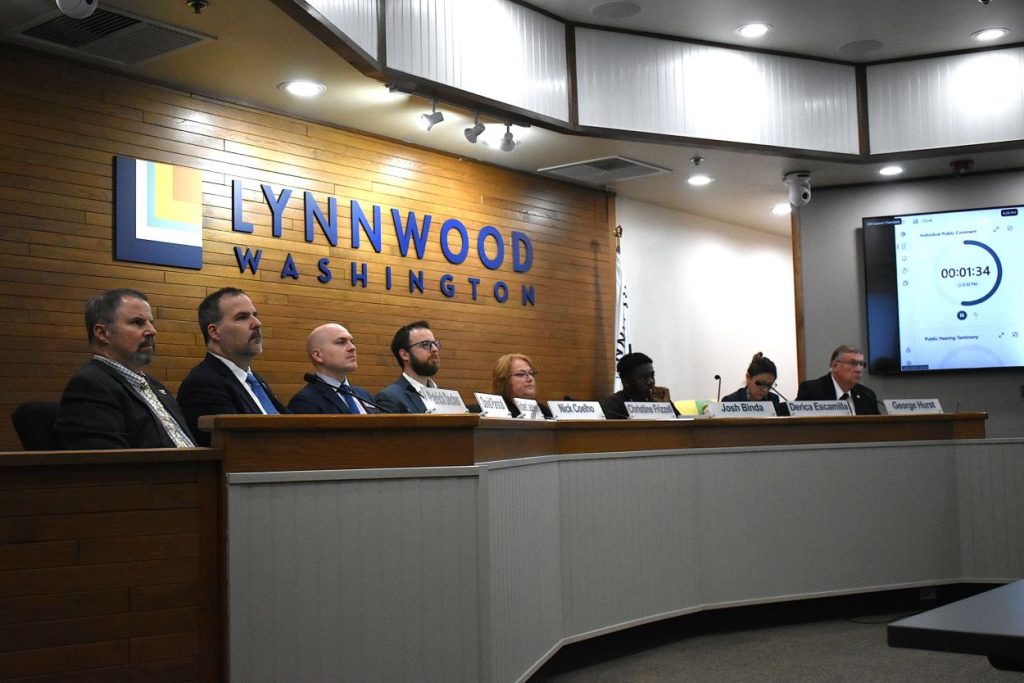
Introduced by Council President Nick Coelho and supported by Councilman Robert Luetwyler, the ordinance would impose a councilmanic—no voter approval required—0.1% sales and use tax dedicated to public safety and criminal justice purposes. If enacted by the council and pre-conditions approved by the Criminal Justice Training Commission (CJTC), the tax would raise Lynnwood’s sales tax rate from 10.6% to 10.7%—the highest in Washington state.
The authority stems from House Bill 2015 (RCW 82.14.345), that took effective July 27, 2025, allowing cities to impose a 0.1% public safety sales tax without a public vote only if the municipality meet the same stringent eligibility requirements required for a separate $100 million state grant program administered by CJTC. Compliance with these requirements is mandatory to collect the sales tax, even if the city never applies for the grant funds.
Key eligibility requirements for both the public safety sales tax and grant include:
- Adoption of policies aligned with Attorney General guidance on citizenship status, duty to intervene, de-escalation, use of force, and police dogs
- Full participation in specified CJTC trainings (behavioral health, first aid, crisis intervention—at least 25% of officers—and gender-based violence—100% completion by required officers)
- Policies for court-ordered firearm relinquishment and volunteer supervision restrictions
- A CJTC-certified police chief with no disqualifying convictions
- Future compliance with statewide use-of-force data reporting
The $100 million grant program which expires June 30, 2028, is restricted to:

- Hiring and retaining new (non-lateral) officers and co-responders
- Training and certain broader public safety initiatives
- Maximum state contribution of 75% of salary + benefits, capped at $125,000 per position over three years (not annually).
The Department of Revenue (DOR) has a 75-day notification lead time to implement a new sales tax. CJTC has 45 days to review the documents and notify a city of any outstanding deficiencies. The city will then have 180 days to respond and correct any deficiencies.
Taking these timeframes into account, the earliest a sales tax would take effect in Lynnwood would by July 1, 2026, assuming it is approved by the council and sales tax conditions are confirmed by the CJTC no later than April 1, 2026. The January 1, 2026, tax update was due by October 17, 2025, and the deadline for the April 1, 2026, tax update is January 16, 2026.

If Lynnwood enacts a councilmanic 0.1% sales tax but fails to meet the qualifications by CJTC and still collects the tax revenues, the Washington state treasurer is required by law to withhold $100,000 of revenue collections each month until Lynnwood comes into compliance, as verified by CJTC.
Councilman Leutwyler, a strong supporter of the measure, pointed to its value beyond traditional policing.
“The sales tax, one of the things that I appreciate about it is [it] comes with a grant that we can pursue, which I think is helpful,” Leutwyler said. “It’s a fairly broad definition that is being used for what is an appropriate law enforcement purpose.”
Leutwyler called the tax a practical choice, saying, “It’s a matter of taking the least bad options… [It] provides a little bit of the cost of running a police department that is not sized for the city of Lynnwood, it’s sized for the retail hub that we have here.”
Council President Coelho backed the ordinance for budget-driven reasons, stressing the city’s looming financial shortfall as a key motivator.
“Part of the reason and rationale for kind of pushing this forward is… we were kind of on the verge of a gigantic deficit,” said Coelho. “And there was a window of time where if we had enacted this… we could have actually hit the January 1st deadline and received the full year’s worth of sales tax revenue. And at this point, every penny kind of counts.”
Opposition to the 0.1% councilmanic sales tax centered on its regressive effects, the recently approved millions of dollars approved in tax and fee increases a week earlier on November 24, and the need for more council deliberation.
Mayor-elect George Hurst expressed wariness about state oversight, saying, “I’m very leery of… signing us up for things that Olympia can dictate… I want to protect the sovereignty of the city. I want to make sure the chief and his staff have time to look at what might be in that grant package, what we’re signing up for.”
He further advocated for Chief Langdon’s input: “I would also like for him to review the requirements related to the grant to make sure that there isn’t anything onerous… that would run counter to the direction that Lynnwood wants.”
Councilwoman Derica Escamilla shared that she was initially supportive of the sales tax but is now waning on the proposal after hearing feedback from the community.
“I quickly jumped in to do some research this weekend where I was initially kind of in support of this,” Escamilla said. “Then I found we got… three emails about it from community members that they were willing to pay the full maximum property tax, but they are… staunch against the sales tax.”
Councilman Patrick Decker stated he would vote “no” if the ordinance were before him that evening, echoing both Escamilla and Hurst concerns on recent tax increases and funding conditions.
“I think we have raised taxes enough on everybody this year… We’ve taxed this city to death right now. Let’s give them a break,” he said adding, “Instead of this actually going for our police department, it would have to go to all of these other things… human services and… domestic violence… I would be more in favor if this was making sure our police department had the funding they need to do their job specifically, not being watered out.” Councilman David Parshall called for a deeper dive, stating, “I would honestly suggest not moving forward with this on the agenda for next week. This is the first time we’ve heard about it in council chambers, and we don’t really even have a formal presentation tonight… I would wait until we can really actually dig into this in a work session.”

Author: Mario Lotmore