

WASHINGTON, D.C.—President Donald J Trump has formally revived the 182-year-old Monroe Doctrine, introducing a “Trump Corollary” in his administration’s new National Security Strategy to reassert U.S. dominance in the Western Hemisphere amid rising concerns over Chinese influence, migration, and drug trafficking.
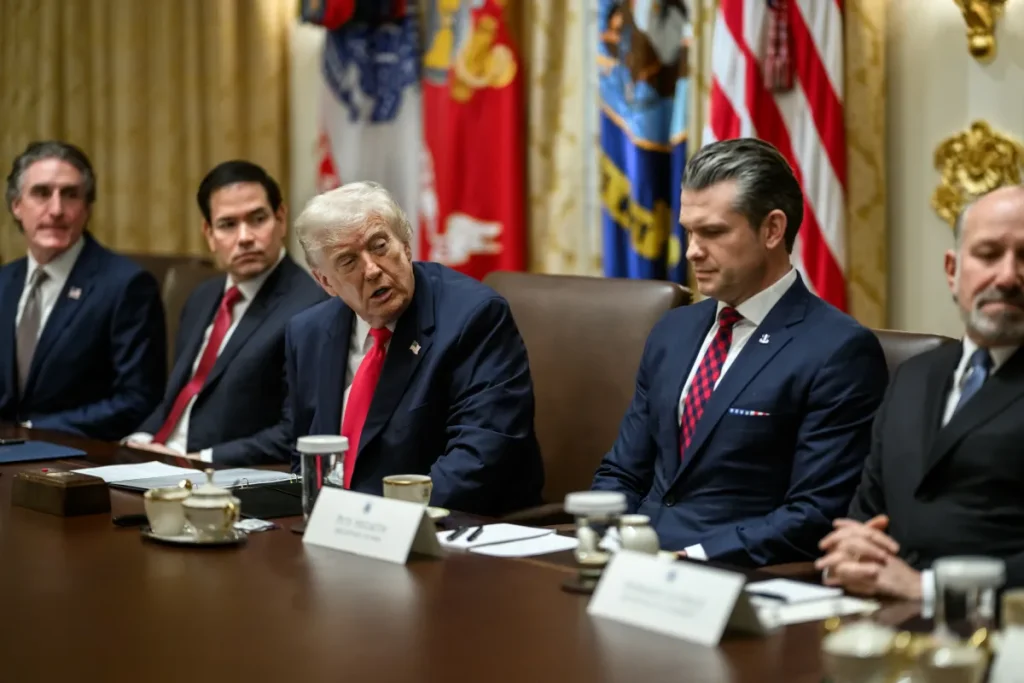
The 33-page National Security Strategy document, released in November 2025, declares that “after years of neglect, the United States will reassert and enforce the Monroe Doctrine to restore American preeminence in the Western Hemisphere, and to protect our homeland and our access to key geographies throughout the region.” It frames the “Trump Corollary” as a “common-sense and potent restoration of American power and priorities,” denying non-Hemispheric competitors the ability to position forces, threatening capabilities, or control vital assets in the region.
This foreign policy shift prioritizes regional security, emphasizing goals to ensure stability, prevent mass migration, combat narco-terrorists and cartels, secure supply chains, and maintain access to strategic locations.
Originally proclaimed by President James Monroe in 1823, the doctrine warned European powers against further colonization or interference in the Americas, establishing the U.S. as the region’s guardian. Over time, it evolved into a justification for American interventions, from the Spanish-American War to Cold War-era operations in Latin America. Trump’s revival echoes this historical stance but adapts it to contemporary challenges, including what this strategy describes as “external encroachments” by adversaries like China.




President Trump has hinted at such a policy since he first ran for office in 2015.


“Here in the Western Hemisphere, we are committed to maintaining our independence from the encroachment of expansionist foreign powers,” Trump stated in a 2018 address to the United Nations General Assembly.
During his first term, Trump amplified this theme amid the Venezuelan crisis at that time. In April 2019, Trump declared at a White House event, “The Monroe Doctrine is alive and well,” as his administration imposed sanctions on the Maduro regime and recognized opposition leader Juan Guaidó as interim president.
Just as Monroe sought to block European colonialism, Trump’s first administration targeted foreign investments in Latin America that could undermine U.S. interests. Sanctions on Venezuela mirrored historical efforts to isolate regimes seen as threats, while trade deals like the USMCA incorporated clauses to limit Chinese economic inroads in North America. The latest strategy document released in November 2025 builds on this, vowing to “cultivate resistance” against authoritarian regimes in the region, evoking President Theodore Roosevelt’s 1904 corollary that justified U.S. intervention to maintain stability.
In his second term, President Trump has already taken concrete steps reflecting this renewed focus.


In December 2024, Trump threatened to reclaim control of the Panama Canal if Panama allows excessive Chinese involvement, citing national security concerns over the vital waterway. Similarly, the Trump administration has revived discussions about acquiring Greenland from Denmark, emphasizing its strategic Arctic position to counter Russian and Chinese advances.
President Trump’s National Security Strategy document calls for bolstering U.S. Southern Command, halting drug flows from Mexico, and ending illegal migration—actions framed as defending the hemisphere from external exploitation. It outlines an “Enlist and Expand” approach: enlisting regional allies to control migration, neutralize cartels, and promote stability; and expanding partnerships through commercial diplomacy, tariffs, and reciprocal trade to make the U.S. the “partner of first choice.”
The U.S. Army activated the Western Hemisphere Command (USAWHC) in a ceremony at Fort Bragg, North Carolina, on December 5, merging U.S. Army South, U.S. Army North, and U.S. Army Forces Command into a single entity aligned with national strategic priorities.
The new USAWHC serves as the Theater Army for U.S. Northern and Southern Commands, focusing on homeland defense, crisis response, regional security cooperation, and building military alliances across the Americas.
Army Chief of Staff Gen. Randy A. George described it as “designed for speed, flexibility and relevance to effectively respond to challenges in our complex times,” noting it streamlines processes and frees resources for fighting formations. Incoming commander Gen. Joseph A. Ryan emphasized the merger’s role in transforming the Army to secure American interests in the Western Hemisphere.
“Halting the flow of deadly drugs flowing through Mexico, ending the invasion of illegal aliens across our southern border—these are all part of reinvigorating the Monroe Doctrine,” President Trump said in his proclamation accompanying the strategy.

Author: Mario Lotmore