

WASHINGTON, D.C.—President Donald J. Trump signed an executive order on December 15 designating illicit fentanyl and its core precursor chemicals as weapons of mass destruction, framing the synthetic opioid as a national security threat akin to a chemical weapon.
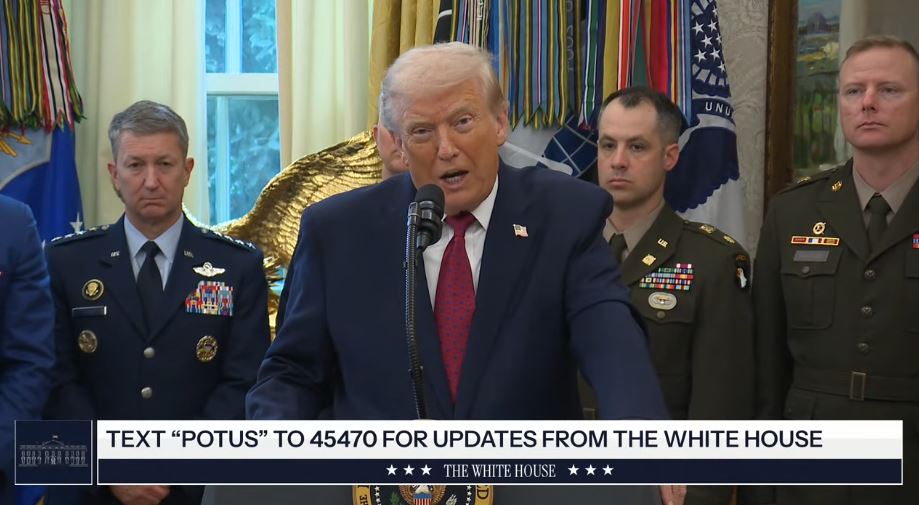
“Today, I’m taking one more step to protect Americans from the scourge of deadly fentanyl flooding into our country,” President Trump said during the signing of the executive order in the Oval Office on Monday. “With this historic executive order I’m signing today, we are formally classifying fentanyl as a weapon of mass destruction — because that’s what it is. No bomb does what this is doing. It’s killing 200,000 to 300,000 people a year.”
The order states that “illicit fentanyl is closer to a chemical weapon than a narcotic,” noting that just two milligrams — equivalent to 10 to 15 grains of table salt — constitutes a lethal dose. It highlights that hundreds of thousands of Americans have died from fentanyl overdoses and that the drug’s manufacture and distribution, primarily by organized criminal networks, threatens national security while funding operations of cartels and foreign terrorist organizations, including assassinations, terrorist acts, and insurgencies.
.@POTUS announces he is signing an Executive Order today to formally classify fentanyl as a Weapon of Mass Destruction. pic.twitter.com/grshF47tlV
— Rapid Response 47 (@RapidResponse47) December 15, 2025
The order defines “illicit fentanyl” as the substance manufactured, distributed, or possessed in violation of the Controlled Substances Act, and “core precursor chemicals” as those like piperidone-based substances used to create it and its analogues.
Nearly all illicit fentanyl enters through the southwest border with Mexico, where Mexican cartels produce the drug using precursors mainly from China, with India emerging as a secondary source. Over 90 percent of seizures occur at official ports of entry, often hidden in vehicles driven by U.S. citizens.


“The potential for fentanyl to be weaponized for concentrated, large-scale terror attacks by organized adversaries is a serious threat to the United States,” the executive order reads. “As President of the United States, my highest duty is the defense of the country and its citizens. Accordingly, I hereby designate illicit fentanyl and its core precursor chemicals as Weapons of Mass Destruction (WMD).”
An accompanying White House fact sheet describes the move as unleashing “every available tool against the cartels and foreign networks” that have made fentanyl the leading cause of death for Americans aged 18-45. “By designating illicit fentanyl as a WMD, President Trump is ensuring the full weight of the Federal government is focused, coordinated, and mobilized to confront fentanyl as the deadly chemical weapon it is.”



The Attorney General is instructed to immediately pursue investigations and prosecutions into fentanyl trafficking, including through criminal charges, sentencing enhancements, and variances as appropriate.
The Secretary of State and Secretary of the Treasury are to take actions against assets and financial institutions involved in or supporting the manufacture, distribution, or sale of illicit fentanyl and its precursors.


The Secretary of War and Attorney General must determine whether resources from the Department of War should aid the Department of Justice in enforcing relevant laws, consistent with existing statutes. The Secretary of War, in consultation with the Secretary of Homeland Security, is directed to update directives on Armed Forces responses to chemical incidents to include the fentanyl threat.
Additionally, the Secretary of Homeland Security is tasked with identifying fentanyl smuggling networks using WMD- and nonproliferation-related intelligence to support counter-fentanyl operations.
U.S. drug overdose deaths, driven primarily by illicit fentanyl, have fallen significantly in recent years, with provisional Centers for Disease Control and Prevention data showing approximately 76,000 fatalities in a recent 12-month period as of late 2025. The decline marks a continued downward trend from peaks exceeding 110,000 annual deaths in prior years, with synthetic opioids like fentanyl accounting for the majority of cases.
Border seizures of fentanyl have also dropped markedly. U.S. Customs and Border Protection reported approximately 7,517 pounds seized from January to September 2025, a 55 percent decrease from the same period in 2024.
The Drug Enforcement Administration reports seizures of about 44 million fentanyl pills and 4,500 pounds of powder in the first half of 2025, amid reports of reduced fentanyl purity and challenges in precursor supply chains.

Author: Mario Lotmore