

WASHINGTON, D.C.—President Donald J Trump signed an executive order Thursday directing federal agencies to expedite the rescheduling of marijuana to Schedule III under the Controlled Substances Act, a move aimed at removing longstanding barriers to research on its medical uses and providing better guidance for patients and doctors dealing with chronic pain and other conditions.
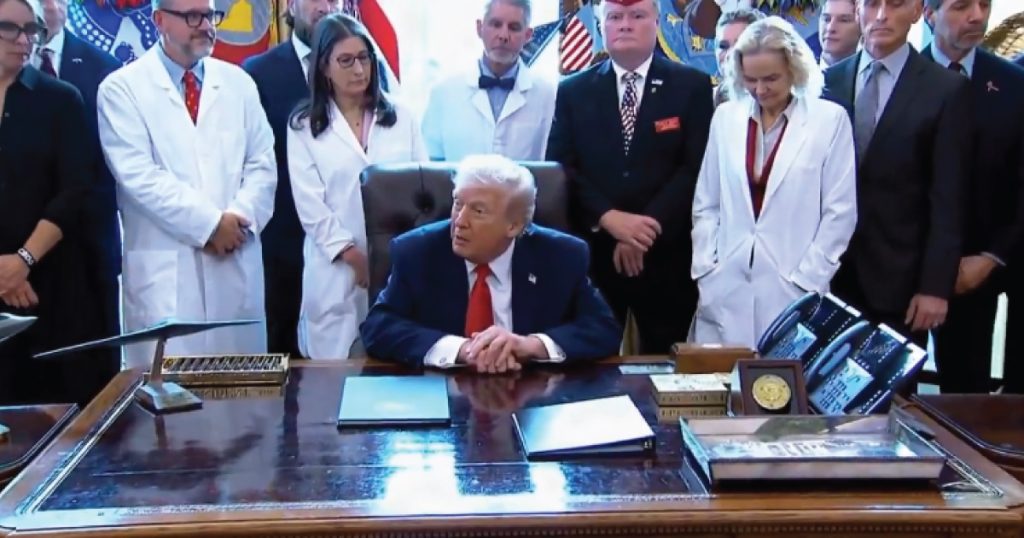
The order, titled “Increasing Medical Marijuana and Cannabidiol Research,” seeks to address what the White House described as decades of federal oversight that has limited scientific study of marijuana’s safety and efficacy. By shifting marijuana from Schedule I — a category reserved for drugs with no accepted medical use and high abuse potential such as heroin — to Schedule III, the administration said it would align federal policy with growing evidence of marijuana’s therapeutic benefits, including for pain management, anorexia related to medical conditions, and nausea and vomiting.
“We have people begging for me to do this, people that are in great pain,” President Trump said during Thursday’s signing of the order. “I think I probably have received more phone calls on this, on doing what we’re doing. I don’t think I received any calls on the other side of it, but hopefully this reclassification, which by the way polls at 82%, will help many of those patients live a far better life.”
.@POTUS: "I'm pleased to announce that I will be signing an Executive Order to reschedule marijuana from a Schedule I to a Schedule III controlled substance with legitimate medical uses." pic.twitter.com/yzFcv9Qpyg
— Rapid Response 47 (@RapidResponse47) December 18, 2025
The executive order instructs Attorney General Pam Bondi to complete the rescheduling rulemaking process as quickly as possible, building on a 2023 recommendation from the Department of Health and Human Services that recognized marijuana’s accepted medical use for the first time. That HHS assessment cited more than 30,000 licensed healthcare practitioners across 43 jurisdictions authorized to recommend medical marijuana to over six million registered patients for at least 15 conditions.
FDA reviews found credible scientific support for marijuana in treating chronic pain, a condition affecting nearly one in four U.S. adults and more than one in three seniors.


Six in 10 people using medical marijuana report doing so to manage pain, according to the White House fact sheet accompanying the order. One in 10 seniors used marijuana in the last year, with some evidence showing improvements in health-related quality of life and pain relief.
Yet, the Schedule I classification has stifled research, leaving patients and providers without FDA-approved guidance on dosing, interactions, or long-term effects. Just over half of older Americans using marijuana have discussed it with their healthcare provider, the fact sheet noted, heightening risks for vulnerable groups like seniors on multiple medications.


The order also targets cannabidiol (CBD) and other hemp-derived cannabinoids, which are not controlled substances but lack a clear FDA regulatory pathway. One in five U.S. adults and nearly 15% of seniors reported using CBD in the past year, with studies showing benefits for chronic pain patients.
However, inconsistencies in product labeling and recent legal changes affecting full-spectrum CBD — which may contain trace THC — have created confusion and safety concerns.


To address this, the order directs the White House deputy chief of staff for legislative, political, and public affairs to collaborate with Congress on updating definitions for hemp-derived products, allowing access to appropriate full-spectrum CBD while restricting risky items. It also tasks HHS, including the FDA and National Institutes of Health, with developing research models using real-world evidence to improve access and inform standards of care, focusing on long-term effects in adolescents and young adults.
Thomas Winstanley, executive vice president and general manager of Edibles.com, a wellness-focused online marketplace for THC products, welcomed the announcement.
“This is a historic moment for our partners across regulated cannabis,” he said in a statement, expressing hope for a balanced approach to hemp that ensures consumer safety and innovation.
Cato scholar Dr. Jeff Singer criticized the federal government’s conflicting cannabis policies, noting that while CMS’s announcement expands Medicare coverage for CBD to recognize its therapeutic value, Congress’s efforts to close the hemp loophole tighten restrictions, undermine supply, and create policy whiplash that limits practical access.
“The CMS announcement runs counter to Congress’s recent effort to ‘close the hemp loophole,’ and the two policies undermine each other,” wrote in a statement. “CMS is signaling that CBD has legitimate therapeutic value and should be easier for patients—particularly seniors—to access, while Congress is simultaneously tightening federal restrictions, shrinking the legal CBD market, and increasing compliance costs for manufacturers. One branch of the federal government is trying to normalize and integrate CBD into mainstream health care; another is narrowing supply, complicating legality, and potentially raising prices. Instead of coherent reform, we’re experiencing policy whiplash—expanding coverage on paper while limiting availability in practice.”
The rescheduling push revives a process initiated under President Joe Biden but stalled amid legal challenges. In 2022, Biden ordered a review, leading to HHS’s 2023 recommendation. The Drug Enforcement Administration proposed the change in May 2024, drawing nearly 43,000 public comments, but proceedings halted in March.
Under the 1970 Controlled Substances Act, marijuana’s Schedule I status has grouped it with heroin and LSD, despite 40 states plus the District of Columbia having sanctioned medical programs and 24 allowing recreational use. This federal-state divide has complicated banking, taxation, and research for the industry. Schedule III placement would not federally legalize recreational sales but could ease tax burdens, facilitate clinical trials, and attract investment.
President Trump first floated the idea during his 2024 campaign, pledging on Truth Social to “unlock the medical uses of marijuana to a Schedule III drug” and pursue banking reforms. In August, he told reporters the administration was examining reclassification, acknowledging mixed views on youth and public health impacts.
Public support for legalization stands at 64% in 2025, according to Gallup polls, down slightly from 70% in 2023 but with sharper partisan divides — only 40% among Republicans. Trump cited polls showing 82% approval for his action, though it’s unclear which survey he referenced.
The order fits into Trump’s broader healthcare agenda, including deals with pharmaceutical firms to lower drug prices, transparency in medical costs, phasing out synthetic food dyes, expanded veterans’ care options, and a $50 billion investment in rural healthcare through the Working Families Tax Cuts Act. It also aligns with an earlier executive order imposing scientific rigor on federal agencies to restore public trust.
Advocates like the Last Prisoner Project praised the recognition of marijuana’s lower abuse potential but pushed for full descheduling to address incarceration’s harms.
“This is a historic step that reflects the will of the American people,” said Jason Ortiz, director of strategic initiatives for the Last Prisoner Project, a nonprofit advocating for cannabis policy reform. However, he added that rescheduling alone does little for the tens of thousands still incarcerated for cannabis offenses, urging Trump to grant clemency to cement his legacy on the issue.
Cato legal scholar Matthew Cavedon welcomed the reclassification of marijuana to Schedule III as a step toward recognizing its legitimate medical uses, but criticized it as insufficient, noting that most possession will remain a federal crime and the move continues to undermine adult autonomy in health and recreational choices.
“It’s heartening to see President Trump recognizing what virtually every state decided long ago: cannabis has legitimate medical uses, so the federal government should allow access to research and funding,” he wrote in a statement to the Lynnwood Times. “But even a move to Schedule III will leave most marijuana possession a federal crime. Cannabis will continue to be treated as a reason for the federal government to invade privacy, arrest and jail people, seize property, and more. And even a Schedule III classification reiterates the same old message: the federal government doesn’t trust American adults to make their own decisions about their health and recreation.”
Editor’s Note: Article updated 9 a.m., December 19, 2025, adding statements from Matthew Cavedon and Jeff Singer.

Author: Mario Lotmore