

Aboard Air Force One on Sunday, January 4, President Donald J Trump outlined a bold U.S. strategy to dismantle what it was described as a “drug caliphate” in Latin America, just days after American forces captured Venezuelan leader Nicolás Maduro. Trump portrayed the operation as a vital step to curb narco-terrorism, secure borders, and foster prosperity in the Americas, warning of potential actions against Colombia, Mexico, and Cuba if they fail to address drug trafficking and regional threats.
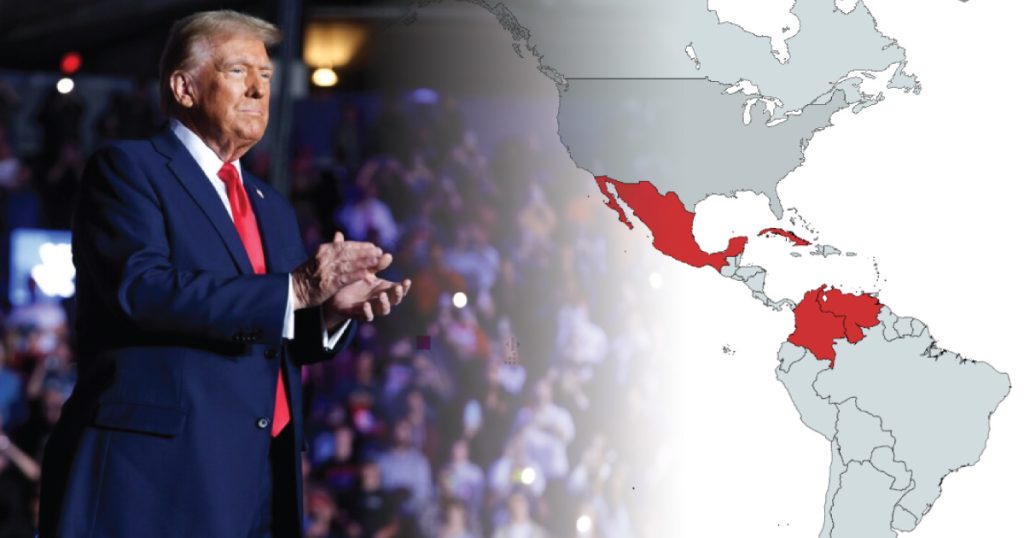
Senator Lindsey Graham (R-SC) who was with President Trump aboard Air Force One framed the moves to reporters as defensive measures against nations flooding the U.S. with drugs and migrants, that are aligned with narco terrorists who are in bed with Hezbollah.
“When a country is a narco terrorist state that floods your country with cocaine that’s aligned with Hezbollah, what’s the right response? You blow up the boat before they get here. You take down the source of the problem,” Sen. Graham said. “He did what other people talked about but didn’t have the balls or the guts to do it. This is a good thing. This is not interventionism. This is making America safer.”
U.S. troops seized Maduro and his wife, Cilia Flores, in a predawn raid on Caracas Jan. 3 during Operation Absolute Resolve, which involved over 150 aircraft from 20 bases and no American casualties. Maduro, indicted in New York in 2020 on narco-terrorism charges, surrendered at his compound and is now in New York City for trial on counts including cocaine importation conspiracy and possession of machine guns. Trump announced that the U.S. would oversee Venezuela temporarily, with American oil companies investing billions to rebuild Venezuela’s infrastructure while maintaining an oil embargo until a “proper and judicious transition” of power.



“We’re in charge,” Trump told reporters when asked Who’s in charge of Venezuela.
Trump stated that intermediaries are communicating with Delcy Rodríguez, Maduro’s appointed vice president—now Acting President. Though Rodríguez is cooperating without U.S. guarantees, Trump warned she could face a “situation probably worse than Maduro” if she fails to comply with U.S. demands.

“Venezuela thus far has been very nice, but it helps to have a force like we have,” Trump said not ruling out a second strike if needed. “We were prepared to do a second strike if we needed. We’re totally prepared.”
Shifting to Colombia, Trump criticized its leadership under President Gustavo Petro as “very sick,” accusing the country of producing and exporting cocaine to the U.S.
“He’s not going to be doing it very long,” Trump said of Petro’s alleged involvement in “cocaine mills and cocaine factories.” He told reporters that he is open to a U.S. operation in Columbia replying to a reporter’s question on the topic with, “It sounds good to me.”
Petro defended his administration’s anti-drug efforts in a detailed post on X, highlighting record cocaine seizures and asserting his legitimacy while denying any personal involvement in narcotics.


On Mexico, Trump urged tougher action against cartels he claimed control the country.
“The cartels are running Mexico, whether you like it or not,” Trump said.
He recalled offering troops to President Claudia Sheinbaum on multiple occasions to combat drug trafficking, praising her as “a terrific person” but noting her hesitation due to fear of the cartels.
“Every single time I talked to her, I offered to send troops,” Trump said. With drugs and migrants “pouring through Mexico,” he warned the U.S. might intervene if Mexico does not act.
“Mexico has to get their act together because they’re [drugs] pouring through Mexico and we’re going to have to do something,” said Trump. “We’d love Mexico to do it. They’re capable of doing it. But unfortunately, the cartels are very strong in Mexico.
Cuba drew Trump’s attention as vulnerable following the cutoff of Venezuelan oil subsidies.
“Cuba now has no income. They got all of their income from Venezuela, from the Venezuelan oil. They’re not getting any of it,” Trump said.
He described the Cuban regime as “ready to fall,” and downplayed the need for direct U.S. action, likening it to a fighter “going down for the count.”
Trump shared that there were a lot of Cuban casualties in the Operation Absolute Resolve.
Cuba confirmed that 32 of its nationals were killed in Venezuela during the U.S. operation to capture Nicolás Maduro.
Miguel Díaz-Canel, President of Cuba, denounced the U.S. actions as “state terrorism” and a violation of international law, calling for an urgent global response. He has also announced two days of national mourning for the 32 Cuban nationals killed in the U.S. strikes, describing them as heroes.
In Saturday’s presser following the apprehension of Maduro by U.S. forces, Trump invoked the Monroe Doctrine, what he now calls the “Donroe Doctrine,” declaring that American dominance in the Western hemisphere “will never be questioned again.”

Author: Mario Lotmore