

OLYMPIA—The Washington State Legislative Black Caucus released the 2025 community survey results and 2026 legislative priorities for this years’ session, which begins on January 12, 2026.
The Caucus’ Community Priorities Survey guides the caucus’ work to advance policies that protect Black children, strengthen families, support economic mobility, and invest in Black-led solutions statewide, it says.
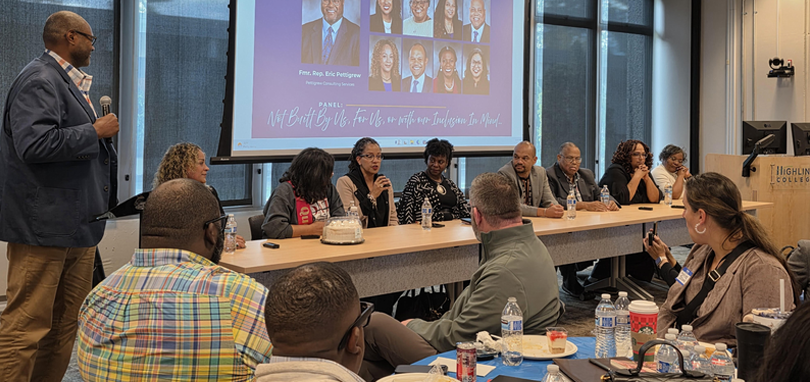
The 2025 LBC Community Priorities Survey was developed to narrow and prioritize community-defined priorities developed at the State of Black Washington Town Hall, which convened on November 8, 2025, at Highline College in Des Moines, Washington. The LBC’s community engagement process began with this town hall before formulating a community survey, which then will directly translate into the LBC’s legislative agenda this session.
Overall, more than 300 people attended the November 8 Town Hall, where 11 policy areas were explored, 150 priorities were drafted by community members, and 9 core policy areas were synthesized.


The subsequent Community Survey was distributed statewide and held a three-week response window.
“The 2025 Community Priorities Survey reflects the voices, lived experiences, and collective wisdom of Black communities across our state. This report is rooted in a simple but powerful principle: policy is strongest when it is shaped with the people most impacted by it,” said Legislative Black Caucus Chair Rep. Kristine M. Reeves (D-Federal Way). “Through deep community engagement, listening sessions at the State of Black WA: Black Town Hall, and partnership across our legislative districts, Black Washingtonians articulated clear priorities grounded in dignity, opportunity, and accountability.”

Reeves continued that she expresses deep gratitude to the community members who shared their time, insight, and trust and she remains committed to translating this collective vision into meaningful, lasting change.
The findings of this community engagement process presented a clear call to action: to move beyond crises response toward long-term stability, equity, and accountability, grounded in data, lived experience, and community leadership.
The core themes of the survey were:
- ‘Protecting Black children and youth’ through non-punitive, culturally sustaining systems that disrupt the school-to-prison pipeline.
- ‘Stability, Ownership, and Generational Wealth’ – securing housing, healthcare, and economic opportunity that allow families to pass opportunity forward – not trauma.
- And ‘Accountability, equity, and community power’ through durable policy change, statewide investment, transparent metrics, and power-shifting toward Black-led solutions.
As for core policy areas, these included:
- Housing (increased funding for starter home construction and family-sized housing).
- Education (more investments in Black educator recruitment, training, and retention).
- Healthcare (strengthen culturally competent maternal and mental health services).
- Climate (target environmental investments in overburdened neighborhoods).
- Immigration (protect unaccompanied minors and prioritize family reunification).
- Food Security (expand food access grants for Black farmers, cooperatives, and mobile markets).
- Economic Justice (Systems Accountability: Standardize racial data reporting across state agencies).
- Juvenile Justice (Replace punitive youth systems with development-focused support).
- Small Business (Expand capital access for Black and Brown entrepreneurs).
Additionally, survey participants defined ‘what success looks like’, regarding these core priorities, as “structural, measurable, and durable change: systems that protect Black children, enable generational wealth, and allow families and community to thrive without navigating constant harm or precarity.”


Respondents further emphasized culturally sustaining education, beginning in early learning, stable housing, accessible healthcare, economic opportunity, and statewide investment that reaches Black community across urban, suburban, and rural Washington.
“Success” was repeatedly framed as progress that is both visible in the data and felt in lived experience, according to the report, reflected in “narrowing racial disparities, improved youth outcomes, community safety, and the ability to experience stability, dignity, and joy.” What this means in practice, the report continued, is sustained investments in Black-led organizations, culturally concordant care, and policies designed and governed in partnership with Black communities.
About the Washington State Black Caucus
The Washington State Black Caucus was established in 2019 by Representatives Eric Pettigrew (D-LD37), John Lovick (D-Mill Creek), Melanie Morgan (D-Parkland), Debra Entenman (D-Kent), and Kristine Reeve (D-Federal Way) to ensure Black community are meaningfully represented in state policymaking.
Today, with 14 members, the Caucus is the largest legislative Black caucus in the western United States. Members advance policies grounded in equity, lived experience, and partnership with Black community across Washington State.

Author: Kienan Briscoe