

For the first time in more than 50 years, a rocket built to carry humans around the Moon is standing on the launch pad. Submitted names will be included on an SD card that will fly inside Orion when the Artemis II mission launches in February 2026. This is a unique way to experience the excitement of launch or milestone activities. As an event gets closer, new opportunities and resources become available. To submit your name, click here.
Since 2020, NASA has invited the public to be virtual guests at launches and milestone events. As a virtual guest, one will have access to curated resources, schedule changes, and mission specific information. Following each activity, guests are sent a stamp for their virtual guest passport! All resources, participation, and registration are FREE.


Artemis II is NASA’s first crewed test flight in the Artemis campaign. Four astronauts will fly aboard NASA’s Orion spacecraft and confirm the spacecraft’s systems operate as designed in the deep space environment. In this Golden Age of exploration and innovation, the Artemis missions will allow astronauts to explore the Moon for scientific discovery, economic benefits, and help build momentum for the first crewed missions to Mars.
The launch date is scheduled for February 6, 2026, with a launch window of 9:41 p.m. to 11:41 p.m. EST.


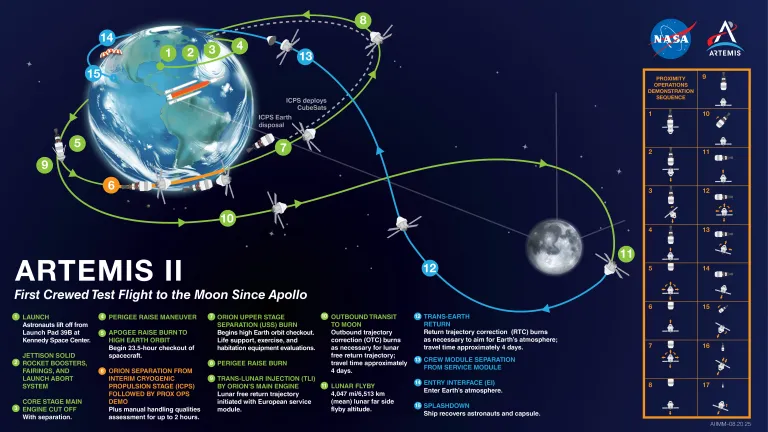
The Artemis II mission profile follows the uncrewed Artemis I flight test by demonstrating a broad range of SLS (Space Launch System) and Orion capabilities for deep space. This mission will prove Orion’s life support systems are ready to sustain crew on future missions and allow the crew to practice operations essential to the success of Artemis III and beyond.
NASA’s Reid Wiseman, Victor Glover, and Christina Koch, and CSA (Canadian Space Agency) astronaut Jeremy Hansen are the Artemis II astronauts.
The initial launch will be similar to Artemis I as SLS lofts Orion into space. With crew aboard this mission, Orion and the upper stage, called the interim cryogenic propulsion stage (ICPS), will then orbit Earth twice to ensure Orion’s systems are working as expected while still close to home.
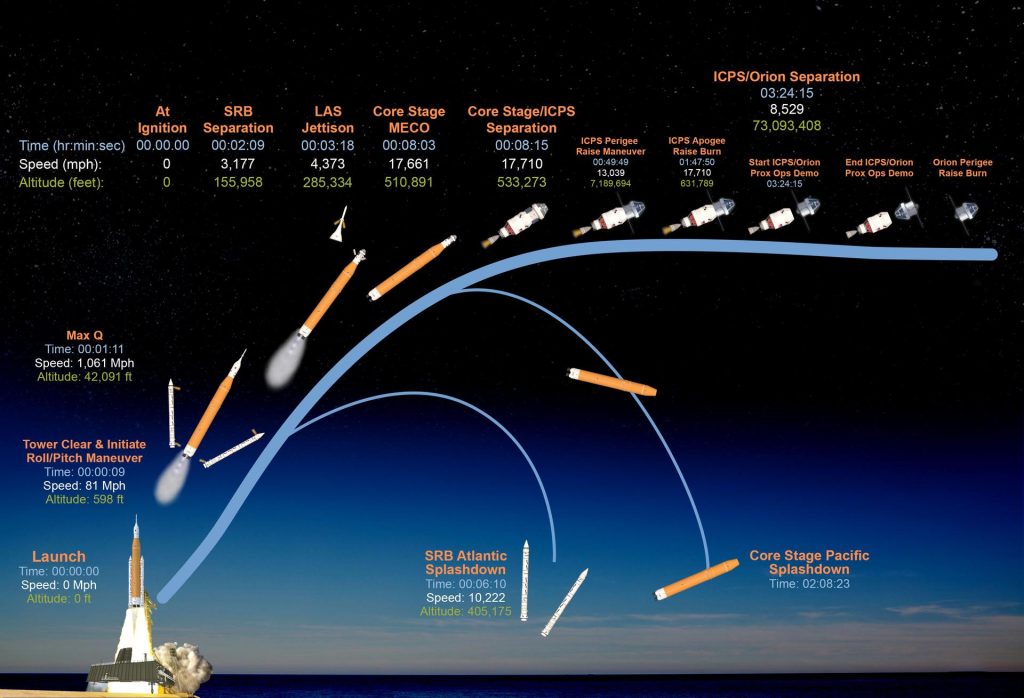
Orion will start in an elliptical orbit that will be refined to a “safe” high Earth orbit of approximately 44,525 x 115 statute miles. For perspective, the International Space Station flies a nearly circular Earth orbit about 250 miles above our planet.
After the burn to enter the high Earth orbit, Orion will separate from the upper stage, which the crew will use as a target for a manual piloting test called the proximity operations demonstration. During the demonstration, mission controllers at NASA’s Johnson Space Center in Houston will monitor Orion as the astronauts transition the spacecraft to manual mode and pilot Orion’s flight path and orientation. This demonstration will provide performance data and operational experience that cannot be readily gained on the ground in preparation for critical rendezvous, proximity operations, and docking – as well as undocking – operations in lunar orbit beginning on Artemis III.
Moonbound, Free Ride Home
The Artemis II crew will travel approximately 4,600 miles beyond the far side of the Moon. They will see the Earth and the Moon from Orion’s windows, with the Moon close in the foreground and the Earth nearly 250,000 miles in the background. From the crew’s location, the Moon will look about the size of a basketball held at arm’s length.
Once Orion and the crew come around the far side of the Moon, they’ll begin the return leg of their journey home. Instead of requiring propulsion on the return, their fuel-efficient trajectory will harness the Earth-Moon gravity field, ensuring Orion will be pulled back naturally by Earth’s gravity for the free-return portion of the mission.
Orion will splashdown in the Pacific Ocean, and the spacecraft and crew will be recovered with the help of the U.S. Navy, offering another opportunity to put new processes to the test for the first time. The lessons learned throughout the mission will pave the way for humans to return to the lunar surface. Through Artemis, NASA will explore more of the Moon than ever before and create an enduring presence in deep space, while simultaneously preparing to land the first astronaut – an American – on Mars.
The Artemis II crew is expected to break the distance record set by Apollo 13 for the farthest any humans have ever been from Earth.
Mission Priorities
The Artemis II test flight will confirm the systems necessary to support astronauts in deep space exploration and prepare to establish a sustained presence on the Moon. There are five main priorities for Artemis II:
- Crew: Demonstrate the ability of systems and teams to sustain the flight crew in the flight environment, and through their return to Earth.
- Systems: Demonstrate systems and operations essential to a crewed lunar campaign. This ranges from ground systems to hardware in space, and operations spanning from development to launch, flight, and recovery.
- Hardware and Data: Retrieve flight hardware and data, assessing performance for future missions.
- Emergency Operations: Demonstrate emergency system capabilities and validate associated operations to the extent practical, such as abort operations and rescue procedures, as needed.
- Data and Subsystems: Complete additional objectives to verify subsystems and validate data.
Meet the Astronauts
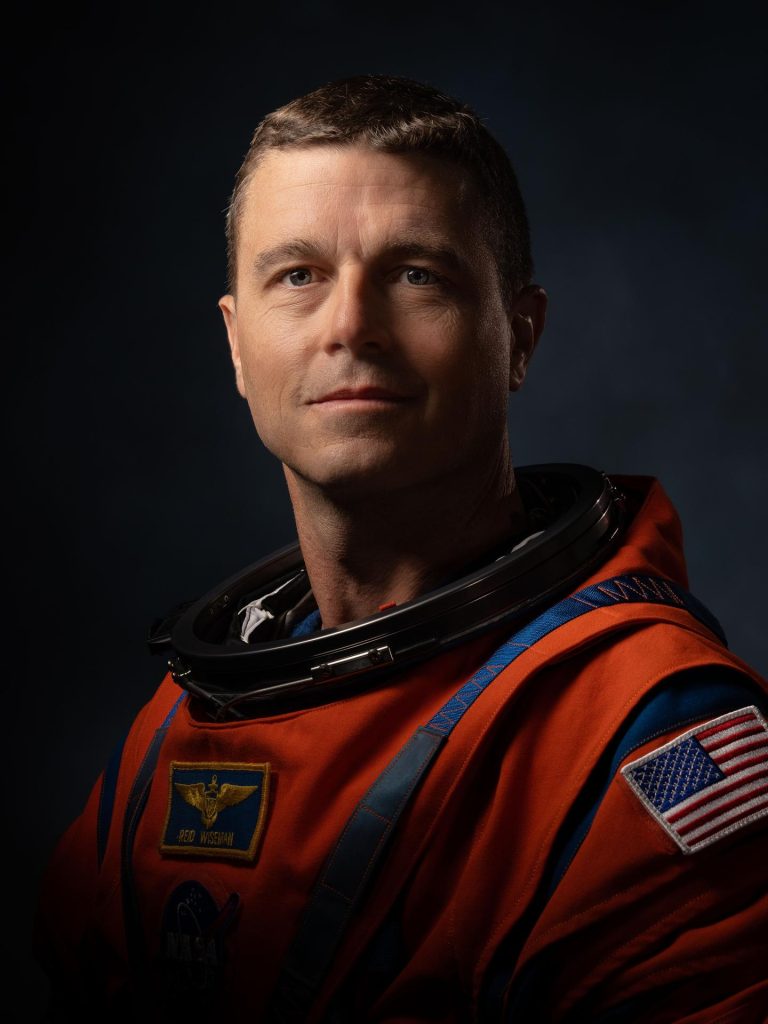
Reid Wiseman is commander of NASA’s Artemis II mission. The Baltimore native previously served as flight engineer aboard the International Space Station for Expedition 41 from May through November of 2014. During the 165-day mission, Wiseman and his crewmates completed more than 300 scientific experiments in areas such as human physiology, medicine, physical science, Earth science and astrophysics. They set a milestone for station science by completing a record 82 hours of research in a single week. He also served as chief of the Astronaut Office from December 2020 to November 2022.
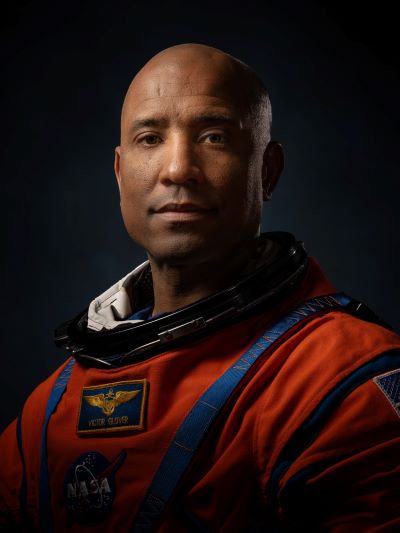
Victor Glover has been assigned to be pilot of NASA’s Artemis II mission around the Moon. Glover was selected as an astronaut in 2013 while serving as a Legislative Fellow in the United States Senate. He most recently served as pilot of the Crew-1 Dragon spacecraft which flew to the International Space Station, where he also was flight engineer for Expedition 64/65.
The California native earned an undergraduate engineering degree, is a naval aviator, and was a test pilot in the F/A‐18 Hornet, Super Hornet, and EA‐18G Growler.
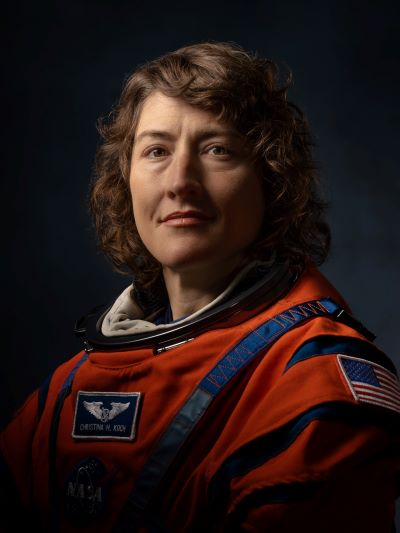
Christina Koch is an explorer and engineer who became astronaut in 2013 and will serve as a mission specialist for NASA’s Artemis II mission. Her previous experience in spaceflight was living and working on the International Space Station for almost all of 2019 in Expeditions 59, 60, and 61. Koch spent a total of 328 consecutive days in space and participated in the first all-female spacewalks. She served as branch chief of the Assigned Crew Branch in the Astronaut Office and did a rotation as assistant for technical integration for the center director at NASA Johnson. Prior to becoming an astronaut, Koch’s experience spanned both space science mission instrument development and remote scientific field engineering in the Antarctic and Arctic.
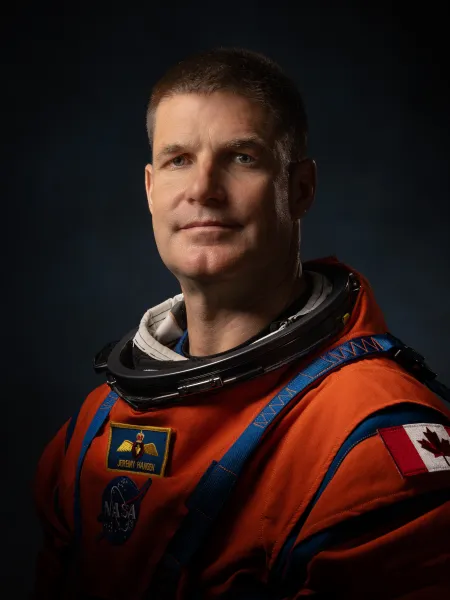
Born in London, Ontario, Canada, Colonel Jeremy Hansen is a Canadian astronaut and a former fighter pilot. He has extensive experience in mission operations and leadership roles. He has been assigned as a mission specialist for the Artemis II mission, which will make him the first Canadian to fly around the Moon. Hansen was selected as an astronaut in 2009 and completed astronaut candidate training in 2011. He worked as capcom at NASA’s Mission Control Center in Houston and participated in international training missions, including ESA’s CAVES program in 2013 and NASA’s NEEMO 19 underwater mission in 2014. He also took part in several field geology training expeditions, including in Canada’s High Arctic. In 2017, he became the first Canadian to lead a NASA astronaut class.
Industry Partners
NASA has several prime contractors for Artemis II, including Amentum, Boeing, Lockheed Martin, L3Harris, and Northrop Grumman.
More than 3,800 suppliers across 49 states contribute to NASA’s Artemis campaign. With NASA investments, additional U.S. companies, including small businesses, are advancing the operations and systems needed to live and work on the Moon.
NASA’s prime contractor supporting Exploration Ground Systems for Artemis II is Amentum of Chantilly, Virginia. Amentum is responsible for development and operations of flight vehicle components and has helped NASA to upgrade facilities and ground equipment at Kennedy to prepare for the test flight.
Lockheed Martin is the lead contractor for the design, development, testing, and production of the Orion spacecraft for NASA’s Artemis missions.
NASA’s prime contractors for SLS include L3Harris, Boeing, and Northrop Grumman. L3 Harris manufactures SLS’s four RS-25 engines. Boeing manufactures its core stage, and Northrop Grumman manufactures SLS boosters. United Launch Alliance has provided the interim cryogenic propulsion stage under contract with Boeing.
Orion’s European Service Module is provided by ESA and built by its main contractor, Airbus. Workers across 10 European countries and the United States supply components for the service module, including Germany, Italy, Switzerland, France, Belgium, Sweden, Denmark, Norway, Spain, and the Netherlands. The Artemis II service module was assembled at Airbus facilities in Bremen, Germany, before being shipped to NASA.

Author: Lynnwood Times Staff