

President Donald J Trump issued a stark warning to Iran on Thursday, giving Tehran 10 to 15 days to reach a “meaningful” nuclear deal or face severe consequences, as the United States amasses its largest military presence in the Middle East since the 2003 invasion of Iraq.
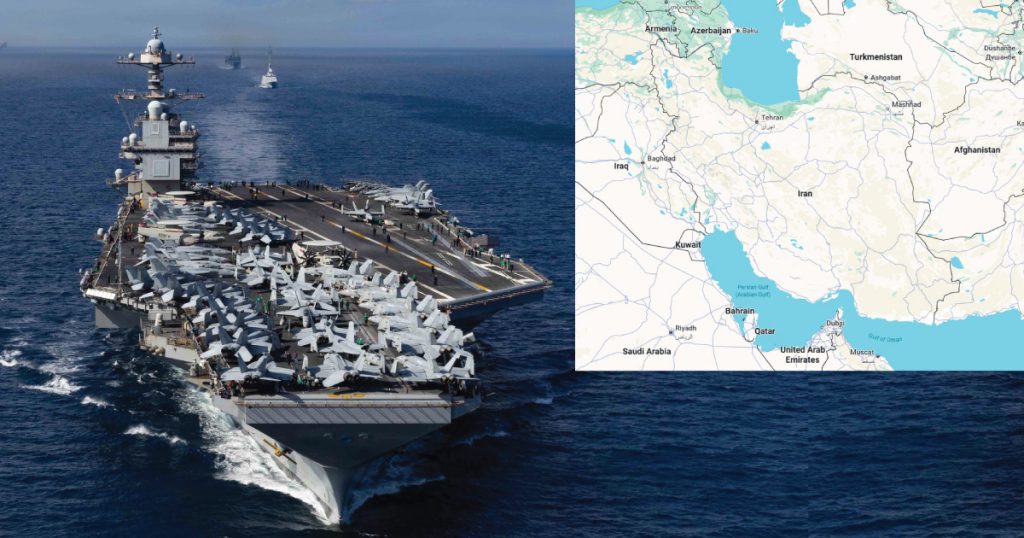
The buildup, including two aircraft carriers and over 120 fighter jets, comes amid stalled diplomatic talks and escalating tensions involving Iran, Israel and the U.S., raising fears of a broader conflict.



The USS Abraham Lincoln carrier strike group, with F-35 Lightning IIs and F/A-18 Super Hornets, has been positioned in the Arabian Sea since late January. It is set to be joined by the USS Gerald R. Ford, the Navy’s most advanced carrier, arriving in the region this weekend with additional destroyers and over 5,000 personnel.
Dozens of aircraft, including 48 F-16s, 12 F-22s and 18 F-35s, have relocated to bases in Jordan, Qatar and the United Arab Emirates, supported by 40 refueling tankers and surveillance planes like E-3 Sentries.




The Pentagon has also deployed air defense systems and submarines, creating a force capable of sustained operations.
U.S. officials describe the deployments as a deterrent amid Iran’s nuclear ambitions and support for regional proxies, following a 12-day war in June 2025 where the U.S. and Israel struck Iranian nuclear and military sites.


Trump, briefing reporters, said negotiations are progressing but warned, “We have to make a meaningful deal. Otherwise, bad things happen.” Indirect talks in Geneva on Tuesday yielded “guiding principles,” but Iran requested two weeks to respond, a timeline Trump dismissed.
Iran is insisting on its right to uranium enrichment and is rejecting U.S. demands to dismantle its nuclear program and its curb ballistic missile program.
Foreign Minister Abbas Araghchi called Trump’s comments a “real risk of military aggression.”
On Monday, Feb. 16, the Islamic Revolutionary Guard Corps conducted drills in the Strait of Hormuz and joint naval exercises with Russia on Thursday, simulating rescues but a visible sign of military readiness.
Iranian commanders have shifted to an “offensive” doctrine, deploying Khorramshahr-4 missiles underground and warning of strikes on U.S. bases and allies if attacked. Proxies could also target U.S. interests, and Iran has threatened to close the Strait of Hormuz, disrupting global oil flows if attacked.
Supreme Leader Ayatollah Ali Khamenei said even the “strongest military” could be crippled.
Tensions with Iran stem not only from its nuclear ambitions but also recent killings of thousands of anti-regime protestors.
If a war were to break out, U.S. officials have raised alarms about Iranian sleeper cells in America, citing plots like assassination attempts on former officials Mike Pompeo and John Bolton. The FBI disrupted a 2024 scheme to kill Trump, and experts note Iran’s history of using proxies for attacks.
Border vulnerabilities under the Biden administration’s open border policy have heighten risks of a U.S. mainland attack by Iranian sleeper cells.
A war could resemble a sustained air campaign lasting weeks, targeting nuclear sites, missiles and leadership to weaken the regime. The US may even use infrasound technology resembling methods used to abduct Madura in Venezuela. Iran might retaliate with missile barrages on U.S. bases and Israel, proxy attacks and cyber operations.
Oil prices surged above $71 a barrel Thursday amid fears of supply disruptions if a military action were to happen. The White House insists diplomacy remains open, but with forces in place, the region braces for potential conflict.

Author: Mario Lotmore