

LYNNWOOD—A retired Lynnwood homeowner was shocked to see a $500 water bill from Alderwood Water District at the beginning of the month, an impact from the City Council’s decision to approve a utility tax increase last November to address the city’s budget shortfall.
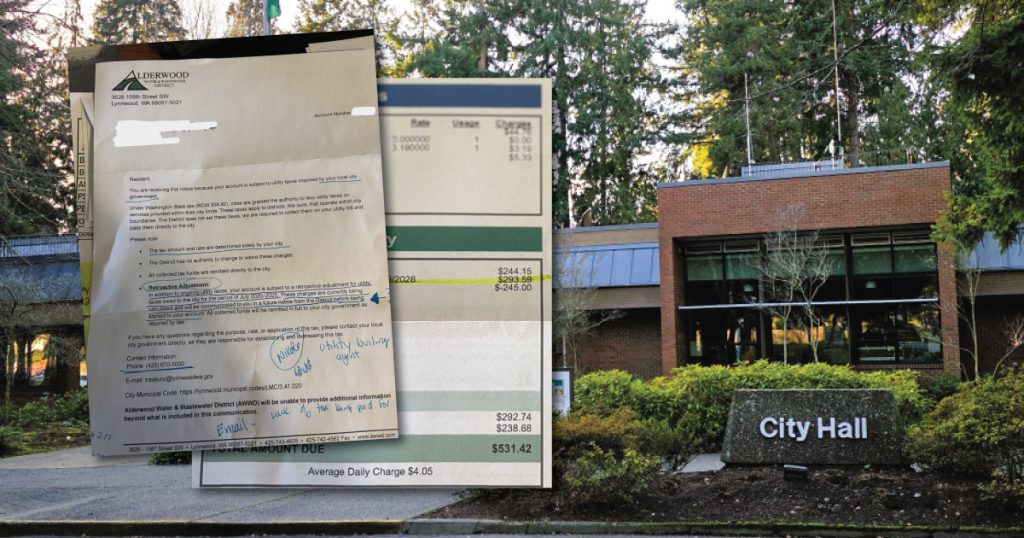
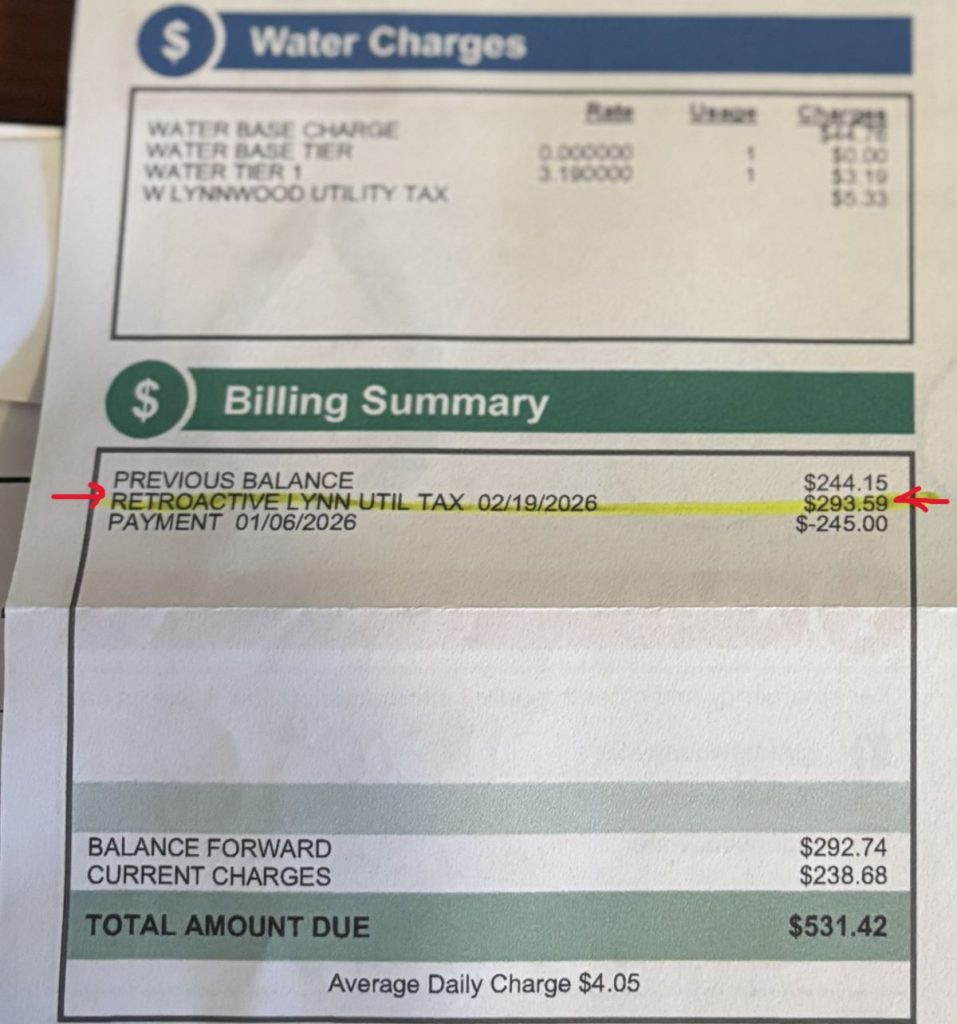
The Lynnwood resident – who has asked to remain anonymous so we will be referring to as “Beth” – picked up her water bill on Saturday, February 14, and immediately noticed the $500 amount due was significantly larger than her typical $200/a month bill. The due date was scheduled for March 16.
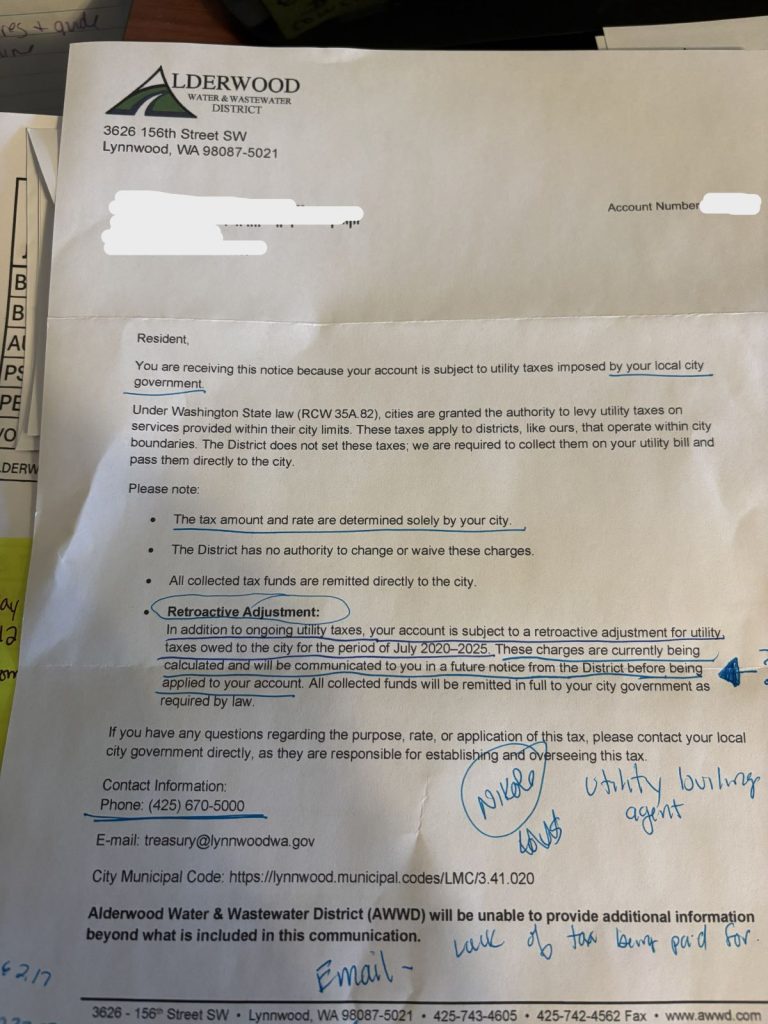
A month prior the Alderwood Water District issued letters to consumers notifying there would be a “retroactive adjustment” to account for the increasing taxes, approved by Council on November 24, 2025, but that these charges “will be calculated and communicated in a future notice from the district before being applied to [an] account.” However, Beth informed the Lynnwood Times she never received this notice.
The letter further stated, “you are receiving this notice because your account is subject to utility taxes that are imposed by your local city government.”



“There wasn’t a letter. That’s when I started going, okay this is a problem because $300 is a lot on top of my rate, especially for someone’s who’s retired and living on a fixed income,” said Beth. “I was shocked. Because it doesn’t always say on the letter. I figured that they would just increase the rates in order to figure out they were going to settle this. My thoughts are the city screwed up because they didn’t say ‘he we’re not getting this money,’ and Alderwood Water screwed up because they weren’t collecting the money and sending it to the city. So why is it the customers who are responsible for paying it?”
Under Washington State Law, RCW35.A.82, cities are guaranteed the authority to levy utility taxes for services provided within their city limits. Taxes are applied to districts, like Alderwood Water District, that operates within city boundaries.

“The district does not set the taxes, we are required to collect them on your utility bill and pass them directly to the city,” the letter sent by Alderwood Water states.
Beth decided against taking the money out of her savings account to pay for her account, paying the amount due, including an additional $62.17 making her check an even $300.
When Beth reached out to the Alderwood Water District she was informed that there should have been another letter received, not only disclosing the amount that would be reflected on her bill, but that there would be a payment plan in place. She eventually did get this letter, after talking to a representative at the Water District, she said. Beth has since opted for the payment plan.
The shortest payment plan is for six months, for anyone up to $500. Other payment plans include 12-month, an 18-month, and 24-month for anyone over $2,700.


“I was just frustrated by the fact that if the two departments screwed up why are they coming back and now charging us. I feel like you screwed up, you pay for it,” said Beth. “I’m sure there will be a lot of people whose bills are going to be bigger than mine.”
Alderwood Water District chimes in
According to Michael Kundu, Communications and Resiliency Planner, for the Alderwood Water District, after the City of Lynnwood approved the tax rate increase back in November of last year, seeing as the Alderwood Water & Wastewater District is a Special Purpose District, they are obligated to collect these taxes and relinquish them to the city.
“The decision to raise them were not made by the District. We don’t touch, or keep, any of these taxes,” said Kundu. “Whenever you see something like this, a retroactive tax, obviously there’s going to be concern – especially if we’re looking at folks who have to pay up to $500 or more.”
The reason consumers are being retroactively charged, Kundu continued, is that the city approved the taxes owed to the city between 2020 to 2025 – five years’ worth of back taxes that are now showing up on people’s bill.
These taxes are then transported into the city’s general fund.
Kundu informed the Lynnwood Times that, though the District offered several payment plans, because the taxes were city mandated, many utility assistance programs (for example, NGO and Snohomish County) do not apply. Despite the lower latitude, Kundu continued that the District continues to refer their customers to other programs that may be able to assist with the retroactive charge.
When the Alderwood Water District first heard the city of Lynnwood was increasing its taxes last November, the District sent out a notification in December that there would be rate increases, and another letter in February after the tax rates were implemented.
“There’s definitely no effort to try and hide what’s happening. As any government utility, even special purpose districts that are run by a Board of Commissioners, we have public hearings, so people know what was going on,” said Kundu. “In this case it was solely with what was happening with the City of Lynnwood, and we tried to let people know that there would be some changes coming up.”
Kundu continued that the Water District did not receive any notification, or communication, from the city that they would need to collect these taxes and that they learned of the tax increases from the media.
According to Nathan McDonald, Manager of Communications and Public Affairs for the City of Lynnwood, since the city does not receive any of the collected monies (and it goes straight into the general fund) there is no obligation by the City to inform Alderwood Water District of the changes.
This retroactive charge (in Beth’s case, the additional $300) is a one-time lumpsum charge, however rates will still be increased moving forward at an additional 6-10%.
“From this point on, we will only be collecting what the City of Lynnwood has decided as its 2026 rate. There shouldn’t be any lumpsums, and I recognize that these lumpsums hit. I know the city is scrambling to fill in some gaps, hopefully there won’t be anything else that’s been discovered and come to us with the dirty work of needing to collect it,” said Kundu.
Separate to the city-imposed utility taxes, Alderwood Water District plans to raise its own rates to 6-11%, depending on specific categories of homeowners (apartments and individual residents, for example).
Kundu added that the Water District recognizes that these rate changes adversely impact its clients, but with state mandates, infrastructure problems, federal mandates concerning water quality, and so on, the Water District Board has been trying their best to balance infrastructure improvements with rate increases.
Alderwood Water District still has significantly lower rates than other similar districts in the region, such as Seattle Public Utilities, King County, and so on.
As of January 1, 2026, the average monthly water bill (not including wastewater) for Alderwood Water District is $41.88, compared to the City of Edmonds ($70.26), the City of Seattle ($63.42), the City of Everett ($47.56), and so on. For wastewater, the average monthly bill for Alderwood Water District is $102.09, compared to the City of Seattle ($141.26), and the City of Lynnwood ($110.60).
Editor’s Note, 9:26 a.m., March 16, 2026: After receiving new information by the city, the Lynnwood Times published an update to this article which can be found here.
- According to the City of Lynnwood the decision to charge retroactive tax collection was an Alderwood Water decision, not the City’s.
- Lynnwood Mayor George Hurst and Finance Director Michelle Meyer informed the Lynnwood Times the tax hike was not approved by the City Council, as originally stated by the Water District. The $360,000 owed to the City by the Water District was agreed upon prior to November of 2025 by former Mayor Christine Frizzell, without the knowledge of the City Council, according to Hurst and Meyer.
- The City of Lynnwood adopted its utility tax on water and wastewater services in 2010 and later adjusted the rate in 2015 and 2025. In 2025, City staff discovered that the Water District had not been paying utility taxes to the City associated with services provided to customers within the city limits.
- City staff communicated with the Water District regarding these obligations in mid-2025. Under state law, the City could go back 6 years for delinquent collections, but in negotiations with the Water District, the prior City Administration agreed to limit the recovery period to 5 years to July 2020. The prior City Administration also agreed to waive any penalties or interest that could have been charged to the District because of non-payment.
- In October 2025, the Water District then informed the prior City Administration it would be seeking to collect the full past due taxes from its customers for the period July 2020 through September 2025. Letters were sent in December 2025, by the Water District, instructing customers to contact the City’s Finance Department if they had any questions.
- In February 2026, the District began to send bills to their customers that included a retroactive utility tax amount. The District has sent a new letter providing a payment plan which now reads informing customers to contact the Water District office to arrange the payment plan.

Author: Kienan Briscoe