


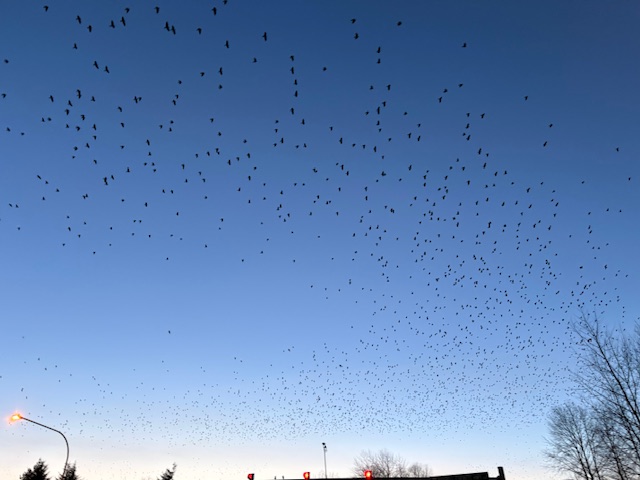
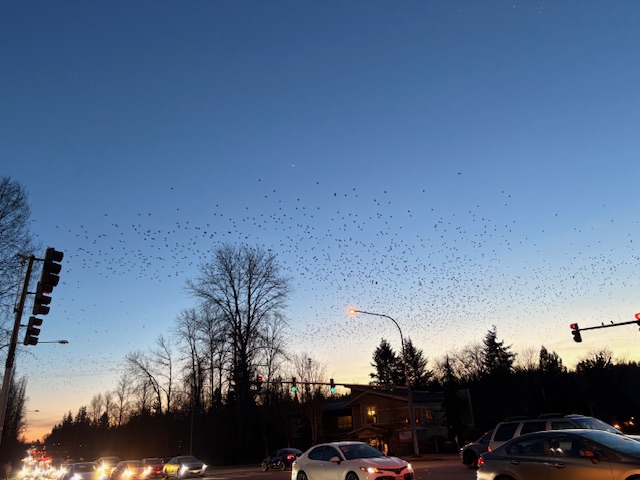
BOTHELL—Anyone living in, or passing through, Bothell near sunset has likely witnessed a peculiar sight; tens of thousands of crows holding daily councils, cawing, roosting, and congregating in one area every single night, particularly between the months of October and March.
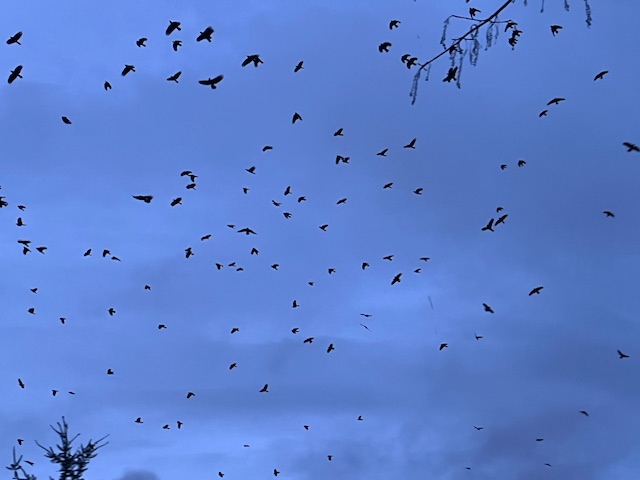
It’s a natural phenomenon that has piqued the interest of wildlife researchers for decades, inspired Bothell-crow merchandise, attracted bird watchers, and was even the motivation behind the city’s annual ‘Crow Fest’ which takes place each October in downtown Bothell.
At the peak of this roost, researchers estimate that approximately 20,000 crows – traveling from all across the Puget Sound – from Seattle, from Mill Creek, from Mukilteo from Snohomish, from even Whidbey Island – meet, exchange information, and baffle scientists.
In fact, the distance that some of these birds travelled to-and-from their homes to Bothell each night in a single year is greater than the Humpback Whale’s annual 3,000-mile migration from Alaska to Hawaii.



Nobody knows exactly why these crows congregate each night, though Doug Wacker, Biology Professor at University of Washington Bothell and avid bird researcher – who has studied the Bothell Crows since 2012 – holds some hypotheses.
One idea is protection from predators, he informed the Lynnwood Times, which is common in bird communities. Wacker, and his Biology class, set up several cameras throughout the UW Bothell campus to observe these birds, noticing that dozens of crows dispersed quickly once an owl appeared, supporting this idea. He, and his students, also noticed that the crows often stay high up in trees, telephone wires, and roofs instead of landing on the ground.


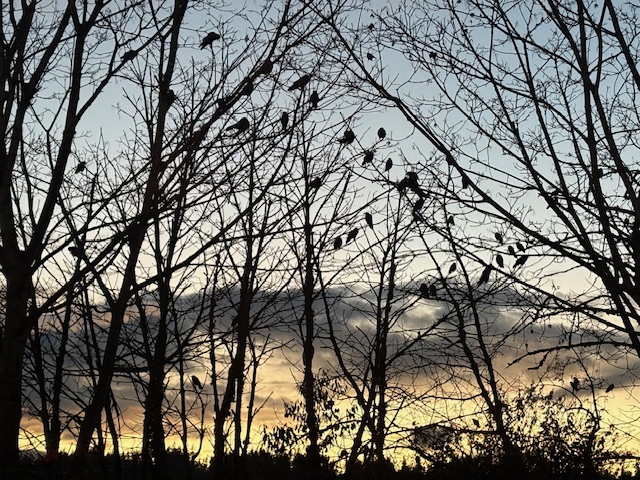
Another reason could be an exchange of information, with the crows often engaging in what’s called “pre-roost aggregation” where the birds meet and become highly vocal before settling down to roost.
“We certainly don’t know what they’re communicating about. It could be as boring as there’s a lot of them and they’re just saying ‘don’t come too close to me’, but it could also be food sources, potential mates, there’s a number of things they potentially could be talking about and that’s what we’re looking at,” said Wacker.
The million-dollar question that nobody has an answer to, Wacker continued, is why Bothell of all places? It’s certainly not due to the lack of predatory birds with Bothell being home to various hawks, and even owls.
There are at least four massive crow roosts in the State of Washington, one in Renton, one in Auburn, and another that used to be in University Place though this roost has recently dissolved. What’s similar to all of these roosts is the crows seem to prefer tree coverage, but then again, there’s plenty of places with tree coverage where crows don’t congregate.


Crows are incredibly intelligent birds with cognitive behaviors often equated to a five-year-old human, or ape. They’re able to solve complex, multi-step puzzles, use tools, communicate with themselves, and have a great memory.
John Marzluff, Professor of Wildlife Science at the University of Washington who specializes in human-bird relations, conducted a study in 2020 where his team wore masks while capturing and handling birds. He later observed that the crows would act differently whenever someone would walk by wearing that same mask – even crows that weren’t initially captured.
In Wacker’s Investigative Biology classroom, his undergraduate students conceptualize a project related to crow communication, plan experiments, write methods or procedures, test their hypotheses in the field, collect data, use programming to compile their data, and then present it all within the span of a quarter.
“Students will look at some aspects of crow behavior. Often it relates to the kind of calls they make in different situations. Crows do different things. They mob predators, they pre-roost, they sleep on these roosts at night, they forage and we record the calls they make while they do these different behaviors and we compare them,” said Wacker. “Recently we’ve been using machine learning to do this before us, to remove the bias of humans, from this analysis. Once we notice patterns of different calls in different situations, we can start to better understand what these calls mean.”
The University of Washington Bothell’s work has attracted the attention of Washington Fish and Wildlife (who assist in crow counts) and local mechanical engineers who collect recordings with microphone arrays.
UW Bothell has also partnered with the Pilchuck Autobon Society for a number of years to conduct crow counts.
Some of Wacker’s students have gone on to present scientific research on the effects of crow roosts. Wacker plans to publish another paper, this summer, exploring sparrow communities and how they are also impacted by crow roosts.
“We’re starting to see variables related to crow calls that are different between contexts that might not be what you would expect from human language. These crows are seemingly producing complex vocal communication, and with new technology our research is moving in some really exciting directions,” said Wacker. “These crows are endlessly fascinating. I could probably spend an entire lifetime worth of research and not even come close to answering all the questions that I, alone, have of them.”
Though thousands of crows still pre-roost in Bothell nightly, Wacker said the Bothell roost has recently moved to Redmond. There’s no telling why they’ve recently relocated, but it could be due to developments in Bothell, or something else entirely.
Wacker and his students are also currently working on a paper on why it may be that crows choose to relocate their roosts.
“There’s been a lot of changes to the Bothell campus and that might have disrupted the crows. Or perhaps the roost developed in a way that was less suitable and some of them happened to move, and the others followed. We’re in the process of at least assessing our different hypotheses by looking at lots of different roosts across the United States to see if we can find some commonalities to find a better answer to our question,” said Wacker. “There’s been a lot of folks who have done this work, it’s certainly not just me, and it’s been mostly the students.”
Some of Wacker’s students have continued to pursue crow-related research even after graduating.

Author: Kienan Briscoe







10 Responses
I have a theory as to why they’re in Bothell and why they’re leaving. Before Six Oaks apartments were built in downtown Bothell there used to be several oak trees (definitely more than 6) on the empty lot. You’d see the whole murder (hundreds upon hundreds) feeding on acorns leading up to spring. It’s be a decade since I know but perhaps they finally scouted a new food source in Lynnwood.
I never knew where they were headed, but many times I’ve seen a massive stream of birds flying from west to east across Kenmore. The sky is mostly clear of birds, except the flock, with hundreds passing each second, for 10, 15, 20 minutes and longer. I believe they were following the Sammamish River. (although from a human perspective it seems like they follow 522.)
It looks like an enormous murmuration of starlings, but even larger and moving in one unified direction.
If these are rhe same birds, going to the Bothell roost, that pattern suggests to me that they meet up somewhere else first, not sure if the researchers missed that part, or if these were/are not the same birds, which would be even weirder if there are two massive groups!
What a privilege it would be to study a murder so indepth. I was in Mill Creek a little over a year ago. I was at a friend’s house and was waiting for a call from my counselor in Mount Vernon. About 2 minutes before the call approximately 200 crows suddenly gathered in the trees and ob feces all around me. I thought, okay thus is odd. 30 seconds before my cell phone rang al the crows started squabbling and continued all through my call. This was 1pm on a Tuesday. 30 seconds after the call (approximately 45 minutes) they all stopped. At about the 2 minute nark after the call, they all flew off. They were extremely loud too. I don’t know why or anything. Coincidence or was nature telling me something, who knows. I was supposed to drive uo to Mount Vernon for my appointment but I had weird vibes that morning and then discovered a sudden dead battery with, nothing was jeft on to drain it and no way of getting a jump start. Didn’t have any other battery issues for 6 months either. My counselor has that call documented too. Feel free to use my story for some of your research if you wish, and feel free to contact me as well.
What if the North Creek Wetlands are just a rich food source for the roost? Sometimes the simplest explanations are the right ones.
It’s an excellent hypothesis! However we have some evidence that suggests that is not the case. We put cameras up all over the wetlands when they were roosting there (Bothell) and while we saw tons of crows in the canopy, we never once saw them come to the ground to forage or drink while roosting. It is possible that they were foraging in the treetops, but this is not typically where we see this behavior. During the day, there were not nearly as many crows around campus, so it’s unlikely to me that this particular location was a rich foraging area. Interestingly, while I rarely saw them foraging during pre-roosting on the Bothell campus, I have seen them foraging prior to roosting by the new Redmond roost. So, maybe the availability of that food was one of the reasons that they moved their roost? Thanks for the idea, I hope we get a chance to look at this!
I lived in Lake Forest Park for three years, and walked along the Burke-Gilman Trail almost daily. Every day, particularly between late February and Early November, thousands of Crows made their way across the sky, just before sunset. They seemed to be heading toward Kenmore, and often stopped on the rooftops near the cement plant there, at least temporarily.
I began to take handfuls of chips or nuts with me on my walks. There were one or two crows waiting for me along the trail where, at the same spot, I’d scatter the food. Eventually, one or two evolved into a larger group hanging out there. They would start to call and chatter, perhaps announcing to others my arrival (at least that’s what I liked to think). I couldn’t help but talk back to them. People on the trail must have thought I was crazy.
One day, an Albino crow joined the murder. It was pretty cool, as they are rare.
I see the mob that flys over South Seattle every year I guess on their way to Renton or Auburn. The thing that always strikes me is while normally noisy birds, they are eerily silent when flying in these huge mobs. Not sure why they are so quiet but I always find that silence curious.
I work under the pathway they take every night. I wouldn’t have to look at a clock to know what time it was, as they appear almost on the dot every day. I’ve talked with a few homeless people in the area, and I think it would be good for the students and/or teacher to reach out to them about information around these crows. Some of them, are so knowledgeable and they watch the crows daily. They talk about the habits they see everyday, how the crows act under different scenarios. I’ve known one of the homeless guys for about 10yrs, and tonsot and talk with them about their lives and what they see everyday….. it can be eye-opening.
Just a note about a possible typo: I believe Marzluff’s mask study would be more likely in 2002, not 2020. We lived in the same neighborhood as Marzluff and remember discussing the study and the documentary made about it with him and this was well before 2012.
Good catch – we conducted the study over a number of years, and the paper “ Lasting recognition of threatening people by wild American crows” was published in 2010. Great work highlighted here Doug!