


My wife Krystal is a teacher in the Everett Public Schools. Every day she helps shape the lives of other people’s children. She loves her job and she’s good at it. But we’ve had real conversations about whether it makes financial sense for her to keep working.

Krystal and I have four kids, and this summer we’re expecting our fifth. Like a lot of families, we’re already on the childcare waitlist.


When you add up infant care, preschool, and before- and after-school coverage for the rest of the kids, the cost can rival — or even exceed — her take-home pay. So we’ve sat at the kitchen table and done the math. She doesn’t want to leave her job, but the numbers barely work.
And we’re not the only family having this conversation.
Across Snohomish County, parents are running the same quiet calculation: Does one of us leave the workforce? Can we afford another child? How long can we hold together patchwork care while crossing our fingers? The numbers help explain why. In the Puget Sound region, infant care now averages more than $21,000 a year.


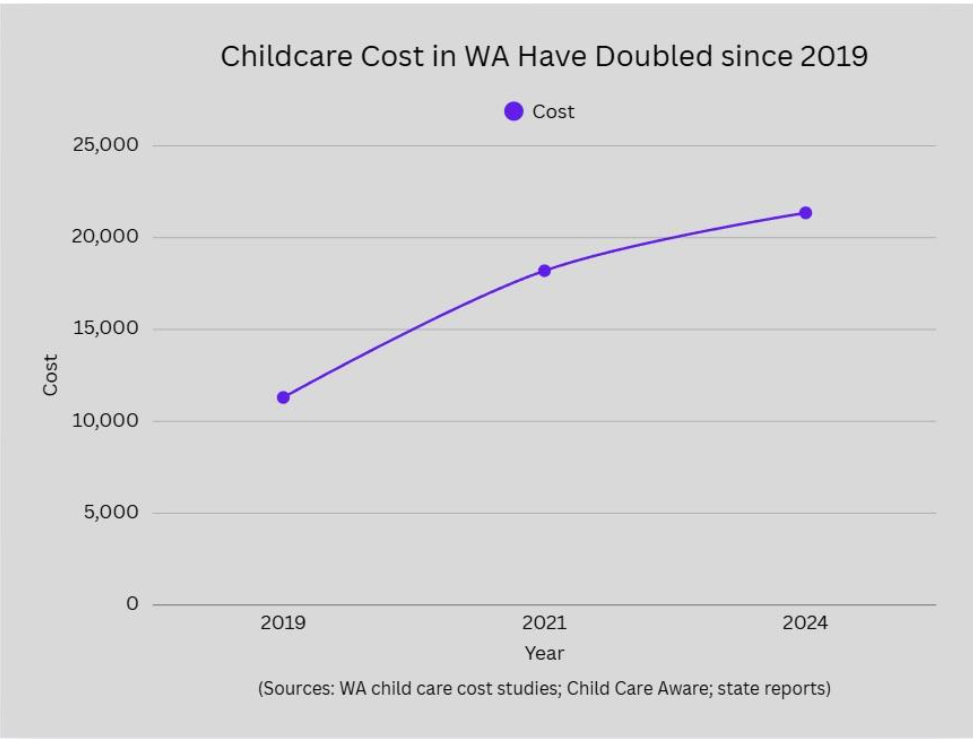
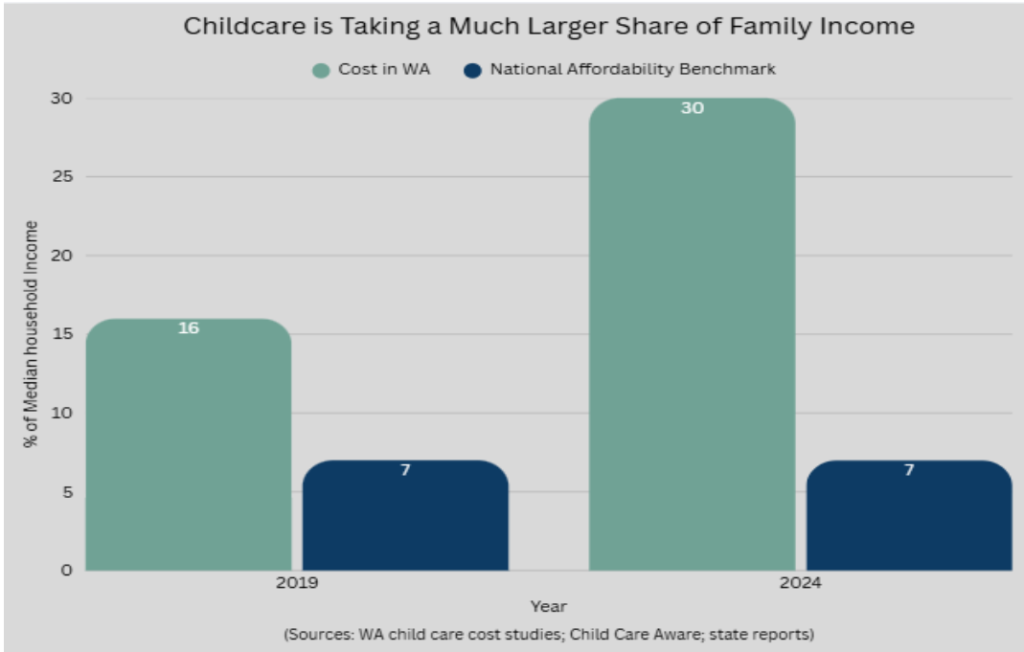
Families with an infant and a toddler can face combined childcare costs above $38,000 a year— rivaling a mortgage payment and exceeding the cost of college tuition in many places. Those costs have nearly doubled in just five years. Wages haven’t come close to keeping up.
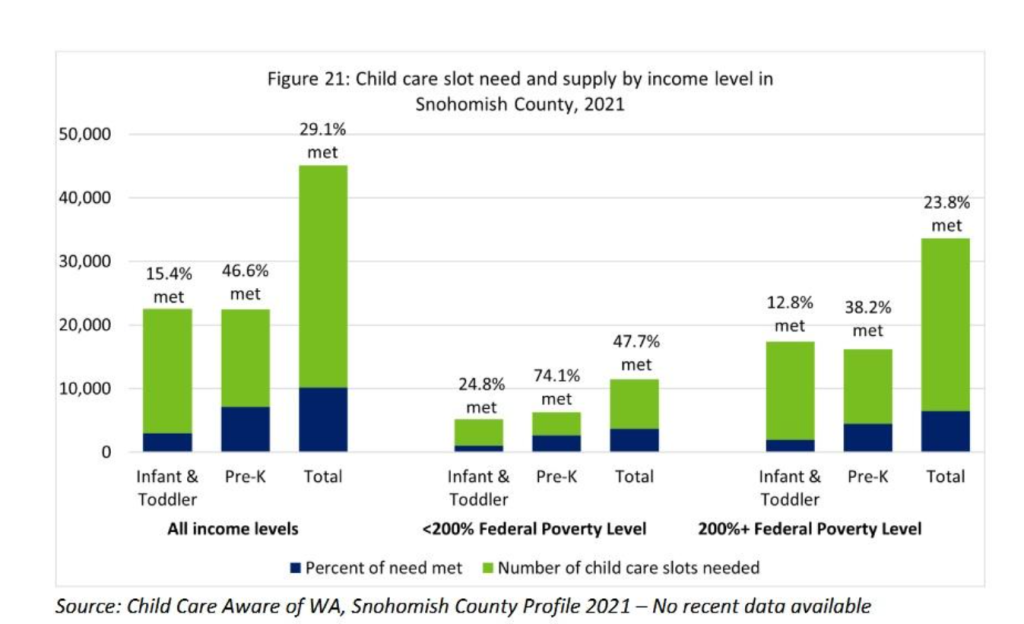
Even families who can afford childcare often can’t find a slot. Snohomish County is officially considered a childcare desert: only 62 licensed childcare openings per every 100 children of working parents. Licensed care for infants, toddlers, and pre-K meets just roughly 29% of total need. Parents report waitlists stretching six to twelve months, and many families sign up before their child is even born.


And the effects go far beyond inconvenience. These gaps reshape family decisions. They affect whether parents stay in the workforce, whether families have another child, and whether kids get early learning during the years that matter most.
Why This Matters Beyond Cost
The cost alone is reason enough to act. But the real stakes are about what happens to the kids who miss out.
Decades of research link high-quality early childhood education to higher lifetime earnings, higher graduation rates, lower incarceration rates, better health outcomes, and longer lives. Economists consistently estimate returns of $7 to $13 for every dollar invested. We’re not talking about babysitting. Early learning is one of the highest-return investments a community can make. Housing shapes where a family lives. Childcare shapes how far a child can go.
Why the System Is Broken
Childcare is labor-intensive by design. Safe, high-quality care requires low teacher-to-child ratios. But the math doesn’t work from any direction: families can’t afford to pay more, providers operate on razor-thin margins, and the people we trust to care for our youngest kids are paid so little that many of them can’t afford childcare for their own children.
Think about that.
My wife is a public school teacher who might have to stop working because her salary can’t cover the cost of care. The people teaching in childcare centers are in an even deeper hole. On top of that, providers face overlapping regulations, lengthy permitting processes, strict site requirements, and rising construction costs. Unlike roads or schools, childcare has never been treated as essential infrastructure—even though it underpins workforce participation and long-term economic mobility.
What I’ve Been Working On
The federal government needs to treat childcare as core infrastructure and move toward a universal system. The state needs to address regulatory complexity and chronic underfunding. At the county level, our tools are more limited—but they’re not nothing.
County government has two real levers: making new facilities financially viable through zoning and land-use reform, and helping build the early learning workforce. Over the past several years, I’ve worked on both.
Last year, based on a months-long listening tour of Snohomish County’s childcare system, I crafted an ordinance that redesigned county zoning to change childcare facilities from a conditional use to a permitted use in many zones- cutting approval timelines and reducing costs. In the same ordinance we made in-home childcare an allowed use in residential zones, recognizing that family-based providers are one of the fastest ways to expand supply. And for the workforce shortage, I was able to secure funding using, COVID relief dollars, to fund the first-ever Early Learning Educator Program at Sno-Isle TECH Skills Center to build a pipeline of trained professionals right here in Snohomish County.
Those are meaningful steps that I am proud of, but they’re not substitutes for broader reform at the state and federal level. At the same time, I’m not willing to pretend the county is powerless while families are struggling.
The Stakes
Young families who can’t afford childcare here, or can’t find it, will go somewhere else. Businesses that can’t count on a stable workforce because parents are being pushed out will see growth slow down. And when children miss early learning during the most formative years of brain development, the costs compound for decades.
Those costs fall hardest on families with the least margin- single parents, lower-income households, families who don’t have grandparents nearby or a spouse who can stay home. And it’s women’s careers and lifetime earnings that take the biggest hit.
Childcare is a family issue, but it’s also a workforce issue, a small business issue, a housing issue, a public health issue, and an economic justice issue.
If we care about opportunity for parents and for children, we have to start treating early learning as essential infrastructure.
As always, please let me know what you think!
Jared Mead, Snohomish County Councilman.

Snohomish County Councilman Jared Mead has served on the Snohomish County Council for the past six years. He was born and raised in the county, and his wife Krystal—an Everett Public Schools teacher—and him are raising their four children in South County. Mead writes this commentary to stay connected with the people who call Snohomish County home and to encourage an honest conversation about its future.
To join the conversation, visit Councilman Mead’s website at: February – Housing
COMMENTARY DISCLAIMER: The views and comments expressed are those of the writer and not necessarily those of the Lynnwood Times nor any of its affiliates

Author: Lynnwood Times Contributor





One Response
I’m sorry Jared, you seem very nice, but I think it’s time to change course in leadership and this article proves it. You’ve been on the council for six years and this is now an issue? Affordability of basic necessities is becoming unobtainable for everyone. Not just those lucky enough to want to have children. (Let alone a fifth) Please consider this when your party increases taxes ad infinitum. We elect leaders for solutions they put forward.
You don’t have any.