

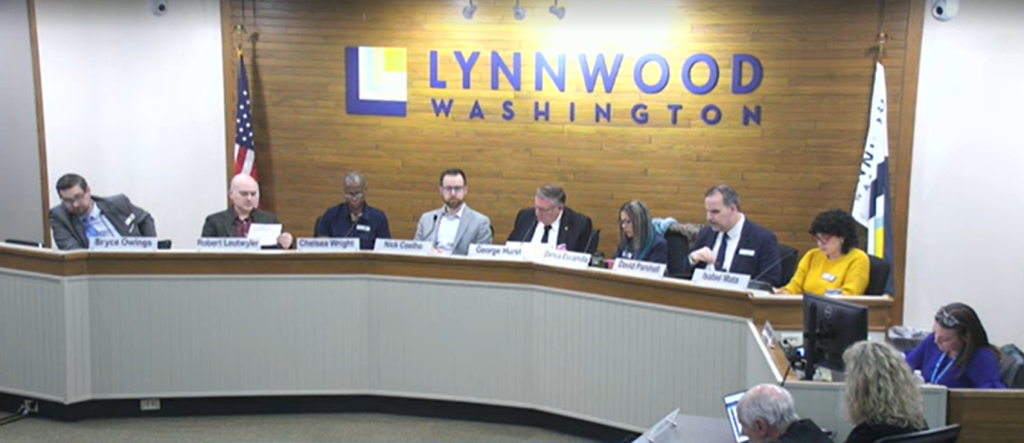
LYNNWOOD—Lynnwood City Council moved forward with a slate of agenda items, unanimously approving updates to the city’s Unified Development Code, advancing plans for a new Youth Council, and taking key steps to address the city’s ongoing budget gap, during their Business Meeting Monday, March 23.
During public comments, residents expressed concerns about funding the new downtown Everett sports arena by using funds from the Lynnwood Youth Activity account, bringing up concerns about not being able to display a Pride flag at Wilcox Park and how the organizer of Capitol Hill Pride (Charlette LeFevre and Philip Lipson) were not invited to join Lynnwood Pride’s planning process, and changing the zoning codes to allow high rise apartments next to multi-family residential homes (specifically the Unified Development Code, which was on the agenda).


After a brief response from council, the unanimous consent agenda was passed consisting of two agenda items: approving a contract for 44th Avenue West pedestrian and bicycle improvements, and approving claims (in the amount of $1,508,707.27) and payroll (in the amount of $1,774,799.46).
Unified Development Code Miscellaneous Update
Council member Robert Luetwyler moved to adopt ordinance 3507, which adopts miscellaneous amendments to the Lynnwood Municipal Code – including Chapter 1.12, Notices/Posting, Chapter 1.40, Code Enforcement, Chapter 8.20, Street and Neighborhood Design, Chapter 8.30, Subareas and Zoning Districts, Chapter 8.35, Use Regulations, Chapter 8.40, Development Standards, Chapter 8.90, Administration and Permit Processes, Chapter 8.99, Definitions, and Title 21 Zoning. The motion was seconded by Council member David Parshall.




The ordinance, known locally as the Unified Development Code, is intended to refine and improve language in the city’s development regulations to streamline implementation and address practical concerns that have emerged since earlier code changes.
Zack Spencer, a city planner, and Karl Almgren, community planning manager, are scheduled to present the proposal, which staff says responds to feedback from developers, residents and city departments following prior zoning code overhauls.
“The Unified Development Code is a living document, and periodic updates help remove barriers to development while maintaining community values,” city documents state, highlighting goals such as promoting affordable housing opportunities and easing unnecessary regulatory constraints.
Before a vote, Council member Isabel Mata addressed the Lynnwood resident who spoke out against the UDC during public comments, former Lynnwood City Council member Ted Hickle.
“I just want you to know that I understand what your concerns are, lack of privacy, buildings blocking light. I think everything is hypothetical at this point because the cost of building is so high, most people aren’t even doing these projects right now, but I do want to acknowledge the problem and questions you’re raising. I’m hoping as we go about permits out, and people doing these projects we can figure out how they’re actually building, what the implications are, and really start to figure out how we can problem solve in a way that allows us to build more housing while protecting domestic tranquility,” said Mata.
The motion passed unanimously.
Youth Council Progress
Following the passing of the UDC, Kelly Schudde, Recreation Superintendent, gave an update on the city’s Youth Council, which was approved by council back in August of 2025. That September the Youth Council was designated to Parks and Recreation and Schudde was chosen as the staff liaison.
Council Vice President Derica Escamilla was selected as the council liaison in January, with Council member Mata serving as the alternate.
“The mission of the youth council is to empower young leaders with a voice in their community, fostering belonging, equity, and purpose through leadership, civic engagement, and collaboration,” said Schudde. “ We are building an inclusive platform where youth are not only heard but are equipped to drive positive change.”
The Youth Council is currently in its first phase of Recruitment, with the first review of applications commencing on March 16 and the application deadline set for April 30.
Beginning in May, the Youth Council will transition to its second phase which will kickstart reviewing applications and holding conversations with applicants.
Phase three will begin in June, with the announcement of its members, a Youth Council Summit in August, and becoming established sometime in the Fall (by way of laws, scope of work, and so on).
The Youth Council is currently looking for a total of 15 council members, who are between the ages of 15-19, and live in the City of Lynnwood (and/or the Edmonds School District). The term will be for two years and voter registration is waived for members of the Youth Council. Graduating seniors can have a one-year term exception.
Financial Report, 2025-2026 Budget, and General Minimum Fund Balance
Lastly on the agenda were three different agenda items all closely related to Lynnwood’s budget and finances.
Finance Director Michelle Myer led each of these items, beginning with the City’s fourth quarter 2025 Financial Report.
Overall, the City of Lynnwood ended 2025 with more funds on-hand than when it did in 2024, a good sign for the city given its recent budget deficit.
“It’s of course not where we would like to be in our general fund, but we are on a positive trend overall especially because we’ve been standing up for some very large capital projects that are coming our way,” said Myer.
The city is required, by law, to not end a fiscal year in the negative. In 2025 the only account that was 0 or negative was the American Rescue Plan Act fund…because it ended.
In the General Fund the City of Lynnwood started 2025 with about $8 million, which was lower than usual. Revenues are about 40%, which is about $70 million. Still, there’s about a $2 million gap between expenditure and revenue.
Council member Isabel Mata asked Finance Director Myer if the city is planning on providing any relief to customers of the Alderwood Water District, after the agency didn’t collect taxes for several years resulting in a retroactive charge, and subsequently expensive water bills.
Myer cited Lynnwood Municipal Code, Section 3.41, which states the obligation of the end tax ultimately lies on the business, so whatever relief offered would have to come from Alderwood Water, not the city.
“As far as the city providing relief to those customers, that is not something we would be able to do,” said Myer. “I’d say it’s really unique. We are the largest service provider of water and sewer utility within the city limits.
Myer explained that when the city first reached out to Alderwood Water last summer, after council took action to change the deadlines, her team was looking at a list of remitters so they could reach out to inform them the forms have changed but noticed Alderwood Water was not paying taxes. At that time Finance assumed there was an agreement on file. They asked Alderwood Water if there was an Interlocal Agreement that did not require them to collect taxes, but the Water District couldn’t find one, nor could the city.
“What we ended up doing is going back as far as we statutorily could, based on the advice of our two attorneys,” said Myer.
“We have so many actual utilities that we do collect, but they all followed the law. When you’re a utility and you do business in Lynnwood, you pay a tax – it was Alderwood that didn’t follow that law, other utilities have,” added Lynnwood Mayor George Hurst. “Unfortunately they decided to do a retroactive tax, that was their choice, not ours.”
Regarding Lynnwood’s current budget gap, Myer presented a budget tracker to fill the remaining $25 million gap, for council’s review.
Beginning in early 2025, it was identified that certain General Fund revenues were not performing in accordance with the adopted budget. Budget estimates were updated and a gap of $25 Million for the biennium was set as the target to close. Throughout 2025, a combination of departmental cuts, transfers-in from other funds and Council action to reduce the minimum fund balance policy and increase certain revenues brought the remaining gap down to $3.75 million by the end of 2025.
In early 2026, City Council took action to implement the Public Safety Enhancement Sales Tax authorized by the State legislature. A conservative estimate of $1.75 Million is anticipated from collections of that tax which goes into effect on April 1, 2026. Departments have identified an additional $2 Million in reductions to fully close the $25 Million gap for this biennium.
In reviewing ways of how to fill the remaining $25 million gap was to reduce the minimum fund balance and maintain a General Fund balance of the equivalent of 2.5 months’ worth of expenditures from the General Fund’s prior year, which would require a resolution to implement.
Council ended Monday’s meeting by passing this resolution, 2026-06, moved by Council President Nick Coelho and seconded by Vice President Derica Escamilla. The resolution amends the city’s financial policies to remove the end date of the General Fund reserve policy.
“Usually, we like to do the ol’ one-two punch of having a Work Session before voting on something. But this is something that is very much needed by our City Departments to be able to plan for our next biennium. The sooner they can get the certainty of the target they can shoot for, the better planning is going to take place,” said Coelho. “I don’t see another path.”
The resolution passed unanimously.

Author: Kienan Briscoe