

OLYMPIA — Governor Bob Ferguson signed Senate Bill 6346 into law March 30, enacting a 9.9% income tax on annual income above $1 million as the Citizen Action Defense Fund announced a legal challenge and Let’s Go Washington also announcing it is launching a referendum to repeal the measure.
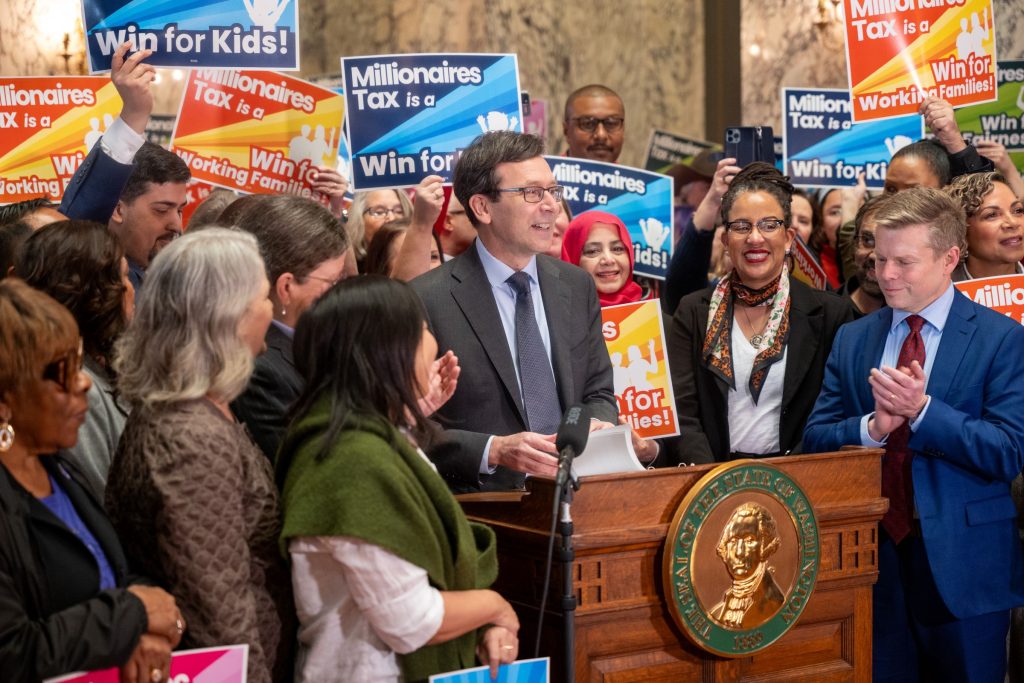
The bill passed the full Senate on a 27-22 party-line vote Feb. 16 and the House on a 51-46 vote March 10 after a near 25-hour Republican-led marathon debate. The new statewide income tax applies to both residents and nonresidents with Washington-sourced income, hits pass-through entities such as LLCs and S-corps while exempting C-corps, and carried a $1 million standard deduction.




Ferguson described the measure as a historic step to address the state’s regressive tax system.
“It’s been a long journey to get here, but because of the hard work of so many folks, it’s a historic day for Washingtonians,” Ferguson said at Monday’s bill signing adding, “I’m proud to join all of you in making history today.”




The legislation aims to expand the Working Families Tax Credit to 460,000 additional families, fund free breakfast and lunch for every K-12 student, invest more than $300 million in affordable child care, reduce or eliminate the business-and-occupation tax for 138,000 small businesses, and remove the sales tax on baby diapers, over-the-counter drugs and hygiene products.
However, none of this is specifically earmarked in the legislation as all of the revenues less 5% for attorneys are deposited into the General Fund.
Ferguson thanked a broad coalition of supporters including the income tax bill’s prime sponsor Sen. Jamie Pedersen (D–Seattle), House Majority Leader Rep. Joe Fitzgibbon (D–West Seattle) who sponsored a companion bill, and Rep. April Berg (D–Mill Creek) who proposed an amendment to provide free breakfasts and lunches to all students enrolled in Washington public schools
Senator Pedersen called the signing a milestone for fairness.
“This is a historic day for our state. I’m proud to be here today to celebrate the most substantial progressive tax reform in our state’s history,” he said adding, “The millionaire’s tax represents hope and change for people in communities like mine and across the state.”
Fitzgibbon described the bill as more than a tax on millionaires but a comprehensive reform to make the state more affordable.
Small-business owner Terrence Santos, who operates a restaurant on Beacon Hill and recently launched a media company focused on community storytelling, spoke of the daily struggles of slim margins and gig work. He hopes that tax will provide small businesses like his better cash flow to make repairs, upgrades and offer steadier employment, particularly for Black, Indigenous and queer-led organizations.
“With this millionaire’s tax, I have hope,” Santos said. “So many of us who are working 50, 60, 70 hours a week and are still seeing the wealth gap widen… but again, I have hope today.”
Tech executive Bryan Kirschner, who recently cashed out a company acquisition, said he was ready to pay more: “For too long, rich people like me have paid less than we truly do thanks to a tax code skewed our way.”
He dismissed fears from opponents that the wealthy would leave “en masse.” He believes that Washington state stands on the brink of an AI-driven wealth boom and the state is right to capture, with the new income tax, some of this wealth for education, health care and relief for small businesses.
Republicans oppose the income tax throughout the legislative process
Senate Republican Leader John Braun (R-Centralia) called Monday’s bill signing “a dark day in our state’s history.”
“An income tax on anyone in our state will become an income tax on everyone,” Braun wrote in his statement calling on the governor to veto the section of the bill preventing a voter referendum. “We fought this long and hard during the session because we know this tax won’t make living in Washington more affordable, for all the reasons listed in our veto request – including how it will drive job creators and their resources from our state.”
Sen. Nikki Torres (R-Pasco) and assistant Republican leader on the Ways and Means Committee, echoed Braun’s sentiment and called on Gov. Ferguson to “stand with the people of Washington,” who have rejected an income tax at the ballot box 10 previous times.
During the historic near 25-hour marathon House floor debate, Republicans introduced approximately 80 amendments intended to address what they considered concerns about the fairness and constitutionality of SB-6346. Nearly all were rejected by the Democratic majority and among the amendments rejected were:
- A referendum to let voters decide whether Washington should have an income tax.
- Removing the bill’s “emergency clause” so the bill takes effect immediately however it is begin collecting taxes in 2028.
- Fixing the bill’s marriage penalty so married couples wouldn’t be treated worse than single filers.
- Protecting small businesses with pass-through income from being swept into the tax.
- Requiring a vote before the tax could ever expand beyond “millionaires.” to high earners making over $150,000 as proposed in the payroll tax in the 2026 session.
- Protecting retirees by exempting pension income.
- Exempting the income of active-duty military service members.
Sen. Chris Gildon (R-Puyallup) and the Republican leader on the Senate Ways and Means Committee, labeled the income tax “unconstitutional, unlawful, unpopular, unnecessary, unfair and unwise.”
“State government doesn’t have a revenue problem, it has a spending problem,” Gildon said.
House Appropriations Committee Ranking Minority Member Rep. Travis Couture (R-Allyn) in an interview with the Lynnwood argued that the state faces spending issues rather than revenue shortfalls and warned of capital flight already that is already under way.
Couture shared that the only thing binding in the proposed income tax bill is 5% ($175 million) earmarked for attorneys which would be used to hire upwards of 223 Full-time personnel at the Washington State Department of Revenue. He alleged this is equivalent to when the federal government hired 80,000 IRS agents to go after Americans, implying that the Ferguson administration is laying the groundwork to weaponize the income tax against Washingtonians.
He pointed out that the timing of a 2028 effective date coincides not only with Ferguson’s re-election but also when state union employee collective bargaining agreements are up that same year—a $3 billion compensation on top of an estimated COLA maintenance level of $3 billion to $5 billion over 2029 and 2030. Those obligations, Couture added, came on top of other deferred programs such as the Fair Start for Kids initiative, estimated at $1 billion, and various tax credits and spending pledges written into the tax legislation only as statements of intent.
“And so, we will continue to see multibillion-dollar deficits well into the future,” Couture told the Lynnwood Times.
Couture added that his number one concern, other than it being unconstitutional and capital flight, was that the tax would not remain on millionaires. “It will be a tax on the middle class and the lower middle class in no time,” Couture said.
He further warned that the income tax could expand beyond millionaires to affect more residents, something Sen. Pedersen admitted to during committee when pressed by a Republican colleague.
“My number one concern, other than it being unconstitutional and all the capital flight, is that it won’t remain on millionaires,” Couture said. “It will be a tax on the middle class and the lower middle class, in no time. And that’s what I see when I look at the budget, when I see through the numbers into what’s going on. It’s not sustainable to be [limited to] a millionaire’s tax.”
Critics warn of capital flight
The income tax followed earlier revenue measures, including a capital gains tax enacted in 2021 and estate tax adjustments signed March 24, amid repeated budget shortfalls that reached $2.3 billion in the current biennium.
The bill takes effect immediately upon signing, with collections scheduled to begin in 2029 and generate an estimated $3.5 billion annually from approximately 21,000 filers (or less than 0.3% of residents). Howard Schultz, Starbucks Founder and twice CEO, announced his family’s relocation to Florida after 44 years in Seattle on March 10, the same day the House passed the bill.
Starbucks recently announced plans to open a Nashville corporate office later in 2026 to bolster supply chain operations, relocating some Seattle-based roles, aligning with broader corporate shifts to lower-tax states like Tennessee, which has no state income tax.
Schultz, whose net worth is estimated at approximately $3.5 billion, now joins former Washingtonians Jeff Bezos (net worth ~$200 billion) who moved to Miami in November 2023, and Ken Fisher (net worth ~$13 billion) who moved to Dallas that same year.
Florida Gov Ron DeSantis in December 2025, prior to the bill being formally introduced in the Senate Ways and Means Committee, said that his state has benefitted greatly from capital flight of residents from the Pacific Northwest.
“Washington has already driven taxpayers out due to bad policies,” Gov. Desantis wrote on X. “Enacting an income tax would be counterproductive — states with no income tax have a major advantage over states that do. The inevitable result is that some taxpayers will flee, the appetite for spending will continue, and the income tax will expand to hit people with sub-seven figure incomes. This will further erode the economic base — and the cycle will keep repeating.”
Tax Foundation senior fellow, Jared Walczak, said that the Washington state income tax would create the nation’s highest combined rate for Seattle residents resulting in result in a combined state and local top marginal rate of roughly 18% on wage income and restricted stock.
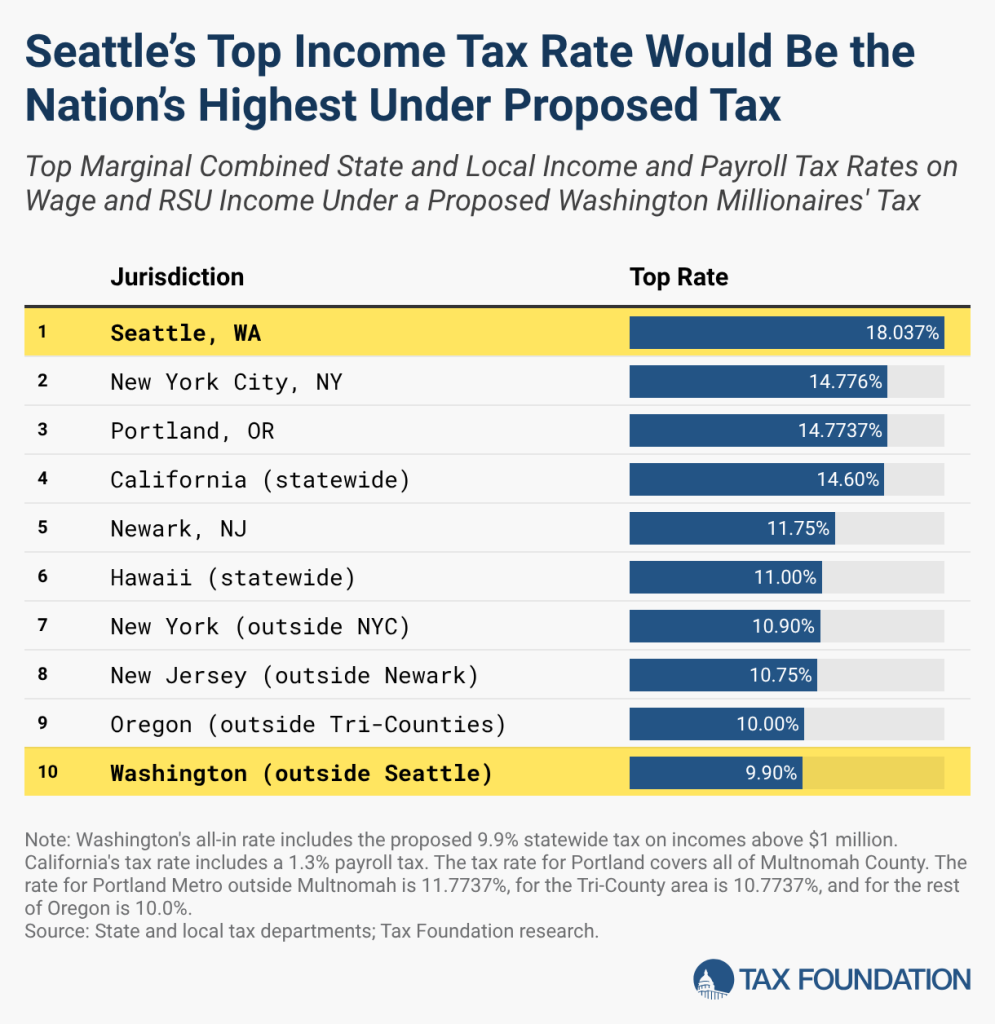
Walczak wrote that the new income tax signed by Gov. Ferguson on Monday for income above $1 million, would stack on top of existing state and local payroll taxes. These include the 0.58% Washington Cares tax, Seattle’s JumpStart Payroll Expense Tax of up to 2.557%, and a 5% Social Housing Tax on income above $1 million. He clarified that although the payroll taxes are remitted by employers this will ultimately be borne by employees through lower wages or slower wage growth. When added to the federal income and Medicaid taxes, the all-in top marginal rate would reach 57.937%.
He added that the income tax would fall largely on small business owners and on tech workers receiving restricted stock units in compensation and particularly detrimental to employees at startups that have yet to go public and whose RSUs could all vest at once.
In a separate analysis, Walczak described a growing divergence in state income tax policy.
Two decades ago, 21 states had top rates between 5% and 7%—today that number is 12. In 2006, 15 states had rates below 5 percent, including those with no tax on wage income; now the number stands at 25. In 2006, only one state had a double-digit top rate, whereas seven does did today, after the passage of the millionaires’ tax. Twenty-three states had reduced their top marginal income tax rates since 2021, while six states and the District of Columbia had raised them.
Walczak wrote that the divergence increased the risk for high-tax states where taxpayers sought to avoid high taxes or to secure jobs and opportunities in lower-tax environments where they had more options than ever before and greater incentives to move. States like Florida and Texas continue to attract new residents, but the growing number of states with competitive income tax rates provided additional options for people which could accelerate outmigration from high-tax states, he added.
The legal fight to repeal the income tax has begun
On the day of the bill signing the Citizen Action Defense Fund (CADF) announced it was preparing to file a lawsuit challenging the income tax’s constitutionality. The group retained former Attorney General Rob McKenna to lead the litigation, which it expected to file within days.
McKenna authored a legal memorandum during the session that outlined constitutional defects.
“Washington’s constitution is clear, and the courts have been equally clear for nearly a century—income is property, and progressive income taxes are unconstitutional under existing law,” McKenna said. “If the State proceeds with the new income tax, it will create a direct conflict with binding precedent and the constitutional protections that safeguard taxpayers. We are preparing to challenge the tax in court.”
Washington’s constitution has long prohibited graduated income taxes, and any income tax is capped universally at 1%. A tax on one must be applied to all persons and not a segregated class.
CADF Executive Director Jackson Maynard said the organization is moving swiftly to protect taxpayers.
“Since lawmakers and the Governor have chosen to ignore both the constitution and decades of settled case law, we will act,” Maynard said. “This lawsuit is about upholding the rule of law and ensuring that Washingtonians are not subjected to an unconstitutional tax scheme.”
Separately, Let’s Go Washington announced it was launching a referendum to repeal the income tax. Founder Brian Heywood said the group filed the referendum because lawmakers and the governor ignored the state constitution.
A referendum allows voters reject a law already passed by the Legislature. Citizens collect signatures to force the law onto the ballot for an up-or-down vote and is considered the “people’s veto” process. However, SB-6346 has a “necessity clause” in the income tax bill which normally blocks a referendum; once this is included, the law takes immediate effect (or on its stated date) and cannot be referred to voters for a repeal vote.
This is a common legislative tactic, though critics argue it’s often abused for non-emergency policies such as the income tax that does not take effect until 2028.
The referendum filed by Let’s Go Washington has a risk of being rejected by Secretary of State’s Office but it can be fought in court arguing that the “necessity clause” is not applicable since the bill takes effect in 2028 and hence can’t be an emergency.
Options to remove the income tax are the approval of an initiative by the people or for Washingtonians to elect state politicians who vow to repeal the income tax.
California Millionaires’ Tax parallels to Washington State
With all this talk about a Millionaires’ Tax in Washington state, California may provide a crystal ball into what may happen here in the Evergreen State. After passing a “Millionaires’ Tax” in 2004, then a “Very-High Earner” tax on those making over $250,000 passed in 2012, now Californians may be hit with a new “Billionaire Tax.”
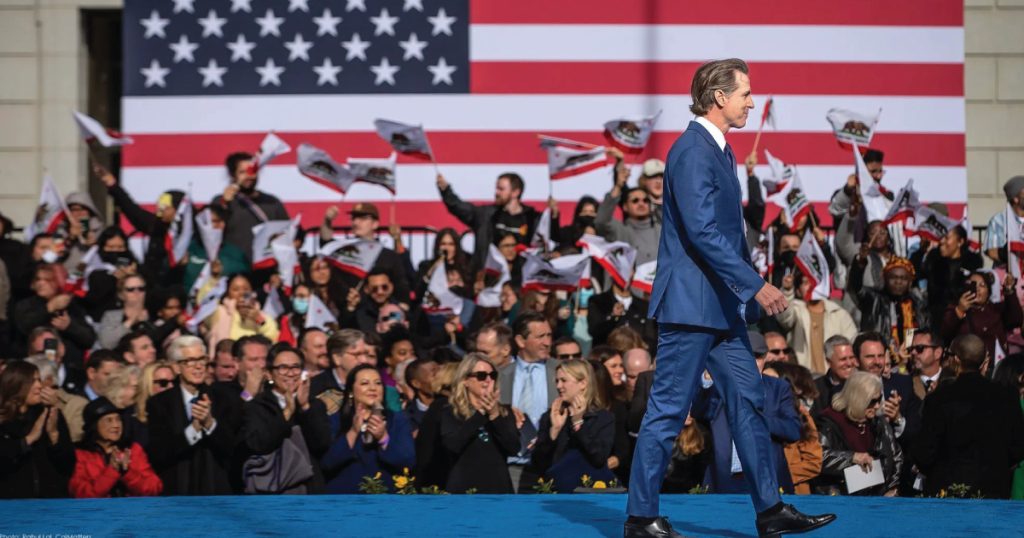
The 2026 Billionaire Tax Act proposes a 5% annual tax on California’s billionaires’ net worth exceeding $1 billion, starting January 1, 2027, to raise $20-40 billion yearly for healthcare, but includes residency rules that taxes former residents for five years post-departure. If the proposed ballot initiative garners the 900,000 signatures needed to qualify, it will be on the November 3, 2026, election ballot.
An initiative from SEIU-UHW targets worldwide assets including illiquid tech stocks with rules presuming full control value for voting shares. If passed, the new tax would apply a tax on ALL property owned, not just real estate but stocks, bonds, furniture, autos, cash, gold, silver – everything. In other words, if a person has a positive net worth but very little cash, the state of California would tax the value of the net worth, resulting in a tax bill to be paid by the taxpayer to the state.
Since 2004 California has had and continues to have a “Millionaires’ Tax” which started at 1% and now 14.3%.
In 2004, California voters approved Proposition 63, known as the Mental Health Services Act, which imposed an additional 1% tax on taxable income exceeding $1 million. This was explicitly described as a “millionaire tax” in economic analyses and was designed to fund mental health services. It took effect in 2005 and remains in place today.
In 2012, Proposition 30, introduced by former Gov. Jerry Brown (D), imposed higher marginal income tax rates for high earners, including a top rate of 13.3% on incomes over $1 million (for single filers; brackets are doubled for joint filers).
Proposition 30 added three new personal income tax (PIT) rates for “very-high-income” earners in California through 2018:
- A 10.3 percent tax bracket for single filers’ taxable income between $250,001 and $300,000 and joint filers’ taxable income between $500,001 and $600,000;
- An 11.3 percent tax bracket for single filers’ taxable income between $300,001 and $500,000 and joint filers’ taxable income between $600,001 and $1 million; and
- A 12.3 percent tax bracket for single filers’ taxable income above $500,000 and joint filers’ taxable income above $1 million.
So, the Millionaires’ Tax now expanded to a “Very-High-Income” Tax starting at $250,001.
This were to sunset in 2018, but was extended through 2030 with the passage of Proposition 55 in 2016. Combined with the 1% Millionaires’ Tax passed in 2004; this resulted in an effective top state income tax rate of 14.3% for those earning over $1 million.
Now that California is facing multi-year structural deficits that balloon to over $22 billion in 2027—the same year the proposed Billionaires’ Tax is to take effect—total net worth is now a viable option to tax.
A New York Post article from January 12, reports that California has lost nearly $700 billion in wealth in the past month due to fears over a proposed “Billionaire Tax” ballot initiative. This exodus reduced the estimated $2 trillion taxable base to now $1.3 trillion, with projections that it could fall below $1 trillion by year’s end.
Recent green-flight from California: Google co-founder Larry Page linked to 45+ LLCs going inactive or relocating, including a $71.9 million Miami mansion purchase; Sergey Brin tied to 15 LLCs moving to Reno, Nevada; In-N-Out heiress Lynsi Snyder shifting to Tennessee with a new corporate office.
Chamath Palihapitiya—a venture capitalist, former Facebook executive, and one of California’s wealthiest residents—described the exodus as a “complete and total unforced error” that could lead to budget shortfalls, lawsuits, and potential tax hikes on the middle class if not addressed.
Governor Newsom now opposes the initiative saying it is a “race to the bottom.”

Author: Mario Lotmore