

EVERETT—The Economic Alliance Snohomish County held a Coffee Chat Tuesday, April 7, on the Communitywide Climate Resiliency Plan, which outlines strategies to help communities prepare for climate-related impacts, such as flooding, extreme heat, and infrastructure strain.
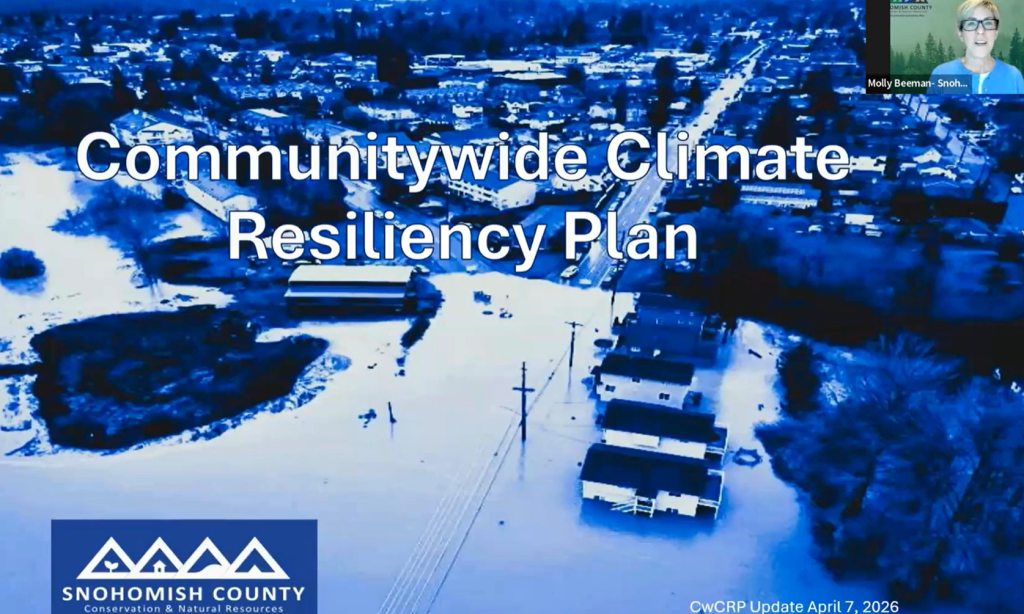
Tuesday’s Coffee Chat provided an opportunity to talk attendees through the plan, understand its structure and priorities, and explore what resilience planning looks like at a countywide scale.


As climate-related disruptions increasingly affect infrastructure, supply chains, and community stability, regional coordination and long-term planning are critical to economic resilience. As such, the discussion primarily focused on key elements of the plan, how it connects to infrastructure readiness and economic stability, and what it means for communities and stakeholders across Snohomish County.
Panelists included Molly Beeman, Energy and Sustainability Manager with Snohomish County, and Eileen Canola, Senior Planner for Snohomish County’s Planning and Development Services.


Together, these two shared contexts on how the plan was developed, the challenges it seeks to address, and how regional partners can engage in building long-term resilience.
The event was moderated by Rachel Morera, Director of Community Engagement for Economic Alliance Snohomish County.
Beeman began by saying without Snohomish County’s Communitywide Climate Resiliency Plan (CwCRP) “we are going to struggle with addressing increasing affects of climate change while managing complexity across systems across partners and our integrated priorities.”
“We will also struggle with fragmented efforts leading to inefficiencies and opportunities. Growing risks can outpace our current approaches and without this plan limited visibility into the collective local, regional, and state progress can lessen our efforts,” said Beeman. “In developing the CwCRP we hope to develop a unified countywide approach, align departments, partners and resources, towards shared outcomes, and improve efficiency, coordination, and decision-making.”
To summarize, the purpose of the CwCRP is to take long-term measures through measurable actions. Why this matters, according to Beeman, is the county is at a point where maintaining the status quo carries more risk than changing does.
“This plan outlines how we reduce exposure while capturing opportunities to build a more resilience, efficient, and effective community,” said Beeman. “A countywide climate resiliency plan that integrates the work of departments and partners isn’t just good practice, it’s essential effective government, risk management, and resource alignment.”
The CWCRP aligns with Washington State’s Climate Resiliency Plan and benefits the county by looking at financial risk and infrastructure protection.
It does this by establishing a vision, setting goals and strategies, taking action, and implementing – anticipating, and mitigating, damage lowering long-term costs.
So far, the county has completed a ‘Strengths and Needs’ assessment, worked with an exhaustive list of internal and external partners to further inform this effort, and ensure the plan aligns with state, regional, and community requirements.
The county looked at actions, both current and future, and is currently working on a final, and refined, draft document – which will be released this Spring for Public Comment and review, followed by another review by planning partners, and then further reviewed by the Planning Commission and County Council.
According to Beeman, currently the biggest risk the county is seeing is wildfire smoke. Second to this is flooding, coming off a record-breaking flooding season this past winter. Storm severity and heat issues are also high on the priority list, and with this comes infrastructure improvements.
Storms specifically can impact utilities (like power outages and wastewater), Eileen Canola added.
“Utilities – power, gas, water and wastewater – are the bangs of our communities. They help us be economically viable and ensure we have healthy and safety and function efficiently. Anything that threatens that, like severe floods, storms, and heat, make our systems very vulnerable,” said Canola. “These are things that can freeze our economy, cut off communities, and halt our public health.”
The county is working on addressing these concerns by mapping climate impacts projections which will be submitted in the 2029 Comprehensive Plan.
This plan also reflects the goals of the Puget Sound Regional Council’s Plan 2050 – which includes updated policies with more focus on Climate Change, environmental justice, and social justice.
The plan also benefits commercial businesses, said Beeman, with efficiency retrofits not only reducing overall GHD emissions, but by saving money on overhead. The plan can also mitigate impacts to the supply chain.
Climate change also impacts tourism, Beeman continued, and during storm or flooding events people can’t get to businesses – further impacting economic development.
When Washington State amended the Growth Management Act, it required the county to use the best available climate science. One of the approved sources is the University of Washington’s Climate Impact group – which does a lot of modeling and forecasting for mid and end of century projections.
When the CwCRP becomes available for public comment from April 6 – May 8, the county encourages the public to get involved in the process and engage in discourse.

Author: Kienan Briscoe