

LYNNWOOD — Nearly three dozen parents, students and district employees urged the Edmonds School District (ESD) Board Tuesday to abandon plans for a 7:20 a.m. start at 12 elementary schools, arguing the change would deprive young children of sleep, expose them to predawn darkness at bus stops and shift an inequitable burden onto working and low-income families.
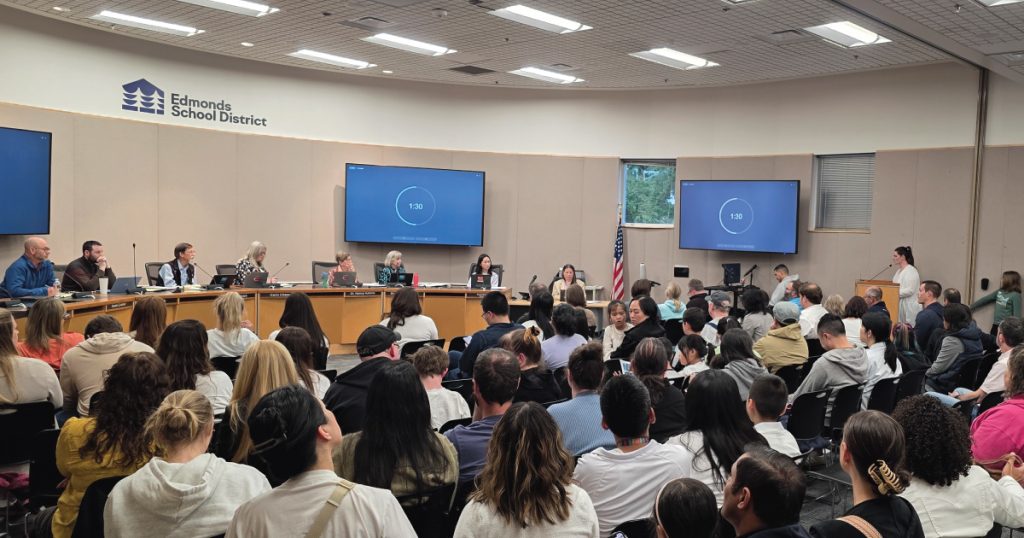
The outcry came during an unusually long public-comment period at the board’s June 9 meeting, where 19 speakers addressed the bell-time proposal in addition to 14 written comments on the issue. All opposed moving elementary start times 85 minutes earlier while expressing support for later starts for middle and high school students. The board did not respond during the session, consistent with its policy.



The district announced the schedule changes on June 2, saying they will take effect in the 2027-28 school year after two years of work by a joint Start and End Times Task Force. No changes will occur in 2026-27, giving administrators an extra year to refine bus routes, coordinate with childcare providers and evaluate impacts on after-school activities.
According to ESD, “a growing body of scientific research” on adolescent sleep cycles shows that teenagers’ natural circadian rhythms make it hard for them to fall asleep early enough for current early school time starts. Later secondary starts, officials said, have been linked to better attendance, alertness, academic performance and mental health.




The proposal to be implemented starting September of 2027 is for high schools to begin at 8:05 a.m. (45 minutes later) and middle schools to begin at 8:45 a.m., 40 minutes later. To facilitate capacity constraints of bus transportation with middle schools, twelve elementaries — Beverly, Cedar Valley, Cedar Way, Chase Lake, College Place, Hilltop, Martha Lake, Meadowdale, Mountlake Terrace, Oak Heights, Terrace Park and Westgate — will shift from 8:45 a.m. to 7:20 a.m., a change of 85 minutes earlier. The remaining elementaries, K-8 schools and early childhood programs stay at 9:25 a.m.


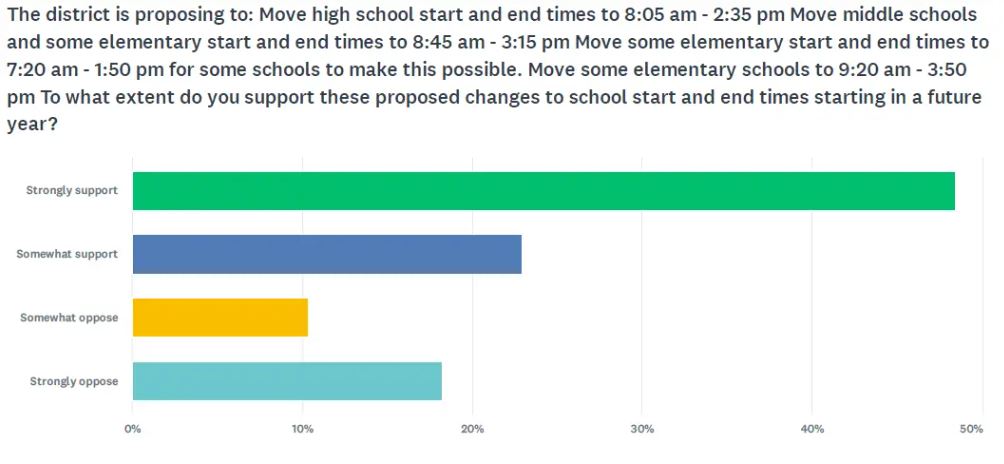
Community surveys conduct by ESD’s Start and End Times Task Force showed strong support for later high school times, with many families wanting the change implemented quickly. A January 2026 survey found roughly 70% of respondents supported or somewhat supported moving start times 85 minutes earlier for elementary students and 40 minutes later for middle and high schoolers overall, and almost 55% preferred starting the changes in the 2026-27 school year. Only 4% selected the 2027-28 timeline the district ultimately chose.


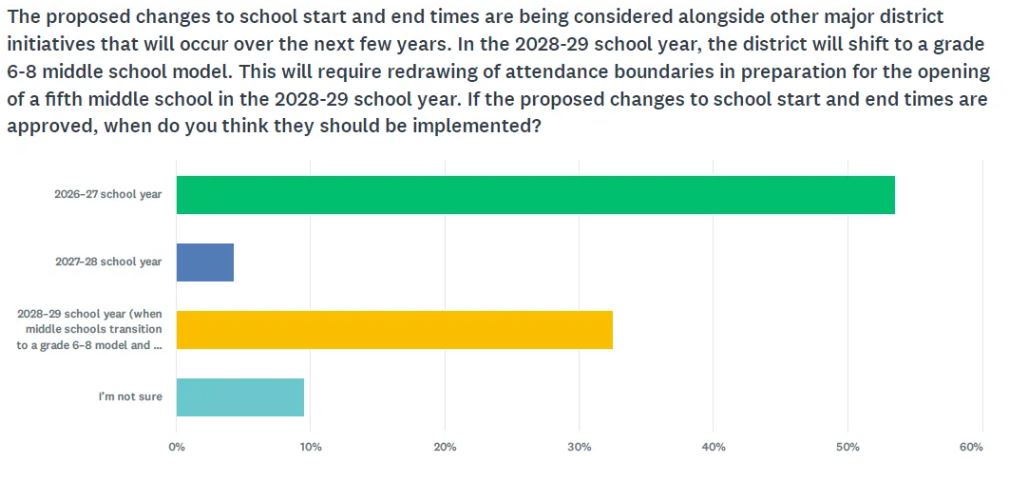
ESD described the extra planning year as a balance between community urgency for adolescent sleep benefits and the need to prepare transportation and support systems.
“Implementing the change in 2027-28 provides an additional year for planning and preparation,” the district wrote. “This includes refining transportation routes, working with childcare providers, evaluating impacts on extracurricular activities, and developing strategies to support students and families across the district. The additional planning time will also allow the district to learn from other school systems that have recently implemented similar changes.”
At the meeting, however, speakers said the plan trades one problem for another by forcing the district’s youngest students into schedules that research shows are developmentally harmful. Many acknowledged the value of later starts for teenagers but insisted the solution should not come at the expense of elementary students.
“According to the National Center for Education Statistics, not a single state in America has an average elementary start time as early as 7:20,” said Tom Kozachinski, a parent of two Edmonds School District students. “The earliest is Mississippi at 7:40.” He noted that 10 of the district’s 14 Title I elementary schools were assigned to the earliest tier, calling it “the opposite of equity.”
Ashley Price, mother of a second-grader at Cedar Way Elementary, described the practical fallout of a 1:50 p.m. dismissal. It would create a four-hour gap before most parents finish work, she said, forcing families into after-care programs that cost $4,500 to $5,750 a year — if spots are even available.
Yijun Chen, who launched an online petition that as of June 10 has collected more than 1,700 signatures in seven days, shared that the district hasn’t produced any survey results supporting a 7:20 a.m. start time for elementary students.
“So we looked at how the surveys were conducted by the district before and we found that we asked ‘Do you support a 7:20 start for your elementary kid?’ We looked hard for evidence that justifies a 7:20 start and we couldn’t find it. The district hasn’t shown us. And the studies we found tested 8:00 a.m. Instead of 7:20. So let’s be honest, 7:20 is a bus routing decision. Not anything we know about our children. To solve these constraints, we’re putting our youngest and most vulnerable kids in the dark, at the bus stop, sleep deprived, at the risk of their safety and elementary harms,” said Chen.
Jolie Leong, a parent with a child at Terrace Park Elementary, during her three-minute public comment shared that the districts own Spring 2025 survey, which drew more than 3,100 responses broadly opposed to the 7:20 elementary start.

Several speakers challenged the task force’s use of researched data to justify early start times for elementary students.
Anna, a Westgate Elementary parent, said the two elementary-focused studies cited by the committee actually showed harm under far milder start-time conditions than Edmonds is proposing. According to Anna, a Denver study found daily sleep loss even with an 8 a.m. start, with another study showing fifth graders losing 45 minutes of sleep per night and nearly four hours per week when start times moved earlier by an average of just 27 minutes.
Multiple parents described kindergartners waiting at bus stops as early as 6:30 a.m. in the Pacific Northwest’s rainy, unlit winter mornings, in neighborhoods without sidewalks or streetlights as a major safety concern.
Equity and family finances threaded through nearly every comment with speakers sharing that low-income and Latino families, many in Title I schools, would face the heaviest burden to the earlier start times. Anna Alcazar, PTO president at Mountlake Terrace Elementary, read letters from families who work long shifts or cannot afford extra childcare.
“Their silence should not be mistaken for agreement,” said Alcazar.
Tandy Lucas, parent of a neurodivergent kindergartner at Westgate, said earlier wake times compress already fragile morning routines, increasing dysregulation that follows children into the classroom. Mika Winskill, a middle school counselor and mother of a first-grader, warned that rushed, sleep-deprived elementary students would be harder for teachers and after-care providers to support.
Commenters pressed the ESD Board to consider specific alternatives. Several urged partnerships with Community Transit so high school students could use free youth passes, freeing buses for younger children. Others called for adding more buses or funding rather than compressing routes, creating optional flex periods or homeroom for older students, shifting the entire district day later if possible, or even developing a funded childcare mitigation plan.
Speakers also demanded for the Board what criteria placed 71% of Title I schools in the earliest tier, whether a comprehensive childcare and safety plan exists, why ESD would adopt an elementary start earlier than any neighboring school district or the national average, and whether every transportation alternative had been exhausted. Several commenters requested a formal risk analysis on childcare costs, family stress and socioeconomic impacts, and a new survey that includes a “no 7:20 a.m.” option.
The American Academy of Pediatrics recommends middle and high schools start no earlier than 8:30 a.m., due to circadian shifts that cause chronic sleep loss with early starts. A 2016 systematic review by Wheaton and colleagues found later starts increase weeknight sleep, improve attendance, reduce in-class sleepiness and are linked to better grades and fewer car crashes. A 2022 meta-analysis in Pediatrics associated 8:30 a.m. or later starts with longer sleep, less negative mood and better developmental outcomes across health domains.
Results on academics are more mixed, with some large reviews describing modest or inconsistent gains in grades and test scores. One 2024 study found initial improvements in sleep and reduced substance use faded after a year without additional supports such as sleep education. For elementary students, a 2022 American Educational Research Association study found no discernible negative outcomes from modestly earlier starts, noting younger children’s more flexible sleep cycles.
The task force reviewed some of the aforementioned sources, yet parents at the meeting argued that the elementary studies examined by ESD were far less extreme shifts than the 85-minute change proposed.
Implementation remains set for 2027-28, and ESD Board have said they will continue to accept feedback from the public on the earlier start times.
Speakers during the two-hours of public comment related to early start times were: Tom Kozachinski, Elizabeth Steele, Ashley Price, Andy Gordon, Hannah Meyer, Jolie Leong, Tobias, Joe Bowen, Heather Lui, Yijun Chen, Mika Winskill, Anna, Anna Reos-Varhat, Anna Alcazar, Emily DiPerna, Jean (third-grader), Alekia Dali, Tandy Lucas, Mikael, and Megan Lind.

Author: Mario Lotmore