

LYNNWOOD—The Lynnwood City Council received an update from local public safety nonprofit ACCESS Project, and were briefed on potential water rate hikes at their Work Session on Monday, July 6.
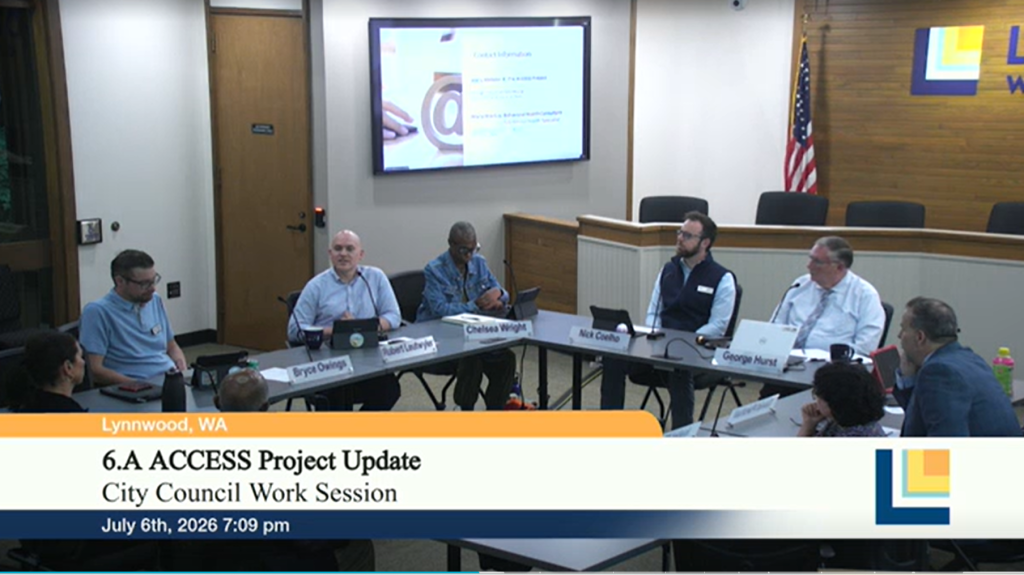
ACCESS Project Update
To kick off Monday’s meeting, ACCESS Project Founder Wally Webster II gave a general update on the status of his nonprofit, whose first major funding source was the City of Lynnwood.
ACCESS Project stands for Association for Collective Community Engagement on Safety and Security. The nonprofit is dedicated to empowering youth and young adults by providing access to supportive services, health and wellness programs, mentorship, and positive community connections.



The purpose is to identify youth experiencing behavioral and emotional challenges and connect them to the right support or program they need, before those challenges escalate into violence, self-harm, school disengagement, or justice system involvement.

It does this through partnerships with schools, law enforcement, and community organizations to provide early intervention, mentorship, wellness-based programming, and positive community connection.

The ACCESS Project serves as a referral and navigation hub for youths between the ages of 13 and 17, primarily through a three-pronged process beginning with referrals, carrying on through an extensive intake process, and lastly connecting youth to services and support.
Since the ACCESS Project’s inception, it has rolled out three major programs: Cops vs. Youth Basketball (which has now expanded to volleyball), Peer Mediation Training, and referrals (both law enforcement referrals and threat assessment referrals).
In 2025 through the first half of 2026, the nonprofit worked with seven high schools, and four middle schools, to train 168 students and a total of 27 school advisors. In its first year (from 2024 through 2025) it had been implemented into four high schools, training 60 students.
A key partner in this work has been the Volunteers of America Western Washington (VOAWW), specifically its Dispute Resolution Center who provided professional training in mediation skills and techniques.
In many ways, Webster said the ACCESS Project was formed in the wake of the School Resource Officer program being discontinued, and a rise of youth violence in the region. According to Lynnwood Police Department data, case reports increased from 49 to 91 (85.71%) since the School Resource Officer program was discontinued. Arrests jumped 100%, from 7 to 14.
“There is a strong statistical indication that those SROs made a difference. Many people stepped away from the SROs believing, without data, that they were the gateway to the penitentiary and the criminal justice system but today I have not had anyone show us data that supports that perception. I can show you data where the SROs did make a difference,” said Webster II.
In 2020 the Edmonds School District Board of Directors terminated the SRO program.
ACCESS Project is funded by Snohomish County, Rick Steves, the White Horse Foundation, Verdant Health Commission, among others.
Marie MacCoy, licensed Clinical Social Worker with ACCESS Project, appeared alongside Webster II to advocate the implementation of a redesigned and reimagined SRO program that would:
- Help protect students and staff in times of threat, crises, or emergency
- Build constructive and trusted relationships between students and law enforcement
- Support prevention, early intervention, and deescalation
- Partner with counselors, administrators, behavioral health professionals, and community organizations
Research estimates each homicide cost the taxpayer $2.1 million. Since 2022, South County has experienced eight homicides at an estimated cost of $16.8 Million. This does not include the cost of the perpetrators or the victim’s families.
Water Utility Purchase Rates
Lynnwood Public Works Director Jared Bond briefed council on the status of a proposed increase in the cost of water purchase proposed by the City of Everett.
The water comes from the Spada Lake Reservoir, just directly north of Gold Bar, which provides drinking water to 75% of the county, is one of the wettest water sheds in the continental United States and holds about 4.5 billion gallons of water.
The Lynnwood Water Utility purchases its water from Alderwood Water and Wastewater District (AWWD), who purchases it from the City of Everett. The City of Everett has proposed to raise their wholesale water rate from $1.0033 per CCF (2024 rate) to $2.4403 (2026 rate).
This is an increase of 143% and includes a 12% utilities tax that will go into Everett’s General Fund, and not to support their Water Utility.
AWWD is currently contesting this increase and continues to pay at the 2024 rate until this is resolved.
Currently, Lynnwood residents pay an average of $68.66 bimonthly for water. With an added 10% Utility Tax hike this sits at $75.53. The potential rate increase could increase the bimonthly bill to $83.56, on average, making it a bimonthly cost of $91.92 with the 10% Utility Tax increase.
Including sewer and storm, this would be an average $356.10 bimonthly bill for users, compared to the current rate of approximately $372.49 bimonthly.
However, currently Lynnwood residents still pay the 2024 rate as the rate increases are currently being contested. If “Everett gets its way,” as Bond put it, and arbitration does not go on the favor of Lynnwood or Alderwood Water District, the City of Lynnwood would need to pay a $1.7 million true-up in April 2027.
Currently Public Works has $1.5 million set aside for this potential true-up, though Bond says the longer arbitration continues the higher the true-up will be.
The City of Everett’s reasoning for increasing their rates is to fund an $80 million project that would replace its current underground reservoir with two new concrete 8 million gallon, and 15 million gallons, reservoirs.
Lynnwood Mayor George Hurst shared that he, and several other Mayors, had a meeting with Everett Mayor Cassie Franklin to discuss retaining the current water rates but, according to Hurst, the meeting was unsuccessful.
Regional Complex Funding Resolution
Council was scheduled to discuss a resolution that would that the Everett City Council seek alternative funding sources for the proposed downtown Everett professional baseball stadium rather than funding associated with the State Youth Athletic Facility Account.
However, there was little council interest in pursuing the matter, so Council President Nick Coelho squashed it from the agenda.
AWC Annual Conference
Monisha Harrell, Assistant City Administrator, and Council President Nick Coelho concluded Monday’s meeting by sharing their biggest takeaways from the 2026 Association of Washington Cities (AWC) Conference in Tacoma from June 22 through June 25.
These included indigent defense, artificial intelligence, permit streamlining, and annexation, among other things.

Author: Kienan Briscoe