


EVERETT—Mill Creek Mayor Brian Holtzclaw addressed the South County Fire Board of Commissioners Wednesday demanding they make do on their promise and return the Station 76 Medic to Mill Creek after being transferred to Martha Lake without proper due process and despite contractual obligation.

In 2021 the City was faced with a tough decision to either extend its contract with SRFR (Snohomish Regional Fire and Rescue) or look for other fire service options.


As Holtzclaw noted, fire service costs for residents would jump in every option but, due to negotiations with SRFR falling through and promising conversations with South County, the city ultimately decided an annex to South County was best for residents and urged their voters to support it.
“A major factor in that decision was Fire Station 76’s staffing level,” said Mayor Holtzclaw. “That was an important factor in our discussions with the district…that was the promise to voters if annexation was approved by their vote.”



Holtzclaw emphasized that he has no gripes with South County Fire’s data-driven decision to transfer out paramedic services but added that he, and City staff, were never presented with those justifications prior to making a decision.

“We were blindsided by this decision,” said Holtzclaw. “I have some serious concerns as to the operational justifications for this change but the operational justifications don’t matter. What matters here is the promise to the residents of Mill Creek that if they approved the annexation the staffing levels at Fire Station 76 would continue. They agreed to that with 76% of the vote. What have they gotten since then? They got a levy lid lift, they got an increase in the benefit charge, and now they’re having their staffing levels reduced from what they were promised.”
South County Fire Chief Bob Eastman, accompanied with Assistant Fire Chiefs, did brief the Mill Creek City Council on its redeployment plan prior to the meeting on July 28, but Mayor Holtzclaw, and City Council members, interpreted this brief as a presentation on data rather than a plan of action.
Holtzclaw continued that Mill Creek is the only city in South County Fire’s deployment plan where service levels are being reduced. He also noted that the City was completely left in the dark regarding data, that a decision to transfer service was even being considered, or virtually any communication whatsoever.
Some Mill Creek residents grew critical of the fire authority’s communications division regarding this topic.
When the Lynnwood Times reached out to South County Fire Public Information Officer Christie Veley to address these resident’s concerns, and why a press release regarding the staffing changes wasn’t published, she said that she didn’t believe a press release would have solved the issue but she did admit there should have been better communication with elected officials at the city of Mill Creek.
“Things happened really quickly after board approval. It [The deployment plan] was not the sort of thing that could have been voter approved. There was a missing piece of communication and people felt like this was hidden from them. I can certainly understand that looking back,” said Veley. “I don’t think a press release would have solved that. I think it needs a more robust communication strategy, though we do realize the importance of communicating with all stakeholders.”
Several other public comments from residents on Wednesday echoed Mayor Holtzclaw’s concerns, with many stating that they voted for the annex with the understanding staffing levels would remain the same.
Holtzclaw concluded his remarks Wednesday mentioning there could be legal grounds seeing as the RFA did not amend its agreement prior to breaking its contract.
That agreement states: “Effective on the annexation date, the RFA will initially adopt the City of Mill Creek’s standard of coverage document for the City’s jurisdictional boundary area. As such, levels of service, standards of coverage, development standards, and customer expectations, on the annexation date shall remain unaffected.”
The standard of coverage is defined in interlocal agreement documents, stating: the Station “shall remain fully staffed 24-hours a day, seven days a week, with five personnel, one of whom shall be a paramedic.” The interlocal agreement further states that these conditions are subject to amendment only by a majority vote by the RFA governing board…but that never happened.
“Implementing this change is a clear violation of the RFA agreement,” said Mayor Holtzclaw.
In conclusion Mayor Holtzclaw stated that the “good will” of the fire authority’s decision-making process was left “hanging by a thread” with how it handled the situation.
Behind the South County Board were three core values fashioned to the wall: integrity, trust, and respect. These core values were challenged by public commenter Peter Connelly Wednesday who called South County Fire a “paramilitary organization that has become too powerful and demands too much of our tax dollars.”
In 2011 Mill Creek residents approved an EMS levy which would increase the cost of fire and emergency services. Part of the justification for that increase in cost to services was to hire a paramedic position for Station 76 which Mayor Holtzclaw added is just one more reason why the decision to transfer the position felt like a betrayal.
Prior to Mayor Holtzclaw’s comments, the South County Fire Board of Commissioners addressed these concerns with a presentation by Assistant Fire Chief Shaughn Maxwell who first admitted the fire authority could have done a better job at communicating this transfer.
“With a lot of this we definitely could have done a better job at communicating and we’ve learned something from that,” said Maxwell. “But to dive into another thing I think the fire services really failed to communicate is how EMS service is delivered to the fire service.”
He continued to justify the decision based on data-driven response and call data, also noting that Mill Creek is just as equipped with medical services as it was before, if not more so.
Maxwell noted that every firefighter with South County is state-certified Emergency Medical Technicians and are fully equipped to deliver medical care in the field. It’s important to note, said Maxwell, that most medical emergency situations require care within the first five minutes of any given situation and firefighters begin to administer life-saving efforts before paramedics arrive. These include basic life support, high performance CPR, defibrillator use, and tourniquets to stop hemorrhaging. They can also administer medications such as Narcan, Epinephrine, Albuterol (for asthma), Nitroglycerin, and Aspirin (for heart issues).
“I’ve read every message, I’ve read every email, and I’ve tried to look for the patterns of concern,” said Maxwell. “We can do better on communication and we endeavor to do so.”
Maxwell continued that people often think of firefighters and EMTs responding out of a specific fire station but the engines and transport vehicles they operate are mobile and can respond to calls throughout the region. With AVL (Automatic Vehicle Location) technology South County pings the location of the emergency and dispatches the closest available.
“Care doesn’t start when paramedics arrive. Care starts when those three emergency medical technicians and the fire truck arrive and start care,” said Maxwell. “And a lot of times that care would be the same care that a paramedic would be doing in those first few minutes.”
When representatives of South County Fire attended the Mill Creek City Council meeting last week they received three calls for service, representing that one fire station is “not enough,” Maxwell added; “it requires a system.”
In the Mill Creek quadrant, which encompasses Stations 21, 11, 76, 12, and 13, Maxwell said there are actually more total paramedics (and ambulances) now than there was before South County implemented its deployment changes – if you consider to the total area of coverage, not specific to the Mill Creek station (76).
Prior to the deployment changes, the quadrant had 26 firefighters during the day, 24 firefighters at night, five paramedics (plus MSO), and three ambulances (consisting of two medics and one aid). After the deployment changes there are 25 firefighters during the day and night, seven paramedics, and four ambulances day and night (consisting of two medics and two aids).
Mill Creek’s Station 76 is located in the southeast corner of the city meaning fire and medical services would struggle getting to portions of the city in a timely manner, Maxwell added, but with the new system station 12 is a closer response to northeast portions of the city, Station 11 northwest, and station 13 southeast. Additionally, station 21 is able to assist 76 in its services in the southwest.
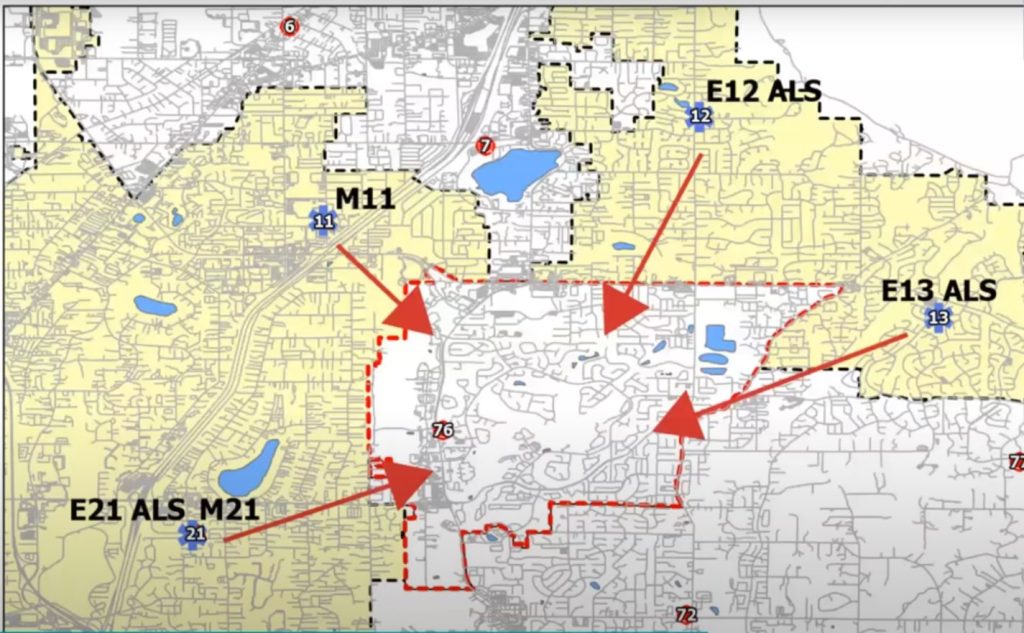
According to South County Fire data, in 2024, Engine 76 was the first to respond to critical calls (for example, when someone stops breathing) a total of 34 times. So far, in 2025, Engine 76 has been dispatched 1,368 times – 34% of which were outside the boundaries of Mill Creek. Medic 76, on the other hand, has been dispatched a total of 1,009 times – 69% of those being outside of the city limits. In other words, the majority of the time Engine 76 responded to calls within the Mill Creek city limits while Medic 76 responded to calls outside the city.
Other data that was considered in South County’s decision to relocate Medic 76 to Martha Lake included international reports which showed that survival rates in areas that utilize a community medic system are drastically higher, South County Fire said. This statement has been supported by National Institute of Health and CDC data.
South County Fire receives monthly data dumps and said they will be adjusting their deployment model according to call reports in the future.
“I don’t think it would be acceptable to, with our growing and changing communities, to not try and change be better,” said Maxwell. “This is us absolutely doing our very best to look at the data and try and do better. And if we’re wrong, we’ll change it. When you look at predictive data, that’s the best you can start with.”
Mayor Holtzclaw, “on behalf of the 22,000 residents of Mill Creek,” said that Maxwell’s presentation undermined the City of Mill Creek’s concerns, cementing the fact that their opposition to the Medic 76 transfer “doesn’t matter.” The only word he could come up with to explain it, he said, is “betrayal.”

Author: Kienan Briscoe




One Response
I believe the term the author wanted was “make good” not “make do”.