

EVERETT—After six years, the Federal Aviation Administration (FAA) has reinstated Boeing’s ability to issue airworthiness certificates for select 737 MAX and 787 airplanes on a limited basis, marking a significant step toward restoring trust in the aerospace giant’s production processes. The reinstatement takes effect starting Monday, September 29.
The FAA’s decision, driven by rigorous safety reviews according to the agency, signals confidence in Boeing’s improved quality control and could pave the way for a potential increase in 737 MAX production, currently capped at 38 aircraft per month, to 42 by year-end, pending further approval.



Under the FAA’s Organization Designation Authorization (ODA) program, Boeing is authorized to perform certain certification functions, such as issuing airworthiness certificates, which confirm an aircraft’s safety for operation. The FAA renewed Boeing’s ODA for three years, effective June 1, 2025, following a thorough review of its production quality.
The reinstatement now allows Boeing to issue certificates on alternating weeks with the FAA, enabling FAA inspectors to focus on critical oversight tasks, such as monitoring assembly stages, ensuring compliance with design and engineering standards, and assessing Boeing’s Safety Management System (SMS). This arrangement, says the FAA, benefits both parties—Boeing gains streamlined certification processes, while the FAA can now allocate resources to enhanced surveillance towards a stronger safety culture.




The FAA previously halted Boeing’s ability to issue airworthiness certificates in 2019 for the 737 MAX following the Lion Air Flight 610 and Ethiopian Airlines Flight 302 crashes, which killed 346 people due to faulty Maneuvering Characteristics Augmentation System (MCAS) software triggered by erroneous angle-of-attack sensor data. Similarly, in 2022, the FAA suspended Boeing’s certification authority for the 787 due to production quality issues.


The recent Alaska Airlines Flight 1282 incident on January 5, 2024, further intensified scrutiny when a 737 MAX 9’s cabin door blew off mid-flight due to missing bolts, prompting the FAA to ground 171 similar aircraft for inspections. In response, the FAA mandated a 90-day deadline for Boeing to submit a comprehensive “Product Safety and Quality Plan,” which was accepted on May 30, 2024, focusing on supplier oversight and manufacturing improvements.


The Alaska Airlines incident led to significant leadership changes, with Boeing’s President and CEO Dave Calhoun and BCA president stepping down, and Robert “Kelly” Ortberg appointed as CEO on August 8, 2024. The FAA also capped Boeing’s 737 MAX production at 38 aircraft per month in January 2024, a limit still in place as of September 2025. Boeing aims to increase output to 42 aircraft per month by year-end, pending FAA approval, with production stabilized at 456 planes annually since June 2025.

On March 13, 2025, U.S. Department of Transportation Secretary Sean Duffy toured Boeing’s Renton facility, emphasizing that production caps would remain until Boeing demonstrates sustained safety progress.
“My message to Boeing during our recent visit was one of tough love,” Secretary Duffy said during his visit. “Acting Administrator Chris Rocheleau and I have made clear that the FAA will continue to cap Boeing’s production of the 737 MAX until they can demonstrate sustainable progress on safety. Only then can they regain the trust of the American people.”
Despite challenges, including a 2024 labor strike, Boeing reported a robust second-quarter performance in 2025, with revenue rising 35% to $22.7 billion and a reduced GAAP loss per share of $0.92, down from $2.33 the previous year. Operating cash flow turned positive at $227 million, and free cash flow improved to a negative $200 million from a $4.3 billion outflow.
For the first half of 2025, revenue climbed 26% to $42.2 billion, with positive GAAP earnings from operations of $285 million, compared to a $1.2 billion loss in 2024.
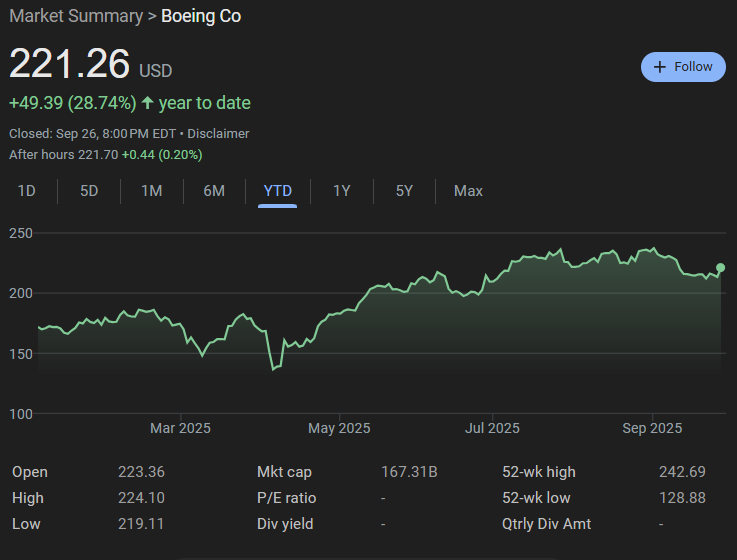
Boeing’s backlog grew to $619 billion, reflecting strong demand for over 5,900 commercial airplanes.
The FAA’s reinstatement of Boeing’s ability to issue airworthiness certificates, coupled with recent financial gains appear to be demonstrating stability to Boeing’s commercial airplane production, aligning with the aerospace juggernaut’s goal to regain fully both regulatory and public trust.

Author: Mario Lotmore