

Brier/Bothell—Snohomish County Public Works cut the ribbon on its new Swamp Creek Bridge 503 project in unincorporated land between the cities of Brier and Bothell, on Wednesday, November 12. The new bridge widens lanes, adds sidewalks, lifts weight restrictions, and takes into consideration environmental conservation and stewardship.
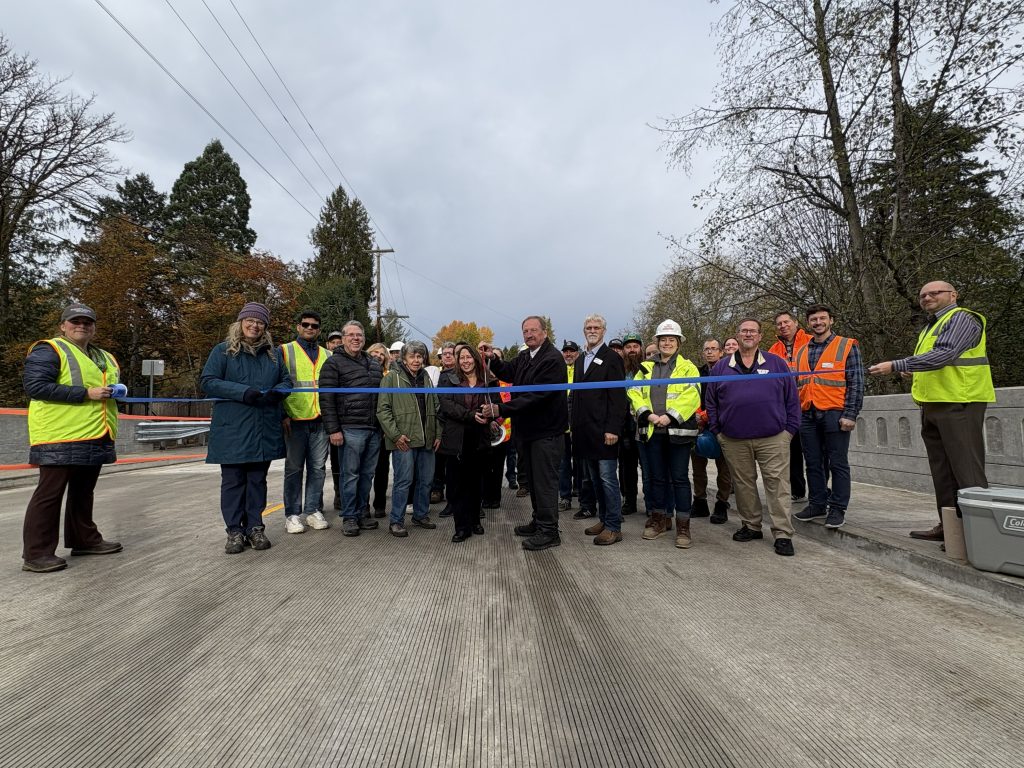
Originally built in 1960, the old Swamp Creek Bridge (located 400 feet north of the 228th Street Southwest intersection) was weight restricted and had narrow lanes and no shoulders or sidewalks. The new bridge is much better suited to accommodate the roughly 10,000 commuters who use the bridge daily in addition to removing in-water supports for improved water flow and stream habitat.





The ribbon cutting ceremony kickstarted with a land acknowledgement read by Public Works Director Kelly Snyder who said the bridge replacement’s “success is in the numbers.”
Snohomish County Public Works replaced nearly 60 bridges in the last 22 years with three of those bridges being completed in 2025 alone, including Jordan Creek Bridge and the restoring/repainting of the historic Red Bridge along the scenic route of the Mountain Loop Highway.




The Swamp Creek bridge project is the second major investment along Locust Way in the last two years. The Larch Way and Logan Road improvement was completed in 2024, just a mile north of Swamp Creek, which added a roundabout to improve traffic flow and pedestrian safety.



“Because of these projects, we are better prepared to meet the multi-modal needs which means more than cars – we need to make sure pedestrians and bicyclists are safe when they come through this corridor – and these will be benefits for many years to come,” said Snyder.


The original construction timeline of the Swamp Creek Bridge overlapped with the Larch Way/Logan Road improvement project and was originally scheduled to be completed last year. However, the County recognized that having two major road closures would severely impact commuters before pushing it back to 2025.
Snohomish County Executive Dave Somers followed Director Snyder with a few words of his own.
“This is the kind of project that really speaks to me; it’s great for people, it’s great for the environment, and it’s great for fish,” said Somers. “I just want to thank everyone who made this happen. As this area grows, improving and replacing this infrastructure is really important for our overall quality of life.”
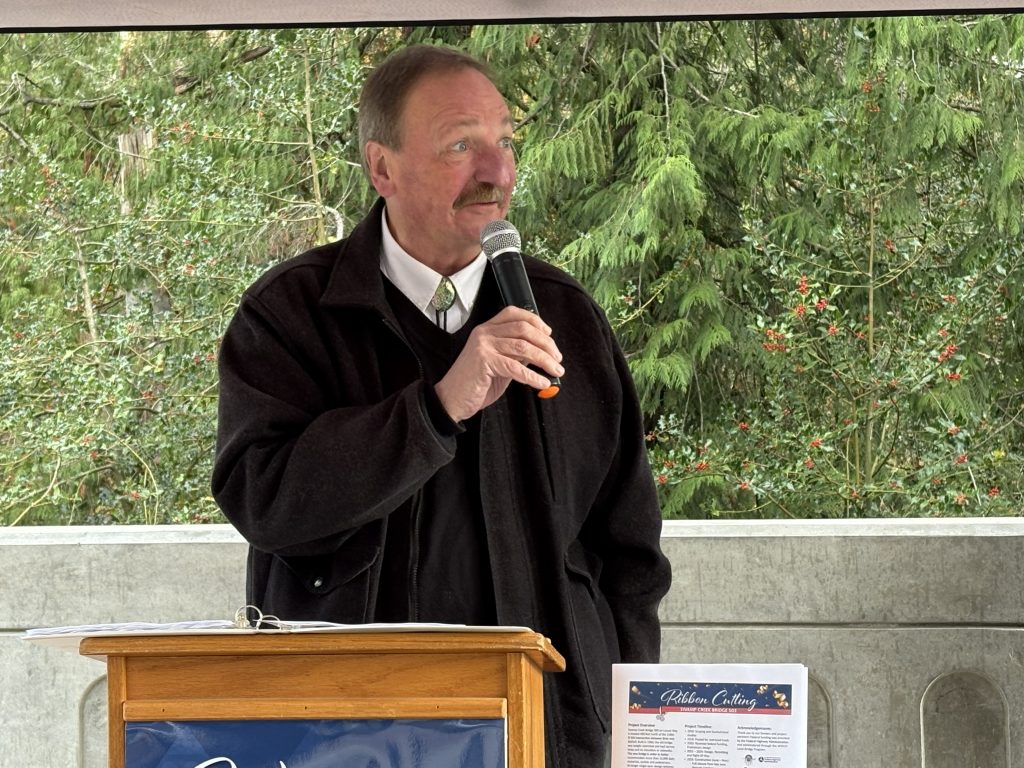
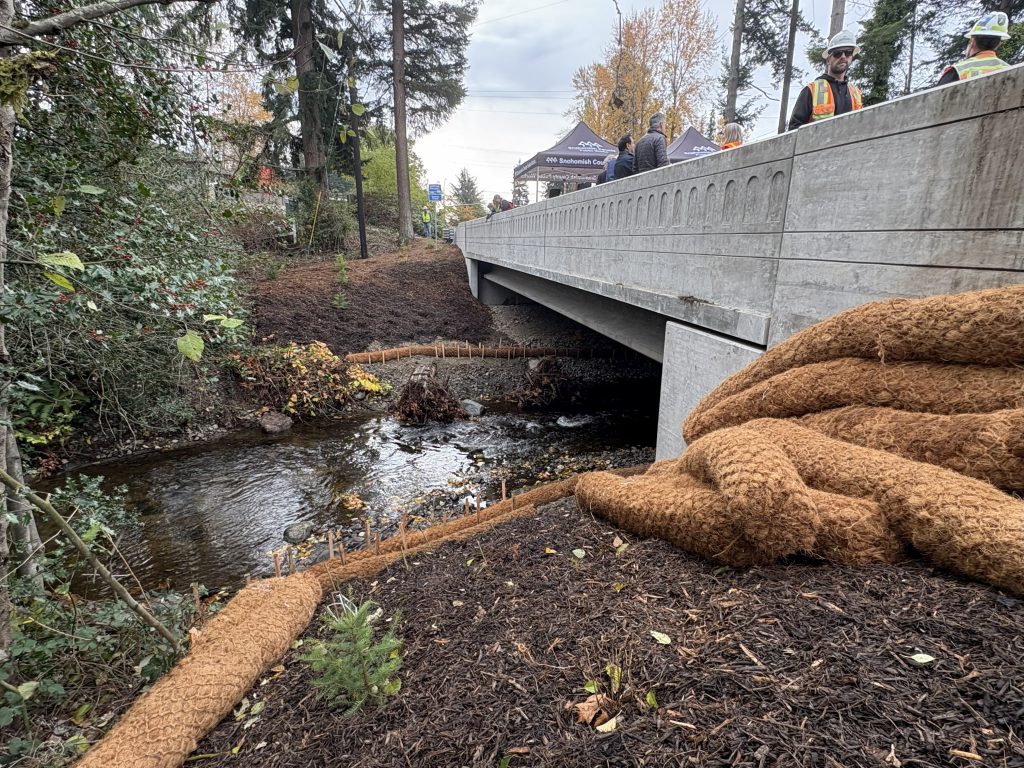
As a former Fisheries Biologist for the Tulalip Tribes, Somers immediately recognized the woody debris in the stream for fish, the water quality improvements, and the pervious concrete which allows water to run through to the streams and soil beneath. One issue Somers had, however, was that the retention pond looked like a “giant O”, which he took as a symbol for Washington’s neighbor state of Oregon.
“We gotta get that fixed right away,” Somers joked.
Public Works partnered with the Muckleshoot Indian Tribe on the stream restoration and design. When reading the land acknowledgement at events like these, Director Snyder added, it’s important the Public Works Department hears from local tribes, especially on environmental efforts.
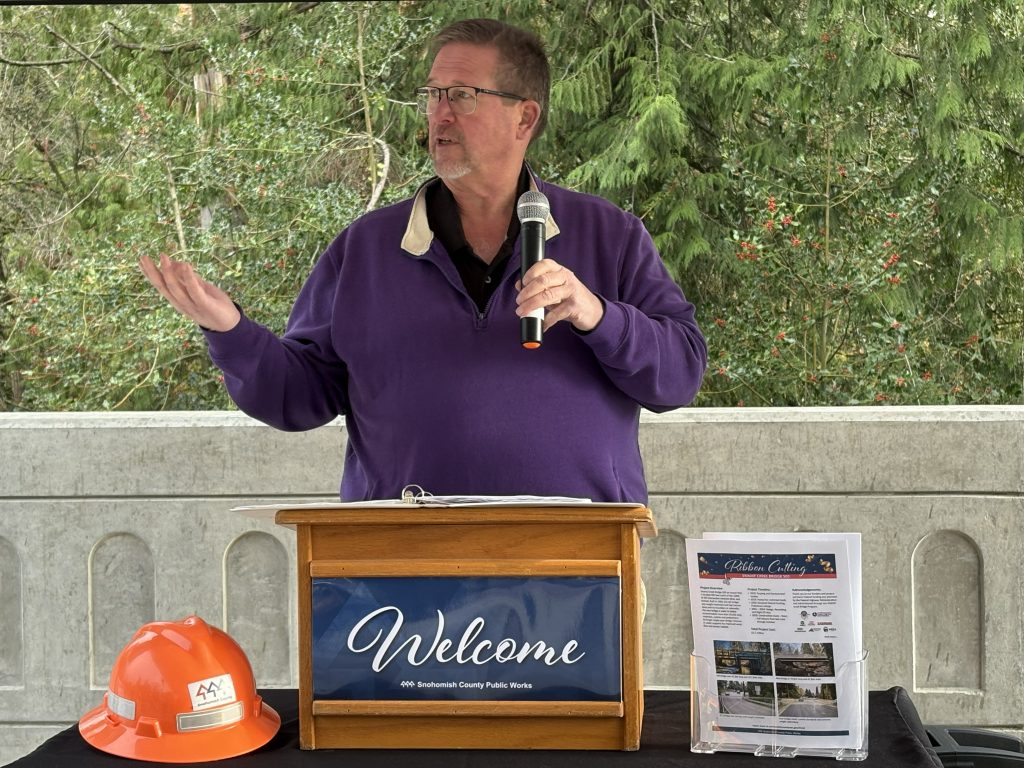
Snohomish County Public Works Deputy Director and County Engineer Doug McCormick followed Executive Somers with a “few fun facts” about Bridge 503 stating there is approximately 150,000 pounds of steel in the structure, the bridge sits on nearly 250 lineal feet of four-foot diameter shafts drilled into the ground, and over a million pounds of concrete that was placed in the substructure below.
“This bridge will be around for a long time with all of that steel and concrete,” said McCormick. “And that’s good because that’s a lot of longevity that will be serving the community for a long time.”

The Bridge’s lead engineer, Nolan Anderson, later informed the Lynnwood Times this exact lifespan could reach a hundred years into the future with proper maintenance.
Nolan also added that the old bridge was a two-span bridge with in-stream creosote timber pilings that would often leach contaminates into the stream. With the new, single-span bridge, it creates a much wider, natural, channel with a 70-foot opening as opposed to a 40-foot opening.
The old bridge was 41 feet long and 22.5 feet wide. The new bridge is 70 feet long and 47 feet wide.
“It’s a huge improvement for fish and other wildlife like deer,” Anderson told the Lynnwood Times. “This is also one of the first projects in the county where we’ve put woody debris under the bridge which is something our partners at the tribes have been asking us to do, so we’re testing that out to see how well that works. The woody debris really helps mimic the natural habitat.”
Doug McCormick added that the Public Works team understands the construction of Bridge 503 has inconvenienced commuters and residents alike and expressed his sincere appreciation, on behalf of the Department, for their patience.
In attendance at Wednesday morning’s ceremony was State Representative Davina Duerr, Brier City Councilman Martin Krienke, and representatives from Congresswoman Suzan DelBene’s Office.
“This bridge is a very vital connection for the community but to see the work done to increase natural habitat and mobility, it’s just a win for everybody,” State Representative Davina Duerr told the Lynnwood Times.
Councilman Krienke informed the Lynnwood Times that he picked up bicycle riding over the summer and takes the Swamp Creek Bridge frequently during one of his routes. He added that the widened lanes, sidewalks, and overall increased visibility is an overall win for the community.
The $5.7 million Swamp Creek bridge was constructed using federal dollars (via the Federal Highway Administration) combined with a local road tax and state money (through the WSDOT’s Local Bridge Program).
Alderwood Wastewater District was also a key partner in facilitating the utilities underneath the structure. Alderwood Wastewater District, for example, added a new water line under the bridge and fitted the total cost of $400,000 for that.
The only local dollars spent went towards the added sidewalks.
The Swamp Creek Bridge project began in 2018 and secured its federal funding in 2020.
The first step was scoping and geotechnical studies before the county posted a restricted loads notice in 2019. The design phase, permitting and right-of-way, of the project spanned from 2021 through 2024. Construction, led by Johansen Construction Company, took place between June, 2025, through November, 2025, with full closure from late June through October.

Author: Kienan Briscoe