


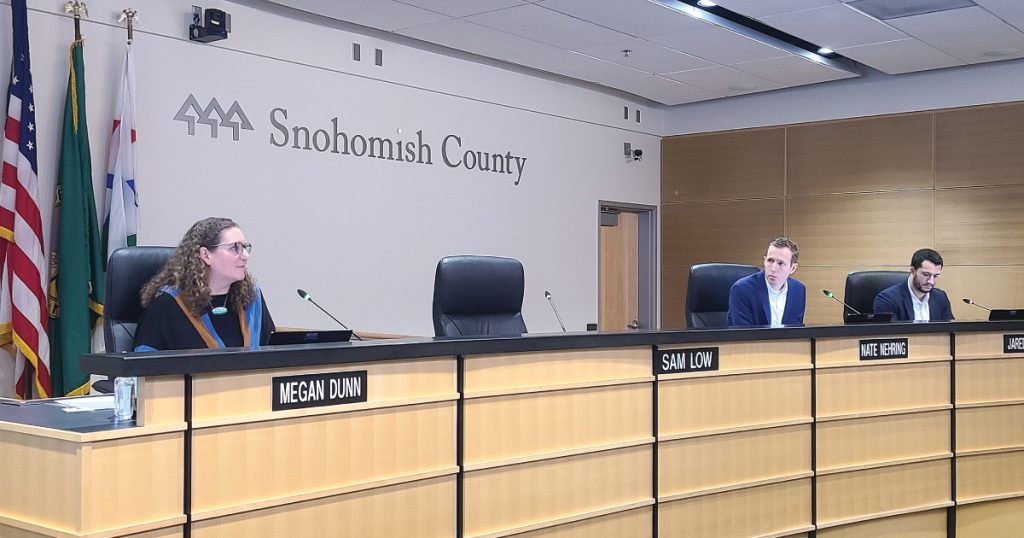
SNOHOMISH COUNTY— The Snohomish County Council unanimously approved a series of motions on January 28, related to service agreements with the Salvation Army and YWCA for its two New Start Centers—a pair of repurposed hotels which the county intend to use for emergency bridge housing for people experiencing homelessness in Snohomish County.
The idea of the New Start Centers is to convert the two hotel buildings into time-limited housing with wraparound services (including support for mental health, employment, substance use treatment, and other basic needs). These are not permanent homes, but transitional sites to help people stabilize, connect to services, and ideally move to longer-term housing.




A total of three substitute motions for each provider agreement were proposed for discussion prior to vote:
- Proposed Substitute 1: Sponsored by Vice Chair Sam Low and Councilmember Nate Nehring, required all agreement extensions to come to Council for approval
- Proposed Substitute 2: Co-sponsored by Chair Megan Dunn and Councilmember Strom Peterson, built upon Proposed Substitute 1 and added a request for evaluation of the referral and eligibility minimum requirements of the agreement and a public presentation recommending changes to those requirements, vacancy rates, and program implementation if necessary.
- Proposed Substitute 3: Sponsored by Councilmember Strom Peterson, to include the language of Proposed Substitutes 1 and 2 and amends the eligibility minimum requirements of applicants to not be deemed ineligible based solely on: (1) a prior conviction of manufacture or distribution of delivery of a controlled substance or; (2) a conviction of a crime of violence as defined by RCW 9.41.010(7) which includes class A felony or an attempt to commit a class A felony, manslaughter in the first and second degree, knowingly forcing, threatening, or coercing another person into unwanted sexual contact, kidnapping in the second degree, arson in the second degree, assault in the second degree, assault of a child in the second degree, extortion in the first degree, burglary in the second degree, residential burglary, and robbery in the second degree.
Discussion centered on Councilman Peterson’s proposal that would relax the eligibility requirements to allow applicants with a conviction of drug manufacturing, delivery or sale within the last five years; or a conviction for a violent crime according to the state statute definition, to be housed in the New Start Centers. The original eligibility requirements were proposed by the awarded providers and vetted by attorneys.



“The idea that somebody who’s doing everything right, has served their time in prison, is now out and putting their life back together, can be rejected from this very critical piece of housing infrastructure solely for that conviction, I think is ill-advised,” Councilman Peterson said.
Peterson described a hypothetical scenario of a young woman who had been trafficked and convicted of drug trafficking who, after serving time in prison, rebuilt her life, achieved recovery, and spent 60 days in a shelter, making her ready for transitional housing in New Start centers. However, she would not qualify for the program because of a four-year-old drug conviction.
“Because of other discrimination and other housing is very difficult for a lot of these folks to find housing and if we want successful reentry, if we want these folks that have served their time and to join back into our communities and back into our society, we have to give them every opportunity for success,” Peterson added. “We are barring them from success.”
Council Vice Chair Low, who in last week’s meeting referred to the projects as “money pits” given the total budget ballooned to $37.7 million as of May 2025—up from the original $20 million allocation—reminded councilmembers of the many people that could have been helped over the last three years with the funds already spent, but have not been due to the prolonged process of refurbishing hotels.
“I’m comfortable with number one or number two [substitute proposals] today,” said Low. “I’m definitely open to number three as we get statistics in over the remainder of this year.”
In 2022 Snohomish County identified two existing hotels that could be repurposed for bridge housing, the Days Inn facility in Everett for $10,823,000 (with about 74 units) and the America’s Best Value Inn in Edmonds for $9,075,000 (with about 55 units)—$155,038 per unit. The county moved forward with these purchases under American Rescue Plan Act (ARPA) funds and the county’s Affordable Housing and Behavioral Health tax, aiming to quickly expand local shelter capacity.
However, it was discovered that both hotel buildings were contaminated with methamphetamine residue from previous use—prior to closing the sale in late 2022. The County subsequently began negotiations with the sellers to account for the cleanup costs and meth decontamination was complete as of early 2024. The facilities were scheduled to open in late 2025 but were delayed further by final approvals and inspections.
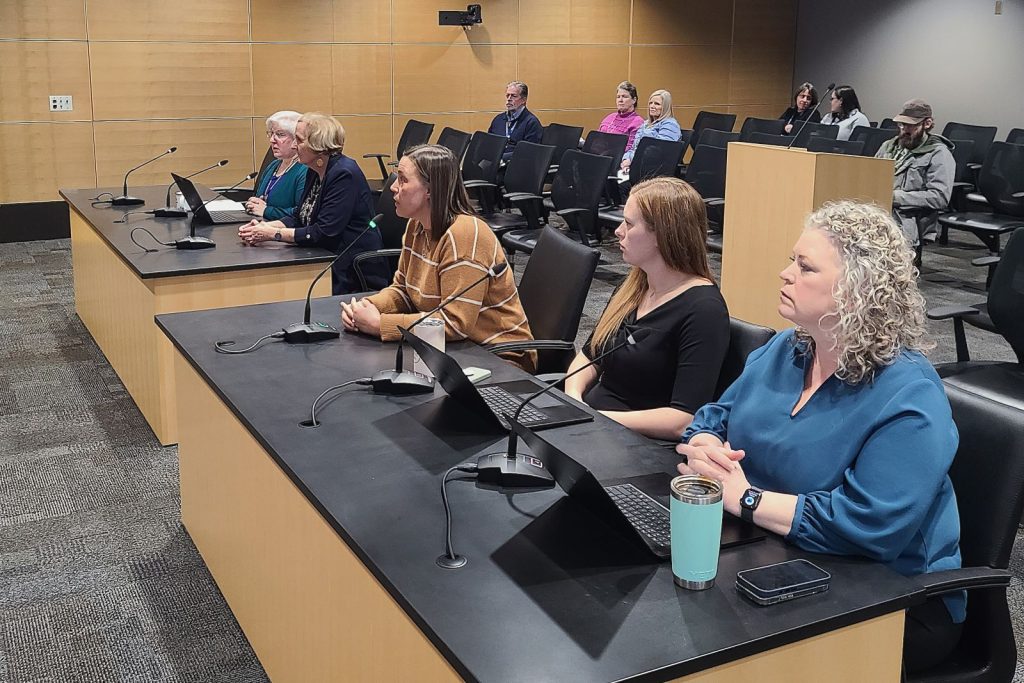
Lacey Harper, Executive Director with the Office of Snohomish County Executive Dave Somers, shared that if the council were to move forward with Peterson’s proposal, “it could delay and restart the negotiations with the providers and delay potentially the opening of the facilities” even further. Currently, both New Start Centers are scheduled to be operational this Spring.
Mary Jane Brell Vujovic, Snohomish County Human Services director, confirmed with the council that prior drug use or a conviction for prior drug use, if the person is at least 30 days sober, will not be a disqualifying condition. She did clarify that specifically drug trafficking or manufacturing would be a disqualifying condition.
“I think that’s appropriate,” Councilman Nehring replied to HHS Director Vujovic. “When we consider these facilities, for me, the grand purpose is that you have an opportunity for individuals who are going through the recovery process to be in an environment where they’re able to succeed in that recovery. And I think allowing individuals who have a history of drug trafficking specifically puts a risk on the entire purpose of the facilities from my perspective. So that’s why I am opposed to that third substitute.”
Director Vujovic shared the providers “have said on the record that they do think that these distinctions are appropriate” and specifically the Salvation Army.
“It’s about what is the appropriate housing for different people with different situations,” HHS Director Vujovic replied to Councilman Mead who inquired why the providers placed certain drug and violent crime offenses as restrictions to program eligibility. “So, I think I feel comfortable saying that they felt that there’s no desire to exclude people from housing, just that mixing folks in this facility did not make sense to them.”
“If these providers are saying this is the best way, then adding an amendment two days prior to the vote…. So, I don’t feel comfortable voting for Amendment 3 or whatever we’re calling it, Proposed Substitute 3, but open to the conversation later,” Councilman Mead said.
Council Chair Megan Dunn, expressed support for the third proposed substitute motion, stating that the New Start Centers were intended to provide individuals with a “new start” beginning after they had progressed through established housing processes and stages. However, she adopted a balanced stance by agreeing that future contract extensions may substantiate Peterson’s claim to “artificial barriers” hindering an applicant’s progress out of homelessness.
“If we can give them a new start with these facilities, that’s really important to me,” Chair Dunn said adding that she doesn’t want to further delay the opening of the New Start Centers. “It comes back to the original intent of some of the dollar switches providing housing for some of our most vulnerable population members.”
The council unanimously agreed to support Proposed Substitute 2 motion as-is; and when the contracts come up for renewal to then re-consider relaxing eligibility requirements for applicants to be placed in the New Start Centers. The motions were introduced by Councilman Nehring and seconded by Mead.
“While I am not in favor of government getting into the landlord business, I am pleased to see that significant improvements have been made to the plan since this process began,” Councilman Nehring provided in a statement to the Lynnwood Times. “My initial concern was that these facilities would be no-barrier and enable ongoing drug abuse without any sort of accountability. Thankfully, county staff and the service providers have put together a plan which is recovery-oriented, including a requirement that individuals be 30-days sober before being placed in these facilities.”
New Start Center Motions
The council unanimously approved on Wednesday the following motions related to the New Start Centers:
Motion 26-005, which authorizes Snohomish County Executive Dave Somers to execute a services agreement with Salvation Army as the selected nonprofit operator for the Everett New Start Center. The Salvation Army will receive $781,012 in HOME ARP dollars for a period to conclude on December 31, 2026.
These dollars will be used to fund six Full-Time Equivalent (FTE’s), including a client services manager, case managers, shelter cooks, and appoint five landlord engagement specialists through a professional service agreement with the YWCA.
Motion 25-582 authorizes the execution of the operating and licensing agreement with the Salvation Army for $2,684,610 for a term also concluding on December 31, 2026, though the agreement does allow for four year-long extensions with cost-of-living expenses in consideration, per the County’s discretion.
In addition to funding the salaries and benefits of 14.7 FTEs the agreement provides funding for office supplies and equipment, security system installation, administrative costs, utility costs and maintenance on vehicles and minor equipment, and other miscellaneous costs. In addition to the contract’s terms and conditions, the agreement includes four additional requirements: the management plan, code of conduct, referral and eligibility requirements, and safety and security requirements.
Similar to the Everett facility, the Edmonds New Start Center also has a motion (26-004) authorizing the execution of a services agreement of $1,884,294 in HOME ARP dollars. The 16.5 FTE’s associated with this contract include a program manager, life coaches, landlord engagement specialist, front desk employees, and a healthcare navigator.
Additionally, it includes $500,000 in meals and $250,000 in client flex funds, which would be used for clearing barriers for housing, legal evictions, healthcare bills, and so on.
Motion 25-583 executes the operating and licensing agreement with the YWCA for $2,122,669 and funds 4.75 FTE including portions of an Admin Analyst, Data Coordinator, Senior Director, Program Supervisor, Chief Program Officer, Maintenance Staff (custodian and on-call custodian).
Also, $450,000 for professional services for security, pest control, fire safety, dollars set aside for insurance, utilities, repairs, administration and other miscellaneous costs were approved. The requirements are identical to the Everett facility.
Each hotel is required to maintain a 95% occupancy rate. The facilities will also be required to provide clean linens at least weekly, one hot and one cold meal per day, individual client plans with the goal of permanent housing within 90 days, and work with the County’s referral network.
Background on the New Start Centers
In 2022 Snohomish County identified two existing hotels that could be repurposed for bridge housing, the Days Inn facility in Everett for $10,823,000 (with about 74 units) and the America’s Best Value Inn in Edmonds for $9,075,000 (with about 55 units)—$155,038 per unit.
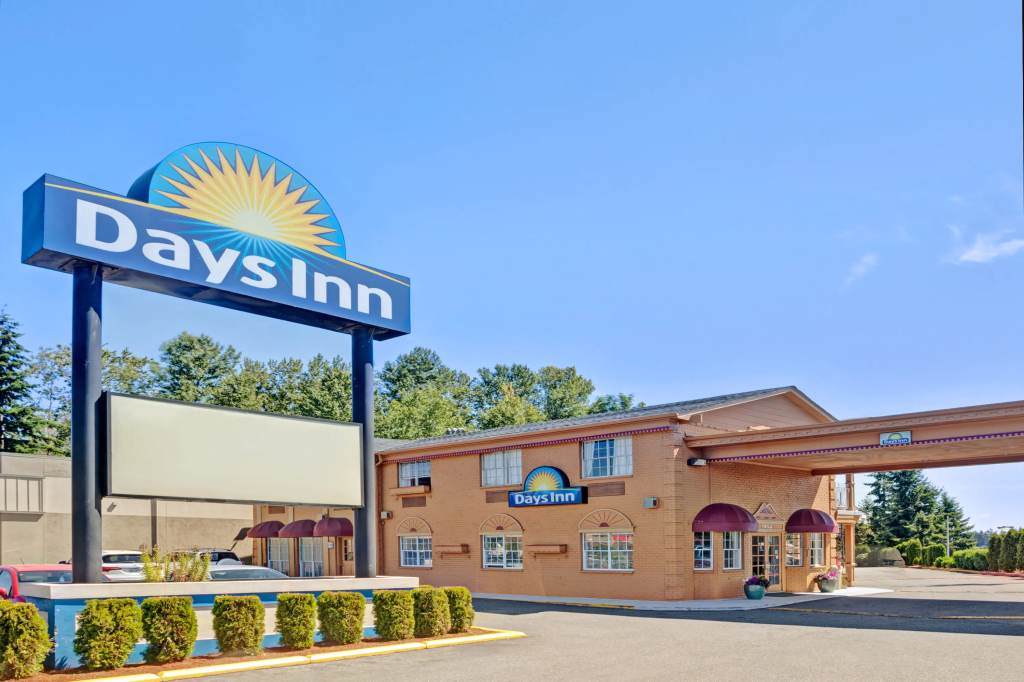
The county moved forward with these purchases under American Rescue Plan Act (ARPA) funds and the county’s Affordable Housing and Behavioral Health tax, aiming to quickly expand local shelter capacity.
After the hotels were discovered to be contaminated with methamphetamine residue, the total budget ballooned to $37.7 million as of May 2025—up from the original $20 million allocation.
The total (County + non-County) annual per unit cost as of January 2026 is estimated at $54,484 (or $4,540 per month) for the Everett New Start Center and $93,290 (or $7,774) for the Edmonds New Start Center—up from the original up from $1,590 (pre-operator estimate) per month per unit. Of that, $22,457 (or $1,871 per month per unit) for each unit per year for maintenance by Snohomish County Facilities, is funded through Affordable Housing and Behavioral Health (AHBH) dollars. The remainder of the annual per unit cost is the site operator piece, which includes AHBH as well as HOME Investment Partnerships American Rescue Plan Program (HOME-ARP) dollars.
During the vote discussion in 2022, it was disclosed by staff that the estimated annual maintenance cost per room per year was $20,000 (for either hotel) and, because of APRA loan conditions, the County would need to utilize the hotels for no less than 20 years.
The AHBH dollars are from the Snohomish County one-tenth of one-percent Affordable Housing and Behavioral Health sales tax. The HOME-ARP dollars are through HUD (HOME-ARP Program – HUD Exchange
Two weeks prior to Wednesday’s meeting, the Snohomish County Human Services Department provided drafts of a Management Plan, a Referral Partner Agreement, and a Code of Conduct. In reviewing those documents, it was identified that the Referral Partner Agreement and the Referral Minimum Requirements listed had some variances.
The contract did not include a provision for 30 days of sobriety, and the draft Referral Partner Agreement did not include a requirement that there be no violent crime conviction. Human Services provided an updated draft including these restrictions to the County to correct this oversight. Also, if a person were to relapse after being accepted into the program, s/he will be required to take mandatory treatment or may be terminated from the program depending on the circumstances of the relapse.
Snohomish County Vice Chair Low, and Councilman Nehring, in last Wednesday’s meeting, sponsored a joint proposed motion to add a requirement that agreement extensions come to the council for approval. Following a presentation by Heidi Beazizo, Chief of Staff for the council, Councilman Peterson expressed concerns about the restrictive eligibility changes.
According to Beazizo, the projects would not be hindered by the HUD’s recent restrictions on low-barrier housing if the drug trafficking/manufacturing and violent crime offense restrictions were removed. The only federal funding in the two New Start Centers is surge funding through the HOME-American Recovery Program (ARP) grant, which is not from the County’s portion of State and Local Fiscal Recovery Funds (SLFRF), or CLFR, subject to the December 31, 2026, deadline.
“Snohomish County received the HOME-ARP grant, which is authorized under a separate section of Public Law No. 117-2, and is using it to fund services in the two centers. The HUD funds referenced below are Continuum of Care funds and the County currently has no plans to utilize those funds for services in the centers,” said Beazizo. “While not relevant to the New Start Centers per se, HUD’s FY2025 NOFO, which attempted to cap Permanent Supportive Housing at 30% for Continuum of Care funds, is currently enjoined. Even if the FY 2025 NOFO were not enjoined, the County has no plans to utilize Continuum of Care funds to deliver services in the New Start Centers. Further, the centers are not classified as Permanent Supportive Housing under Continuum of Care rules.”

Author: Mario Lotmore







One Response
Where is housing for Seniors, 55 and up, who have been displaced because Social Security does not keep up with housing costs? We have as many as 100,000 seniors in cars and camping in the bushes in Snohomish County. Your homeless count is nowhere near accurate because most people who are mobile avoid it.
I understand reoffenders needed chance, but so do Seniors. How many have to die in vehicles and on the ground before you get a clue?