


OLYMPIA—A divided Washington state Senate committee advanced a bill on February 9, 2026, that would empower a state oversight board to remove elected sheriffs from office if their peace officer certification was revoked, igniting a fierce debate over balancing accountability in law enforcement with the rights of local voters.
Senate Bill 5974 cleared the Ways and Means Committee on a party-line vote, with Democrats in support and Republicans opposed, and now headed to the Senate Rules Committee for consideration. If enacted, the changes could take effect before the 2026 elections for 35 of 39 sheriff positions across Washington state, potentially reshaping how local law enforcement leaders are eligible to hold office—King County’s Sheriff is appointed, and Pierce, Snohomish, and Whatcom will be up in 2027.


The bill seeks to update laws dating back decades that governed sheriffs, police chiefs, town marshals, and related personnel. It establishes uniform eligibility requirements roles, including a minimum age of 25, a high school diploma or equivalent, and at least five years of law enforcement experience. Candidates would also need to hold or obtain peace officer certification from the Criminal Justice Training Commission (CJTC) and undergo a thorough background investigation.
In addition, SB-5974 places limits on the use of volunteers, youth cadets, and specially commissioned officers by law enforcement agencies. It clarifies that a primary duty of sheriffs include upholding the Washington state Constitution and laws as enacted by the Legislature and interpreted by the state Supreme Court.



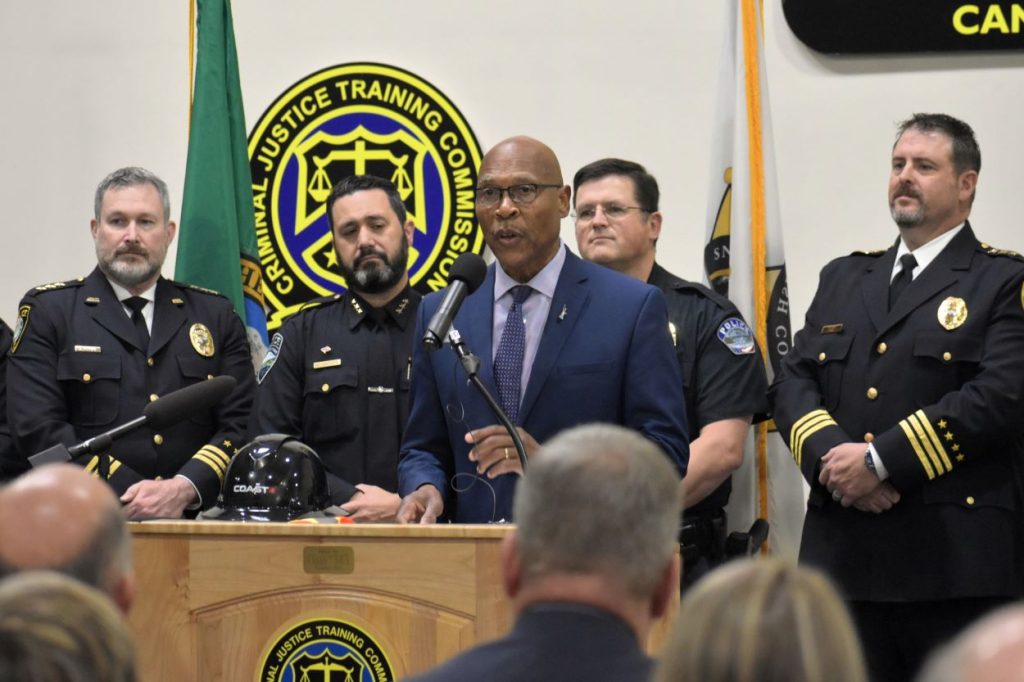
Sen. John Lovick,D-Mill Creek, and the bill’s prime sponsor with over 30 years in the Washington State Patrol, described it as a step toward stronger accountability.

“Since all peace officers must maintain a certification, these laws need to be updated to make clear what occurs when a law enforcement leaders’ certification is revoked for misconduct,” said Lovick during the bill hearing. “I hope the outstanding law enforcement leaders in our state will support this legislation. Great leaders lead by example. They embody the standards of accountability that they expect from their subordinates.”
He joined other Democrats, including Sens. Manka Dhingra, Bob Chapman, Emily Frame, Twina Nobles, Jamie Pedersen, Sam Salomon, Mark Stanford, Yasmin Trudeau, Javier Valdez, and Lisa Wellman, in backing the proposal.
During the Ways & Means hearing on Feb. 9, Sen. Yasmin Trudeau, D-Tacoma, defended the bill by pointing to inconsistencies in standards between top law enforcement officials and their rank-and-file officers.
“I’m always open to having a conversation about how we can be held to the highest standards possible and appreciate that comment,” Sen. Trudeau said. “I think one of the things that’s been incredibly compelling is the hypocrisy of some of our elected leaders in these spaces not being held to the same standard as their line officers. We did hear from line officers about how important that was to their own morale and recruitment and retention for officers.”
Opponents viewed the bill as an overreach that eroded local democracy.
In a letter to Chelan County residents, Sheriff Mike Morrison called the provision allowing the CJTC—an unelected board—to remove a sheriff a “fundamental shift of power away from voters and toward centralized authority.”
He argued that sheriffs were already accountable through elections, recalls, and public scrutiny, and warned of a slippery slope that could extend to other elected officials like prosecutors or judges.
“The recall process has actually worked,” Sen. Nikki Torres, R-Pasco, said during Monday’s hearing against the provision for CJTC to remove elected sheriffs. “It worked in Benton County and a sheriff was recalled there. This is going to take that away from the people of our counties. I’m going to ask for a no vote on this because it already works. There is a process and let the people decide.”
The Governor appoints the majority of members to the Criminal Justice Training Commission (CJTC) board to serve six-year terms.
During a January 15, 2026, hearing before the Law and Justice Committee, Pierce County Sheriff Keith Swank warned that the bill represented state overreach, comparing it to dystopian control and suggesting it targeted sheriffs who cooperated with federal authorities on issues like immigration.
“I’m fighting for the office of sheriff, and the independence of it. The Democrats control the state House, the state Senate. They control every statewide executive office. They control just about every major city in the state,” said Swank. “The only thing they don’t control, the only people they don’t control are the sheriffs. And when they have control of the sheriffs, then it’s all over. They can impose their will upon everything.”
Swank’s remarks, perceived as threatening to legislators, prompted the Washington Association of Sheriffs and Police Chiefs (WASPC) to issue a statement distancing itself from him. While WASPC shared concerns about the bill, it condemned Swank’s approach as unprofessional and initiated proceedings to consider his expulsion from the group.
“WASPC intends to initiate proceedings as required by our bylaws for the board to consider expulsion of Sheriff Swank from WASPC,” the organization wrote in its letter.
Proponents of the bill argued that the legislation does not eliminate voter input but ensures that leaders meet the same certification standards as other officers. Revocation of certification, which could stem from misconduct such as felony convictions or violations of professional standards, would trigger removal, with the CJTC enforcing the rule. A non-compliance to standards could lead to vacancies filled by appointment until the next election, maintaining continuity in law enforcement.
Snohomish County Sheriff Susanna Johnson expressed a balanced but voter-centric view on reforming law enforcement leadership in Washington State in her statement to the Lynnwood Times.
“I support accountability and eligibility requirements for sheriffs, police chiefs, and town marshals in Washington State,” Sheriff Johnson wrote in her statement. “However, I believe that any requirements or removal of elected officials should be left to the voters to decide. I recommend that since almost every sheriff in our state is elected, they should take these suggestions to the voters and let them decide who can be on their ballot and who can be removed from elected office.”

Author: Mario Lotmore




2 Responses
Sheriffs should be elected by the citizens of their counties. There should be no limit placed upon the office other than being of legal age to vote. No other elected official has education or tenure requirements. County commissioners have authority over a lot of people yet have no ability or expertise of them all.
Lovick is a creep. All these people screaming about ICE over stepping their authority need to wake up and stop licking the boots of these dems. They are destroying our country.