

LYNNWOOD—Amid escalating national outrage over fatal shootings and tactics by ICE in sweeping immigration crackdowns — which has deported over 540,000 people since January 2025 — the Lynnwood City Council debated a resolution on Tuesday, February 17, to shield immigrant residents from federal agents and raids. The Lynnwood police warned of legal risks if they are directed by the City Council and Mayor to intervene against federal agents conducting an operation.
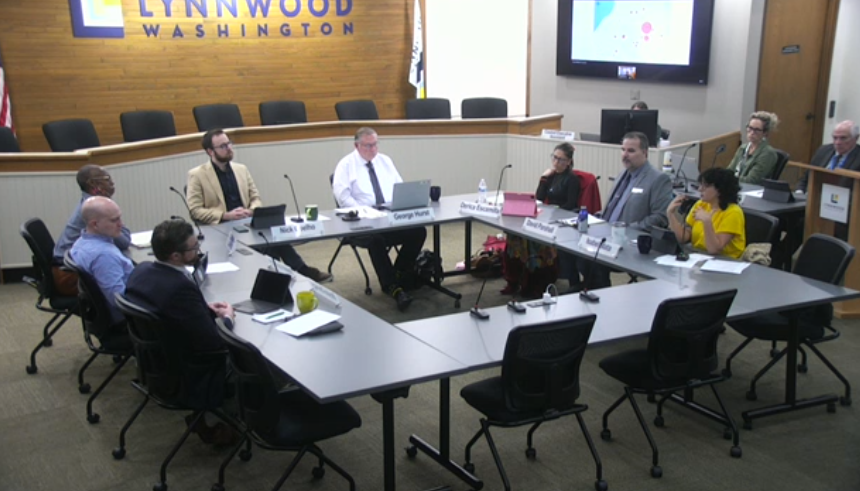
Protecting Immigrant Safety Resolution
The Lynnwood City Council held a collaborative discussion Tuesday on a proposed resolution aimed at protecting immigrant and refugee residents from federal immigration enforcement.


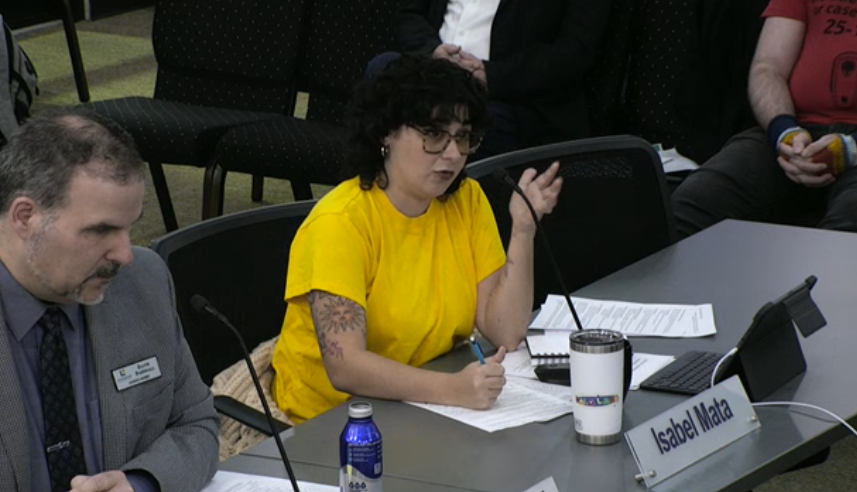
Lynnwood City Councilwoman Isabel Mata is spearheading the resolution that would that foster trust, fairness and safety for all residents, particularly marginalized groups, she said.
“This resolution is designed to be aligned with our city’s trust, dignity, and resolution for all residents, especially for communities who feel marginalized or at risk,” said Mata who spearheaded the resolution discussion. “Right now we are in a time where a lot of scary things are happening in the world, particularly as it relates to immigration and customs enforcement – otherwise known as ICE…when there is a lot of fear people aren’t going to show up, they won’t be going to the grocery store or drop their kids off at school.”




The measure seeks to reaffirm constitutional rights, limit the use of city resources for federal immigration efforts and promote “community-oriented policing.”

Councilwoman Mata continued that what makes Lynnwood great is its diversity, which subscribes to its motto, “All Our Welcome.” But it’s more than that, Mata added that residents have to feel safe. She believes Lynnwood should align itself in this direction instead of rejecting it.
“There’s also a lot of fear for people who are opposed to some of the federal enforcement actions that are happening, protesters who are scared to protest,” Mata said. “Scared to speak up, scared to participate fully because of what’s going on.”
The resolution draws on state laws like the Keep Washington Working Act, which restricts local resources from aiding civil immigration enforcement unless required by law or court order. It also calls for Mayor George Hurst to develop accessible resources, such as webpages and posters on a person’s rights, and urges reviews of police policies on intervening in alleged use of excessive force or unlawful conduct by federal officers.
Police Chief Cole Langdon expressed support for aligning with current state law but raised concerns about provisions in the resolution that could require his officers to intervene against federal agents, warning that directing LPD to intervene in federal operations would expose them to significant risks, including federal criminal liability.
“I’m concerned about anything where we are asking my officers to go out and interfere with federal investigations or federal efforts because how do I know in that moment that they’re engaged in civil immigration work as opposed to preparing to go serve a warrant on somebody who is wanted for human trafficking and they have a warrant?” Langdon stated. “If I get there and I’m like, hey, give me, let me see your copy of your warrant, they’re under no obligation to give me a copy of their warrant.”
He further cautioned that such interventions could lead to officers facing arrest or legal repercussions under federal law, potentially pitting under-resourced local police against armed federal agents.
“We are exposing our officers to potential federal criminal liability. They could be very much committing a federal crime by intervening in a federal operation,” Chief Langdon said. “So to go up there and to do something, to interfere with an arrest, they see something where they perceive that potential federal criminal liability. So we’re asking our officers to potentially be arrested.”
He added that local police lack authority over federal operations and stressed that remedies for alleged federal overreach should occur through courts or federal policy changes rather than on-the-scene confrontations.
“Anything where we are asked to go out and do something towards federal agents, I have concerns about,” Chief Langdon said. “But in terms of not supporting it or just staying out of their work, that’s Keep Washington Working right now.”
Both local and federal law enforcement are bound by the same U.S. Constitution (Fourth Amendment’s “objective reasonableness” standard), but they differ significantly in policy, jurisdiction, and accountability. While local departments often have more granular, variable, and restrictive policies, federal agents follow more uniform, agency-specific guidelines. Local laws are geographically restricted, whereas federal agents have nationwide authority.
Other council members, including Nick Coelho and Robert Leutwyler, questioned the necessity of some sections, such as directing staff amid a budget shortfall, and suggested revisions for clarity.
“I generally do not like resolutions. I generally do not like the performative nature of some of what councils have been doing,” President Coelho said. “That being said, I appreciate you have actual actions.”
Mayor Hurst supported enhancing community resources and outreach mentioned in the resolution and shared his plans for committee to work with organizations like LETI, Refugee & Immigrant Services Northwest, and Washington West African Center, who have shown interest to address ICE activity in Lynnwood.
“I’m trying to do something even further, which is to have a community group,” Mayor Hurst said. “If someone in our city is detained by ICE, that we would find out more as far as what is the impact on that family, can we provide resources to that family.”
Mata agreed to revise the resolution based on the council’s and LPD feedback, including edits to sections on police intervention and resource development. She is encouraging the public to email her or provide public comments to further improve her revision, and plans to present an updated version at a March 2 work session, with a scheduled vote on March 9.
“I want this to be a really collaborative discussion,” Mata said. “I don’t want to go through the process of these amendments … if we can avoid it.”
Cities that have already taken the lead in similar measures include Bothell, Kenmore, Seattle, Mountlake Terrace, Everett, and Edmonds.
“A precedent is being set by some of our neighbors, and I think we should follow in their footsteps,” said Mata.
Currently there are some pending legislation in Olympia aimed to protect privacy, civil liberties, and immigration enforcement – such as a SB-5855 that would prohibit face coverings of law enforcement (passed Senate, now in House), SB-5925 which guardrails for privacy and civil liberties (passed Senate, now in House), HB-2165 that addresses impersonation of police (passed House, now in Senate), and HB-1710, an act relating to compliance with the Washington voting rights act of 2018 (passed House, now in Senate).
Trump’s Immigration Crackdown: How did we get here?
President Donald J Trump’s aggressive immigration enforcement, often labeled draconian by critics, stems from a backlash against policies under his predecessor, Joe Biden, which many Republicans blamed for record migrant encounters at the U.S.-Mexico border.
Biden entered office in 2021 pledging to reverse Trump’s hardline measures. He halted border wall construction, ended the “Remain in Mexico” policy requiring asylum seekers to wait in Mexico for U.S. hearings, and expanded humanitarian temporary parole programs for migrants from Cuba, Haiti, Nicaragua and Venezuela. These changes, combined with global migration pressures, led to over 10 million encounters at the southern border during Biden’s term, according to U.S. Customs and Border Protection data.
Controversies mounted as the Biden administration sued states attempting local enforcement. In 2024, the Biden DOJ challenged Texas’ Senate Bill 4, which empowered state police to arrest suspected illegal border crossers, arguing it violated federal supremacy under the Constitution. Similar lawsuits targeted Texas’ floating buoys in the Rio Grande and other barriers, with courts largely siding against the state.
Biden’s immigration policies also included relocating processed migrants to interior cities of the United States. Through his temporary parole programs such as CHNV, hundreds of thousands flew directly to airports in places like New York, Chicago and even Newark, straining local resources. Republican governors, including Texas’ Greg Abbott, exacerbated tensions by busing over 100,000 migrants to Democratic-led cities, prompting mayors like New York’s Eric Adams to declare emergencies—NYC spent $7.5 billion and projected to end the year at $12 billion in total costs for migrant services; Chicago reported $2.5 billion by end of 2025.
Former ICE Director Tom Homan, now Trump’s Border Czar, shared security risks from Biden-era policies. In congressional testimony, Homan noted over 2 million “got-aways” — migrants who evaded capture — saying authorities “know nothing about those people and they can be a security risk.”
Trump campaigned on illegal immigration crackdown, promising the “largest deportation operation in American history” and invoking Eisenhower’s 1950s “Operation Wetback.”
Upon returning to office in January 2025, President Trump declared a national emergency at the border, reinstated Remain in Mexico, ended catch-and-release, expanded expedited removal nationwide, and suspended birthright citizenship for children of undocumented parents — a move currently facing legal challenges.
Recent enforcement surges have sparked resistance in mainly Democrat-led states.
In Minneapolis, ICE’s “Operation Metro Surge” led to massive protests under the “ICE Out” banner. Tensions escalated with fatal shootings: On Jan. 7, 2026, ICE agent Jonathan Ross killed U.S. citizen Renee Nicole Good, 37, when her vehicle was perceived as a threat and hit one federal officer. Witnesses claimed agents blocked medical aid.
Weeks later, on Jan. 24, Border Patrol agents shot Alex Pretti, 37, an ICU nurse aiding a protester. Videos contradicted official self-defense claims, fueling nationwide outrage and calls to abolish ICE.
As of February 2026, over 540,000 deportations have occurred, but tactics such as administrative warrants and vehicle smashings, have faced further criticism with “Ice Out” protests by local residents have disrupting enforcement operations.
Recent polls from Fox News and The New York Times reveal a divided American sentiment on immigration enforcement, with growing concerns over the aggressiveness of ICE tactics even as support for deportations remains split.
A Fox News poll released in February found that 59% of registered voters view ICE as too aggressive in its enforcement actions, marking a 10-point increase since July 2025.
This shift was particularly pronounced among key demographics: up 14 points among white voters without a college degree, 19 points among moderates, and 22 points among independents. Even among Republican-leaning groups, perceptions of excess rose, including 23 points among non-MAGA Republicans and 14 points among Republican women.
Forty-five percent of Republicans in the Fox News Poll believe ICE “almost always” targets illegal immigrants with criminal records, compared to just 17% of Democrats and 15% of independents.
Overall, 36% of voters now support abolishing ICE, double the 18% from 2018, with sharp rises among Democrats (up 34 points), independents (up 22), women (up 21) and white voters (up 20). Among those deeming ICE too aggressive, 44% cited excessive force, 23% said it targets the wrong people, and 29% pointed to both.
Approval for Trump’s broader handling was mixed: 52% approve of his border security efforts (up 1 point from December 2025), while 45% approve on immigration overall.
A separate New York Times/Siena College poll, conducted Jan. 10-15, 2026, echoed concerns about ICE while showing even splits on policy outcomes. Fifty-eight percent disapprove of Trump’s overall immigration handling, with 40% approving. However, exactly 50% approve of deporting people living illegally in the U.S., with 47% opposing. Half also view Trump’s southern border management favorably.
Disapproval of ICE by respondents was stark: Just 36% approve of how the agency is handling its job, while 63% disapprove, including 70% of independents. Sixty-one percent say ICE has “gone too far” in its tactics, a view shared by nearly one in five Republicans.
Flock Cameras
Lynnwood Police Chief Cole Langdon continued the City’s conversation on flock license plate reader cameras and whether the City should proceed with terminating the contract via resolution or other appropriate legislative action.
Flock, or ALPR cameras, provide officers with real-time information to identify and locate vehicles involved in crimes. The program was founded through a grant from the Washington Auto Theft Prevention Authority (WATPA).
Two days after the first flock system came online in Lynnwood, on July 1, Lynnwood City staff were alerted that law enforcement agencies from across the country appeared to have unauthorized access to the data. According to then-Mayor Christine Frizzell, Lynnwood immediately began working with its vendor, Flock Safety, to determine how this occurred.
The City noticed, on July 8, that by enabling a nationwide search feature, designed to allow agencies to query license plate data beyond their state, automatically created reciprocal access for all participating agencies nationwide.
On October 30, 2025, Mayor Frizzell and the City Council paused use of Flock Safety cameras in October 30, 2025 after identifying compliance concerns under Washington’s Keep Washington Working Act.
Councilwoman Isabel Mata announced during Tuesday’s discussion that she will vote to cancel Lynnwood’s flock cameras, to end license plate readers in Lynnwood. Fear of possible use by ICE for enforcement and lack of “trust” of the vendor with the community she said are driving her voting decision.
Lynnwood Police Chief Langdon shared that over the four months Flock cameras were in operation, car theft was down 58.7% and that the tool was successful in apprehending perpetrators tied to identifying theft, robbery, assault with firearm, etc.
“We had over this four months people, 10 stolen vehicles that were recovered, two of which had firearms, and one of those car vehicles was taken in a car jacking in Seattle, they were held up by gun point and head up here to Lynnwood, and we got them using flock trying to steal a computer,” said Langdon, adding that an agency may not disclose, share, or permit access to ALPR data except in judicial proceedings. Technology can be a powerful tool to enhance community safety – but only when used responsibly. I stand by that we use this system responsibly.”
Lynnwood City Councilman Leutwyler alleged that the country is in a mass surveillance state and does not have faith in Flock’s ability to protect the privacy of searches and possible misuse from outside agencies. Lynnwood City Councilwoman Chelsea Wright also had concerns with possible misuse from outside agencies.
“Our vendor let us down,” added Lynnwood City Councilman David Parshall.
Lynnwood City Councilwoman Derica Escamilla thanked Chief Langdon for his presentation and shared she will be making her decision based on the feedback received from community members.
Lynnwood will take a vote on whether to continue or terminate the contract with Flock on Monday, Feb. 23.
The Lynnwood has a total of 25 flock cameras.
Editor’s Note: Kienan Briscoe contributed to this article.

Author: Mario Lotmore