
OLYMPIA [By: Cassie Diamond] – Legislation that seeks to get more passenger-only ferries on Puget Sound cruised out of the state Senate Friday, March 6, with bipartisan support, but it isn’t out of choppy waters yet.
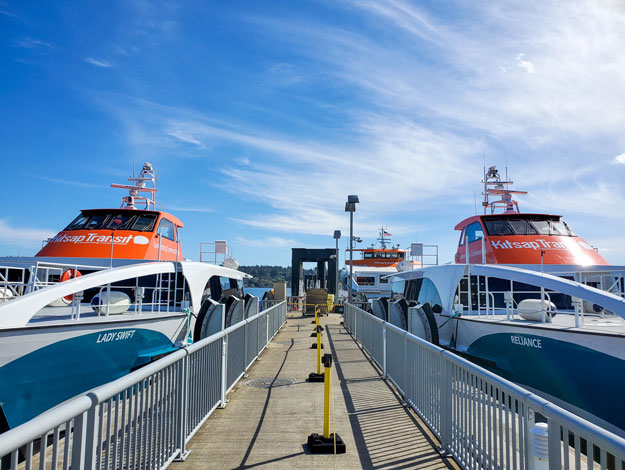
The Senate made several revisions to House Bill 1923, dubbed the Mosquito Fleet Act, that leave the measure’s supporters and prime sponsor unsatisfied. The bill has been returned to the House, where any disagreements over these changes must be resolved before it can be sent to Gov. Bob Ferguson.


Current law prohibits most local governments, port districts, transit agencies and tribes from operating foot ferry services.
The Mosquito Fleet Act, would loosen these restrictions by allowing local entities bordering Puget Sound and Grays Harbor to establish their own passenger-only ferry service districts.



Backers argue this will help ferry-dependent communities in Washington, who have been plagued by major ferry disruptions for the past seven years.
However, advocates say a striking amendment helmed by Senate Transportation Committee Chair Marko Liias, D-Edmonds, and approved by the Senate Friday compromises the policy’s effectiveness.
A major sticking point is the issue of funding.
Liias’ amendment prevents new passenger ferry districts from utilizing a sales tax for funding, instead replacing it with a property tax. The amendment also makes passenger ferry service districts ineligible for state funding starting in 2028.
It further mandates that all vessels constructed for use by a passenger ferry service district must be built in Washington and be zero-emissions.
Peter Philips, marine transit advocate and CEO of COLIBRI Northwest, explained that the built-in-Washington provision is unnecessary because no shipyards outside of Washington would want to build these vessels.
According to Philips, all the requirement would do is make passenger ferry districts ineligible for federal funding to help support the construction of these boats.
“The only reason to insert that language is to prohibit local communities from accessing federal funds,” he said. “That’s wrong. That’s the most onerous component [of this amendment].”
New language in the bill additionally requires passenger ferry service districts to “be mutually exclusive” and not overlap.
Philips said these requirements would prohibit different jurisdictions from coordinating the establishment of new passenger ferry service districts.
Last session, the measure stalled in the Senate Transportation Committee after receiving widespread support in the House.
Liias explained he was concerned the bill would obligate the state to fund local passenger only ferry services at a time when they should be using those dollars to support the Washington State Ferries (WSF) system’s aging fleet.
This year, Liias said he took into account public testimony and feedback from colleagues to develop an amendment that he believes makes the measure more balanced.
“If [local jurisdictions] can do this on their own … we don’t want to be in the way of that innovation while we remain laser-focused on our mission of making sure that our state ferry system is healthy and strong into the long-term,” he said.
However, Philips argued that the House version of the bill would not have imposed a burden on state resources.
“The bill, as introduced to the Senate Transportation Committee, is as close to perfection as one can get,” he said. “All it does is allow local communities to fend for themselves. It gives them the authority to organize themselves, fund ferries and operate them on their own. Why Sen. Liias would have an issue with that is beyond me.”
Philips also pointed out that the new requirements applied to passenger-only ferries in Liias’ amendment, such as being built in Washington and being zero-emissions, do not apply to WSF’s car ferries.
WSF is set to receive three new hybrid electric ferries from Florida to start replacing its aging vessels, with the first boat scheduled to arrive in 2030.
But prime sponsor Rep. Greg Nance, D-Bainbridge Island, and supporters of the Mosquito Fleet Act say local communities can’t afford to wait that long for reliable ferry service.
Nance said in an email statement that while he appreciates the strong bipartisan support the Mosquito Fleet Act received in the Senate, it’s clear “the Marko Liias amendment does not work for local communities.”
“It adds tens of millions of dollars of additional mandated costs, years of additional delays, and takes away democratic choices on the local level for how to solve urgent transportation problems,” he said in the statement. “As we work to reconcile the bills, I’ll be fighting for everyone across Washington that relies on reliable transportation to get this right.”
Sen. Drew MacEwen, R-Shelton, echoed similar concerns during the floor debate Friday, stating that the striking amendment adopted by the Senate makes the policy “unworkable.”
However, MacEwen voted “yes” on the bill despite the amendment’s changes, and described the measure as a “long-term solution” to the transportation challenges faced by the Puget Sound region. But he noted it “might take a few years and other bills to get it right.”
HB 1923 passed the Senate 45-3, with one excused.
To Philips, there are two solutions to the issues he has with the bill in its current form: Either the House version of the bill is adopted during the reconciliation process, or the legislation as it has been amended by the Senate dies.
The House and Senate will have until March 12, the last day of session, to concur on a finalized version of the Mosquito Fleet Act.
The Washington State Journal is a nonprofit news website operated by the WNPA Foundation. To learn more, go to wastatejournal.org.

Author: Washington State Journal