

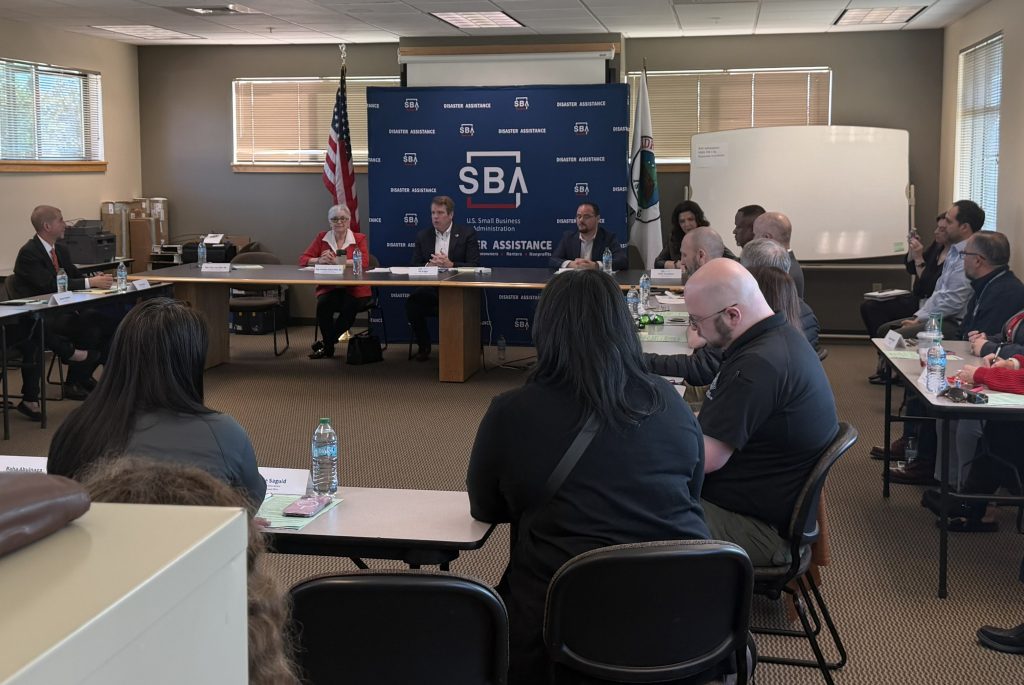
SEDRO-WOOLLEY— U.S. Small Business Administration (SBA) Deputy Administrator Bill Briggs hosted a disaster roundtable and toured two local farms in Washington state on Wednesday to see firsthand the progress on recovery efforts impacted by the record-breaking flooding in the December 2025 back-to-back atmospheric rivers.
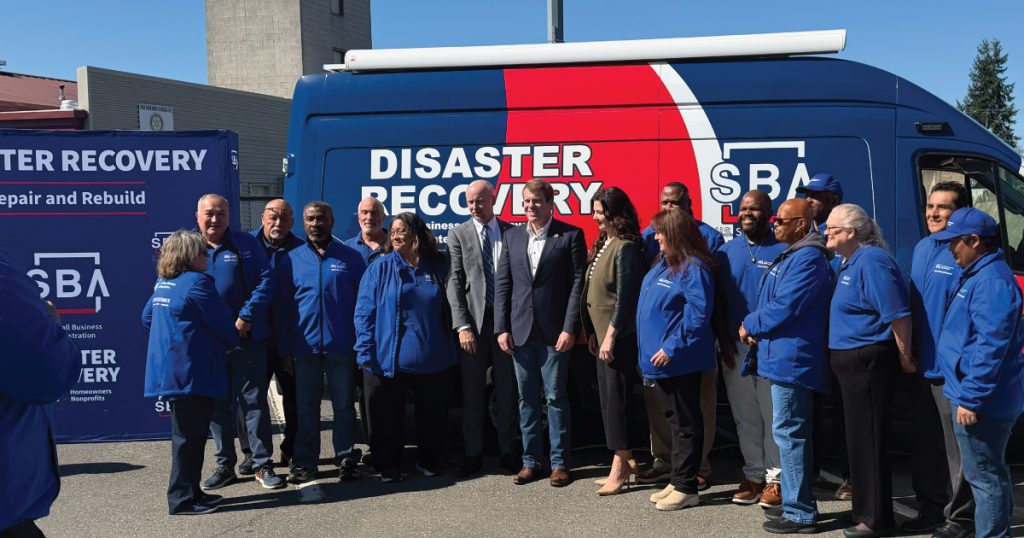
“So, part of what I was doing today was hosting a disaster roundtable with officials to learn what worked, what were the early challenges in sharing information and making sure people were aware of the resources available, and then just how we can operate going forward,” Deputy Administrator Briggs told the Lynnwood Times. “Part of my message, too, is just a larger effort to help our rural, our manufacturing, and our agricultural sectors benefit from the Trump economy.”


Briggs was joined by Washington State Representatives of the 39th Legislative District Sam Low (R-Lake Stevens) and Carolyn Eslick (R-Sultan), along with Nick Lavacca, Mayor Pro Tem of Sedro-Woolley, members of the Sedro-Woolley Chamber of Commerce, personnel with Skagit County Department of Emergency Management, and persons impacted by the floods.
“I appreciate coming out and hearing from those who have lost so much,” Rep. Low told the Lynnwood Times. “People who’ve lost their homes and lost their businesses due to the flooding, I really felt like they were listened to today.”




According to the SBA Office of Disaster Recovery and Resilience, they have received approximately 200 applications for disaster assistance of which roughly 70 have been approved for $7.6 million with $1 million already dispersed.

Briggs shared that a major challenge has been that a lot of residents in rural areas are learning about disaster relief options through “word of mouth” because they aren’t on social media.

“There was tremendous information being shared by social media,” Briggs shared when ask about the current challenges learned from the roundtable. “But there was also just a need for literally going door knocking and sharing information with particularly folks who might be older and not on social media.”
To resolve this, SBA is stepping up efforts with a mobile recovery vehicle to take the loan operation center to “folks in the community.”
“We’re going to go to King and Pierce Counties this week to meet folks where they are and to help give them options or make them aware of their options that SBA may be able to provide them,” Briggs said.
SBA currently has six Recovery Center locations in Washington state:
- King County Auburn DLOC, 1102 Auburn Way, Auburn, WA 98002
- Skagit County Sedro-Woolley DLOC, 325 Metcalf Street, Sedro-Woolley, WA 98284
- Whatcom County Sumas DLOC, 125 Front Street, Sumas, WA 98295
- Snohomish County Snohomish DLOC, 311 Maple Avenue, Snohomish, WA 98290
- King County North Bend DLOC, 128 West 2nd Street, North Bend, WA 98045
- Burlington Library Walk-Ins, 820 East Washington Avenue, Burlington, WA 98233
For exact hours of operation and to schedule an appointment at one of the recovery centers, visit https://appointment.sba.gov/schedule/.
There are essentially two types of disaster loans immediately available to residents and businesses impacted by the floods with hard deadlines approaching — Physical Damage Loans and Economic Injury Disaster Loans.
Physical damages to a property, home, or small business related to the December flooding may be eligible for Physical Damage Loans. Approved applicants may borrow up to $500,000 to repair or replace their primary residence. Both homeowners and renters are eligible for up to $100,000 to replace personal property such as clothing, furniture, vehicles and appliances damaged in the disaster. The loans cover only disaster losses not fully covered by insurance or other sources, with any insurance proceeds deducted from the eligible amount.
Secondary homes and vacation properties are not eligible. However, qualified rental properties may qualify.
Loan terms include a 12-month deferral of the first payment with no interest accrual during that period. For those unable to obtain credit elsewhere — a determination made by the SBA — the interest rate will not exceed 4%. Physical Damage Loans can run up to 30 years, with no prepayment penalties or fees.
The application deadline for a Physical Damage Loan is April 27, 2026.
The second available loan assistance is the Economic Injury Disaster Loan for small businesses who may not have experienced a physical damage, but suffered an economic injury such as not being able to meet financial obligations because of the floods.
This loan provides working capital to help businesses meet financial obligations and pay regular operating expenses until normal operations resume. To qualify, a business must demonstrate “substantial economic injury,” meaning it is unable to meet its obligations and necessary operating expenses as a direct result of the disaster. A loss of expected profits or a decline in sales alone does not qualify.
Businesses must be physically located in the declared disaster area, directly impacted by the flooding and unable to obtain credit elsewhere, as determined by the SBA. Loan amounts are based on the company’s financial needs and can help cover expenses the business would have met if the disaster had not occurred — even if it suffered no physical damage.
The loans carry a 12-month deferral on the first payment with no interest accrual during that period. The interest rate will not exceed 4%. Repayment terms can extend up to 30 years based on the business’s ability to repay, with no prepayment penalties or fees.
Collateral is required for an Economic Injury Disaster Loan over $50,000. For loans of $200,000 or less, the SBA will not require a business owner to pledge their primary residence as collateral if the owner has other assets of equal quality and value.
The application deadline for an Economic Injury Disaster Loan is November 24, 2026.
Briggs told the Lynnwood Times that that turnaround time for both loans varies but he has been told that applicants can expect to be notified of approvals in approximately three weeks of submitting a request.
“It’s not one of those things where you’re instantly approved,” Briggs said. “There’s a little bit back and forth, and so we help with that interaction. It’s done online, and then there’s a process of getting the application actually complete. Then getting the application processed by SBA and then getting the funds dispersed.”
Counties eligible for both loans are King, Lewis, Skagit, Snohomish, Whatcom with contiguous counties of Chelan, Cowlitz, Grays Harbor, Island, Kitsap, Kittitas, Okanogan, Pacific, Pierce, San Juan, Skamania, Thurston, Wahkiakum, and Yakima.
New SBA Grocery Guarantee loans
Starting May 1, the SBA will launch grocery guarantee loans for farmers and other agricultural businesses through its SBA International Trade Loan (ITL) Program
The SBA will cover up to 90% of a loan value up to $5 million compared to the standard 75% guarantee for the agency’s popular 7(a) Loan Program. The Grocery Guarantee will give local lenders greater confidence to deploy capital into the food supply chain, supporting investments in production capacity, processing, and distribution to increase the supply of domestic food products and lower grocery prices, according to SBA officials.
This action builds on the Trump Administration’s broader commitment to supporting American farmers, ranchers, and producers – and bringing lower prices to American consumers.
Following Wednesday’s roundtable in Sedro-Woolley, Briggs visited Del Fox Meats in Bow and Knutson Farms in Sumner, both aligned with the upcoming grocery guarantee loan initiative.
December Floods Federal Disaster Assistance
Governor Bob Ferguson submitted a $182.3 million request to the Federal Emergency Management Agency for Public Assistance funding to help repair state infrastructure damaged by the record-breaking flooding in December 2025. In addition to funding to repair damaged infrastructure, Gov. Ferguson also requested $21.3 million from FEMA’s Individual Assistance program. Both requests are still pending federal approval as of April 8, 2026.
The preliminary damage assessment total of $182.3 million does not include damage to federal highways, nor some state highways, the Governor’s Office confirmed — e.g. damage to US 2 between Skykomish and Leavenworth.
Gov. Ferguson on December 10, 2025, declared emergencies in 13 counties and seven Tribal Nations, directing $3.5 million in state aid and activating relief programs. President Trump approved a federal emergency declaration on December 12, enabling 75% cost-share for protective measures like debris removal in affected counties. Health and Human Services Secretary Robert F. Kennedy Jr. issued a public health emergency on Christmas Eve to streamline care access.

Author: Mario Lotmore