
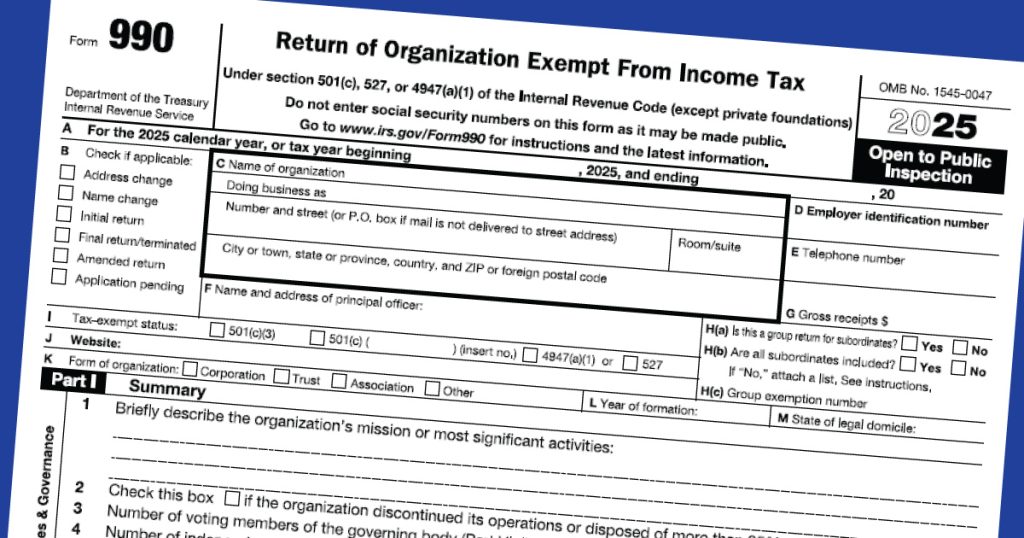
WASHINGTON, D.C.—The U.S. Department of the Treasury on April 23 announced that the Internal Revenue Service (IRS) will revise Form 990, the annual information return filed by tax-exempt organizations under Section 501(c)(3) of the Internal Revenue Code, to require the reporting of government contracts, government grants, and fiscal sponsorship arrangements to boost transparency, strengthen oversight, detect misconduct, and hold tax-exempt businesses accountable.
“Public money and tax-exempt status demand public accountability,” said Treasury Secretary Scott Bessent. “We are ending the days of hiding fraud, abuse, and extremist activity behind complicated nonprofit arrangements. When bad actors misuse charitable structures, directors and officers should understand that transparency can lead to scrutiny, accountability, and liability under the law.”


The upcoming revisions will target two main areas: improve tracking of government grants and contracts, which involve substantial taxpayer funds, to ensure proper classification and reduce fraud; and mandate detailed disclosures on fiscal sponsorships, including project operators, fund flows, and governance relationships.
Fiscal sponsorship allows a 501(c)(3) organization to provide administrative and tax-exempt status support to projects or groups that lack their own nonprofit designation. Recent congressional oversight shared concerns that this obscures who operates a project, who controls the funds, and how money is spent—potentially enabling misuse of tax-deductible donations and public dollars.



“Tax-exempt status is not immunity from scrutiny,” said Treasury Assistant Secretary and Acting IRS Chief Counsel Ken Kies. “If an organization receives public funds or tax-deductible donations, it should be prepared to show who controls the money and where it goes.”
Non-Governmental Organizations (NGOs) — including advocacy, community, humanitarian, environmental, and service groups — frequently use or provide fiscal sponsorship, especially smaller or startup organizations, and often receive government contracts/grants. Sponsors must now identify sponsored projects by name, disclose financial flows between sponsor and project, and clarify control/governance ties.
NGOs with public contracts or grants face standardized, more visible reporting to help detect fraud or improper use of taxpayer dollars.
Many nonprofit news outlets operate as 501(c)(3)s or rely heavily on fiscal sponsorship without the requirement to disclosure their donors and political sponsors.
The proposed requirement will require fiscal sponsors to report sponsored news projects separately on Form 990, including operator details, fund flows, revenues/expenses, and governance relationships. This will end the “black hole” where sponsored journalism activities will now be exposed. Also, news outlets receiving public dollars—federal, state, or local journalism grants—will be required to disclose these monies more explicitly, to determine whether or not the newsrooms are “paid shills” for government-sponsored campaigns, elected officials from personal private donations not reported in public disclosure reports, lobbyist, and special interest groups.
In Washington state, 501(c)(3) fiscal sponsors have long played a key role in channeling government grants and contracts to local initiatives, often for projects that might otherwise lack the infrastructure to receive public money directly. For example, Evergreen Social Impact provides comprehensive fiscal sponsorship to public-private partnerships and unincorporated projects across the Pacific Northwest. Similarly, the Washington Food Coalition uses fiscal sponsorship to help projects receive government funding and support for food security efforts.
State arts funding through ArtsWA partners with fiscal sponsors such as Shunpike to enable emerging organizations to apply for grants. These arrangements have supported health equity, immigrant relief, housing, and community development projects across the state.
However, while existing 501(c)(3) structures have enabled rapid deployment of public resources, they have also sparked calls for greater accountability.
Washington state lawmakers enacted bipartisan reforms to the Community Reinvestment Program after a whistleblower alleged self-dealing and misuse of taxpayer-funded housing grants by some nonprofits.
The Community Reinvestment Program, created by 2022 legislation and funded with more than $200 million, aims to address racial and economic disparities by directing grants for homeownership, small business aid and re-entry services to “by-and-for” nonprofits serving BIPOC (Black, Indigenous, and People of Color) communities.
In October 2025, real estate broker and Tacoma Urban League volunteer Corey Orvold publicly released evidence of alleged misconduct, working with independent journalist Brandi Kruse of the unDivided podcast. The claims centered on nonprofit officials steering down-payment assistance and grants to family members, friends, employees and preferred clients.
For example, Aysia Williams, daughter Director of Financial Empowerment at the Urban League of Metropolitan Seattle Angela Williams, reportedly received approximately $350,000 in combined assistance to buy a $425,000 home in Tacoma while other qualified applicants were denied. Some grants were also allegedly used to pay personal credit-card debt.
In response to a subsequent Department of Commerce and Attorney General’s Office joint review, the Legislature passed House Bill 2523, sponsored by Rep. Kristine Reeves, D-Tacoma, with bipartisan support requiring updated plans for the Community Reinvestment Program every five years, imposes strict conflict-of-interest rules barring officers, employees, family members or affiliates from receiving benefits, and orders a study of fund distribution by the Washington State Institute for Public Policy.
Gov. Bob Ferguson signed the bill on March 23 and is scheduled to take effect on June 11.
In another case, a 2025 King County audit of 36 contracts across four youth programs managed by the Department of Community and Human Services between 2022 and 2025, exposed serious oversight failures and potential fraud in millions of dollars in taxpayer-funded grants, including complications with fiscal sponsorship arrangements that obscured how public money moved between organizations.
Auditors found repeated improper payments, altered or forged invoices, questionable cash withdrawals and payments to unapproved subcontractors. Department spending had more than doubled — from $922 million in 2019-2020 to more than $1.8 billion in 2023-2024 — as officials deliberately accepted higher financial risk to quickly fund smaller, less-experienced community groups. In 2024, nearly half of 359 reviewed grantees were rated “high risk.” Yet fiscal monitoring was minimal, with in-depth reviews of only 1-2% of grantees in 2022-2023, far below the department’s 33% target.
King County Auditor Kymber Waltmunson called the findings alarming, saying weak controls left public dollars vulnerable. A follow-up report in April 2026 showed DCHS had fully implemented only one of ten recommendations, with full fixes not expected until mid-2027.
For years, fiscal sponsorship and affiliated 501(c)(3) structures have allowed large sums of money—from private donors and government sources—to flow with limited to no public visibility. The new tax proposal by the Treasury and IRS signals that the era of secret money in the nonprofit sector is coming to an end. By requiring standardized, project-level reporting, the IRS aims to make it far harder for organizations to shield activities from scrutiny while still enjoying tax benefits and access to public funds.
The Treasury and IRS plan to issue proposed the new regulations soon, with a public comment period before finalizing the changes. No specific effective date has been set, but the updated requirements will apply to future Form 990 filings once implemented, following standard IRS rulemaking procedures, the Treasury reported.

Author: Mario Lotmore