

WASHINGTON, D.C. — The Supreme Court on Wednesday ruled that Louisiana’s congressional map is an unconstitutional racial gerrymander, striking down a plan that created a second majority-Black district in an effort to comply with the Voting Rights Act.
In a 6-3 decision, the court affirmed a lower court’s ruling that invalidated the state’s 2022 map known as SB8. Justice Elena Kagan dissented, joined by Justices Sonia Sotomayor and Ketanji Brown Jackson.



Justice Samuel Alito wrote for the majority opinion that stated while compliance with Section 2 of the Voting Rights Act can serve as a compelling interest justifying the use of race in redistricting, Louisiana’s map did not qualify because the Voting Rights Act did not require the additional majority-Black district.
“Because the Voting Rights Act did not require Louisiana to create an additional majority-minority district, no compelling interest justified the State’s use of race in creating SB8, and that map is an unconstitutional racial gerrymander,” Justice Alito wrote.




The ruling tightens standards for vote-dilution claims under the Voting Rights Act of 1965 and limits when states may intentionally consider race as a predominant factor in drawing legislative districts. It updates the framework established in the Court’s 1986 decision in Thornburg v. Gingles to better align with the statute’s text and constitutional limits under the 14th Amendment’s Equal Protection Clause.


The case stems from redistricting after the 2020 census. Louisiana, which has six congressional districts and a Black voting-age population of roughly one-third, initially adopted a map with one majority-Black district. A federal judge in Robinson v. Ardoin ruled in 2022 that the map likely violated Section 2 of the Voting Rights Act by diluting Black voters’ ability to elect candidates of their choice.

The Republican-controlled Legislature responded by passing SB8, which added a second majority-Black district (District 6). Challengers, including Phillip Callais and other voters, sued, arguing the map constituted an impermissible racial gerrymander. A three-judge federal court in the Western District of Louisiana agreed and struck it down. Louisiana and the Robinson plaintiffs appealed to the Supreme Court.
Under the Court’s updated Gingles framework, plaintiffs seeking to prove a Section 2 violation must now satisfy stricter requirements. Illustrative maps offered by plaintiffs cannot use race as a districting criterion and must comply with all of the state’s legitimate non-racial goals, including traditional districting principles and the state’s specified political objectives. Analyses of racially polarized voting must control for party affiliation to show bloc voting that cannot be explained by partisanship. And the “totality of circumstances” inquiry must focus on evidence of present-day intentional racial discrimination rather than historical events or broad societal effects.
The majority SCOTUS opinion held that the Robinson plaintiffs failed at every step: their illustrative maps did not avoid using race or meet the state’s non-racial criteria, their polarization evidence did not disentangle race from party, and they did not demonstrate an objective likelihood of intentional discrimination.

The dissent argued the majority’s reinterpretation of Section 2 unduly narrows the Voting Rights Act and departs from recent precedent such as Allen v. Milligan (2023).
Impact on 2026 midterms
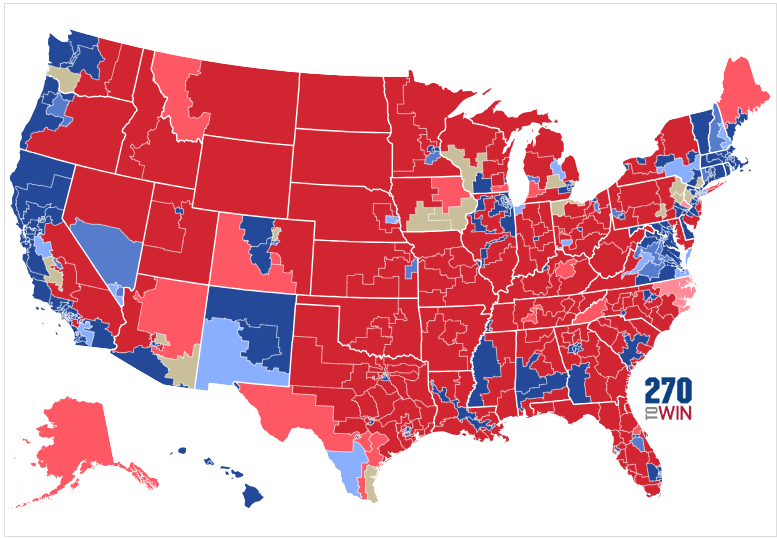
Wednesday’s SCOTUS ruling requires Louisiana to redraw its congressional map without the second majority-Black district in time for the 2026 midterm elections. Under SB8, Louisiana’s delegation was expected to split 4 Republicans to 2 Democrats. A revised map with only one majority-Black district is likely to produce a 5-1 Republican advantage, handing Republicans a net +1 House seat in the state.
More broadly, the decision makes it significantly harder for Voting Rights Act plaintiffs to force the creation of additional majority-minority districts in other states, particularly in the South. By requiring race-neutral illustrative maps, disentangling race from partisanship, and emphasizing present-day intentional discrimination, the updated framework is expected to reduce successful VRA challenges to maps that maximize partisan advantage.
The updated Gingles test now gives Republican-controlled legislatures across the United States stronger defenses against VRA suits and easier paths to challenge court-ordered or legislatively created majority-minority districts as unconstitutional racial gerrymanders. States poised to benefit from Wednesday’s ruling giving Republicans a +4 to 5 seat gain are:
- Alabama: Could target its two majority-Black districts (created post-Milligan); analysts long flagged 1–2 potential flips.
- Georgia: Opportunity to dilute or eliminate 1–2 majority-minority districts; potential for 1–2 seat gains.
- South Carolina: Strong chance to dismantle the 6th District (Rep. Jim Clyburn’s seat) for a 7-0 GOP sweep.
- Tennessee: Could eliminate the Memphis-based 9th District, shifting to an 8-1 or 9-0 delegation.
- Florida: DeSantis has signaled interest in targeting multiple minority-opportunity districts in South Florida; multiple seats at risk.
The SCOTUS ruling amplifies a broader, Trump-initiated strategy of mid-decade redistricting launched in 2025 to expand the GOP’s slim House majority ahead of the 2026 Mid-term elections. Key examples and gains already enacted or upheld giving Republicans a +12 to 13 seat gain are:
- Texas (+5 Republican seats): Trump-called special session produced a new map signed August 2025; SCOTUS stayed a lower-court block, allowing use in 2026. Targets Democratic districts in Houston/Dallas/Austin areas.
- Missouri (+1 seat): New map enacted September 2025 fractures Kansas City’s Black electorate.
- North Carolina (+1 seat): Enacted October 2025.
- Ohio (+2 seats): Enacted October 2025.
- Florida: DeSantis pushing further targets (+3 to 4 potential seats).
Combining the Wednesday’s ruling with mid-decade redistricting and litigation, and SCOTUS upholding the Californian redistricted map with a +5 net gain for Democrats, Republicans are positioned for a net +11 to 13 U.S. House seats relative to pre-2025 maps. While Democrats have been focused on “No Kings” protests and congressional theatrics (soft power), Republicans have been utilizing their hard power within the legislative process to position themselves for a mid-term victory and expand their control in Congress.
The overall House majority threshold is 218 seats. Republicans currently hold 217 seats in the 119th Congress while Democrats hold 212—there are currently five vacancies. All new net gains (+11 to 13 U.S. House seats) from various redistricting efforts most likely than not are safe Republican seats going into the 2026 Mid-term elections and will become post-election gains.

Author: Mario Lotmore