

EVERETT—Snohomish County recorded a 5.8% decline in unsheltered homelessness in its 2026 Point-in-Time (PIT) Count, bucking recent national trends. The count, conducted on January 26, 2026, showed the number of unsheltered individuals fell from 536 in 2025 to 505 this year, while sheltered numbers rose from 604 to 658 due to expanded temporary and permanent shelter beds, including the new Tulalip Tribes pallet shelter.
Overall, the total number of individuals experiencing homelessness increased slightly to 1,163 from 1,140. However, the proportion of unsheltered individuals continued a multi-year decline, dropping to 43.4% in 2026 from 53.8% in 2023.



The PIT count provides a one-night snapshot of people living in emergency shelters, transitional housing, and without shelter. It was supported by 275 volunteers and partner agency staff, along with embedded social workers from law enforcement, first responders, outreach teams, social service agencies, and Human Services Department employees. Data from the Coordinated Entry System helped identify households that might otherwise be undercounted.
“The Point in Time Count is important to help us better understand homelessness in our county and the impact of local programs working to reduce homelessness. While there is still a lot of work to do, it is encouraging that more people were connected to shelter, services, and support this year,” Snohomish County Executive Dave Somers said. “Our county has a strong Partnership to End Homelessness that provides critical guidance and strong partnerships with organizations that work to connect people with shelter or housing. I will continue to fight to preserve our homeless housing system while working alongside our community partners to plan for the future and face challenges including the risk to federal funding for this crucial work.”




“The decrease in visible homelessness reflected in the 2026 point-in-time count is good news. With that said, open-air drug use and high overdose rates continue to be significant challenges which need to be addressed,” Snohomish County Council Vice Chair Nate Nehring. “Getting people under shelter is a good first step, but I don’t think it’s appropriate to celebrate until we have tackled the root causes of homelessness, which include drug addiction and mental health issues. With nearly half of the individuals surveyed self-reporting drug use or mental health concerns, it is clear that there is plenty of work which still needs to be done.”


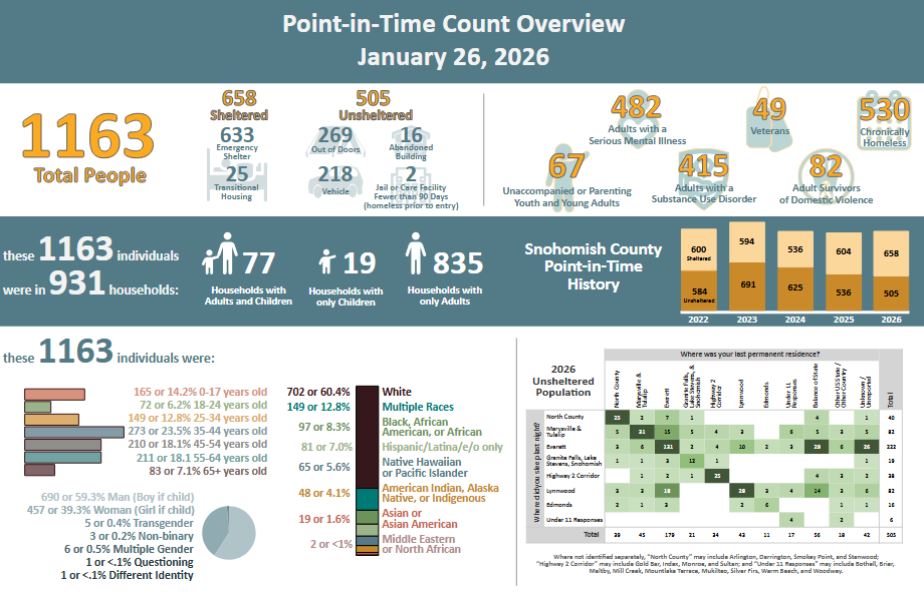
Most unsheltered households were adult-only at 434. Ten included adults and children under 18, and child-only unsheltered households rose to 1 from 0 in 2025. Sheltered child-only households increased to 18 from 17.


The 2026 count saw an increase in the total percentage of people who are American Indian, Alaska Native or Indigenous, multi-racial, and white, while the percentage of persons who are Asian or Asian American, Black or African American, Native Hawaiian or Pacific Islander, Hispanic/Latina/o/e, and Middle Eastern or North African decreased in 2026.
The total percentage of people ages 0 to 17, 25 to 34, and 65 or older decreased in 2026, while the 18 to24, 35 to44, 45 to 54, and 55 to 64 age groups increased. The largest percentage changes were an increase of 26% for people aged 55 to 64 and a 26% decrease in people aged 25 to 34. The percentage of women decreased slightly from 40.5% in 2025 to 39.3% in 2026 while the percentage of men increased from 58.3% to 59.3%. Non-binary, transgender, and persons of more than one gender accounted for 0.2%, 0.4%, and 0.5% of the total, respectively, and those who are of a different identity or are questioning their gender accounted for less than 0.1% each.
Of adults in the 2026 PIT Count, 482 (48.3%) adults reported having a mental health issue and 415 (41.6%) reported a substance use disorder, reflecting an increase from 46.6% and decrease from 45.8%, respectively, in 2025. Of these adults, 293 (29.4%) reported experiencing both issues. A total of 45.6% individuals were chronically homeless, a decrease from 47.2% in 2025.
The PIT count is required by state and federal governments and serves as a key tool for setting funding priorities and identifying trends. Snohomish County uses the data—along with other metrics—to guide efforts by the Partnership to End Homelessness in preventing, reducing, and ending homelessness.


Author: Mario Lotmore