

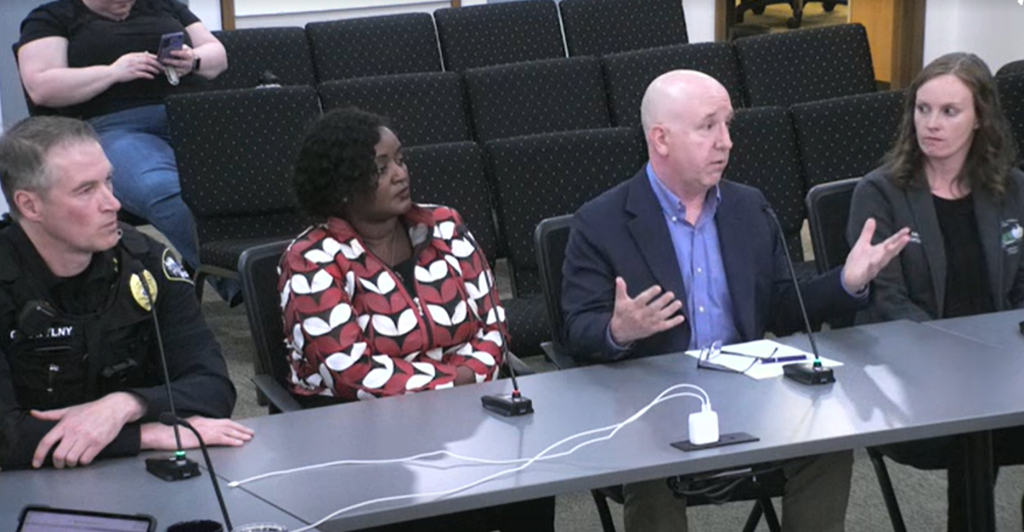
LYNNWOOD—The Lynnwood Community Justice Center (CJC) has reached full staffing and expanded mental health and substance abuse services after switching medical providers and partnering with New Era Mental Health. Jail Manager Gregg Curtis, Deputy Chief Curtis Zatylny, Community Support Specialist Andrea Mullins and Dr. Mercy Wainaina presented the update during the council’s May 18 work session, which included reliable medical coverage under Healthcare Delivery Services and new in-jail treatment, counseling and post-release wraparound support for inmates.
Staffing updates



The CJC currently has 28 staff members, having hired seven in the last six months. This is considered to be “fully staffed” as of now, though the capacity will increase to 31 in a few months. The minimum staffing levels (28, soon 31) allows the CJC to provide the safety and security necessary for the safe operation of the jail, Gregg Curtis, Jail Manager said.
“I think we’ve made significant progress. The challenge remains is that five people are still in training and that training process can often take up to six months,” said Curtis. “We’ve been fortunate to get some lateral applicants. In the coming months what we’re focused on is getting them trained, through the academy, and then available to become solo officers.”




Though the CJC is considered fully staffed, the challenge remains, Curtis continued, that there is almost always someone out on sick leave, vacation, PFMLA, training, and so on. Given that this is a 24-hour facility that has to run (to do bookings, security, medical, etc.) it’s paramount that the minimum staffing is available to ensure its operations.

Medical updates
Another big change at the CJC is its swapping from Wellpath to Healthcare Delivery Services on April 21 at midnight.
“The changes went relatively smoothly, and I’m impressed with the people that they’ve hired. They’ve been covering reliably with every shift we’ve had so far. That was the biggest challenge with Wellpath is not having that coverage reliably day in and day out. With Healthcare Delivery Services we’ve had that,” said Curtis.
What the CJC lost with its swap, Curtis continued is losing the medicate assistant treatments including substance abuse efforts and mental health counseling.
To account for this, they’ve partnered with New Era Mental Health who will be adding many of these services back “and then some.”
Just in the last week the CJC has hired several staff at New Era start including a coordinator, provider, discharge planner, and mental health clinician, and a counselor. The long-term model is that New Era will directly bill to Medicaid and insurance without the cost falling on the City of Lynnwood.
New Era also provides wraparound services outside of the CJC for substance abuse treatment
“That way they can receive substance abuse treatment in jail, and we can bill, and then when they’re released, we can still continue treatment, which is often difficult because they might not have insurance,” said Dr. Mercy Wainaina, Psychiatric Nurse Practitioner and Founder/CEO of New Era Mental Health.
Following release from the CJC, New Era also offers a nine-month program that provides housing, transportation, peer support, job training, and assistance in getting into low-income housing.
“Mercy’s program is incredible. We’ve used it to place 25 people in her program in housing, and we’ve also placed 70 in inpatient where she’s connected with them for housing. We’re proud of what we’ve done but with the caseload we could do more. I’m thankful that Mercy’s team is coming on to do more of the inpatient and substance use stuff so that I can coordinate stuff with other community organizations,” said Andrea Mullins, Community Support Specialist at the CJC.
The timeline for someone entering the CJC begins with booking, which includes a medical intake screening, gathering information on needs, substance use treatment, mental health concerns, housing, case management, and any additional information to help inform a release plan.
Then, within days one through five, referral sources begin (medical, mental health, custody, kite at inmate’s request, outside organizations, and Prosecutor/Defense Attorney).
Next, within the first week, inmates have an initial meeting where they identify next steps as far as alcohol/drug assessment, mental health referrals, case management, and housing.
Then, lastly, within weeks two through three, it ends with coordination and connection to services; discussing options, completing paperwork, setting up meetings, and necessary follow ups.
256 individuals have received full services including alcohol/drug assessment, treatment placement, housing and case management services since the CJC opened.
134 have completed drug/alcohol assessments through partnerships with Evergreen Recovery Center and Bison Health.
95 (70 inpatient placements and 25 intensive outpatient) individuals were placed in treatment including Housing organizations.
And 43 have been connected to active community partners consisting of inpatient and outpatient providers, case management organizations, housing services, and healthcare providers.
Opportunities and partnerships
Moving forward the CJC has applied for a grant that would add an additional officer and an additional social worker to expand its services.
“The jail requires an officer to standby any time someone is in person. As part of the request as part of House Bill 2015, there’s some grant funded where we ask for an extra officer and an extra social worker,” said Curtis. “I believe that covers about $125,000 — you match some of it. The goal would be to have that officer dedicated to programming and filling up as much of their schedule as possible with in-person and group classes.”
These classes would be NA, AA, and even classes hosted by the Department of Health.
The idea with the second social worker is to add to the work that Mullins is already doing while giving a quicker turnaround. The average length of stay at the CJC is only about seven or eight days, which doesn’t give a whole lot of time to provide the services needed. The added social worker would allow
So far CJC staff have not heard of the grant has been approved. Once it is, they would then have to get approval from Lynnwood City Council.
Additionally, everyone in custody receives a tablet which has thousands of hours of programming on it spanning from mindfulness to substance abuse and beyond. Though these programs aren’t as effective as in-person programming, it does provide an alternative option.
The CJC is also looking at partnering with Sea Mar Medical Clinic in Everett though this potential partnership is still in its early stages.
Council questions
Following the CJC staff’s presentation, Lynnwood City Council members had the opportunity to ask questions beginning with Council member Isabel Mata who asked if the jail has explored more “autonomous” models – allowing inmates to have free access to the facility free of officer supervision which, she said, would alleviate staffing and is based upon “studies” in which more autonomous inmates tend to be more successful.
Deputy Chief Curtis Zatylny responded that the jail is not currently equipped to practice that model, and that it may not be conducive to the types of services it intends to provide.
“We treat everyone with empathy. You just never know what’s going to happen. If we don’t provide that security and something bad happens we’re reliable for that so we have to have that supervision,” said Zatylny. “We’re working on efficiency, but we have to crawl before we run.”
Council Vice President Derica Escamilla asked for an update on how the jail is accepting other city’s contracts to which Zatylny replied that the CJC has been effectively accepting inmates from Edmonds. The goal, Zatylny continued, is that the CJC has 20 beds filled a day which they’re “hitting that mark” consistently.
Escamilla also asked what happens if an inmate is prescribed suboxone, for example, while incarcerated but needs to continue with the treatment following release. Dr. Wainaina replied that, through General Health, inmates can continue to receive medications up to three months even after release – filled through local pharmacies and paid for by insurance or Medicaid.

Author: Kienan Briscoe