

OLYMPIA [Jerry Cornfield]—The state of Washington on Tuesday asked the U.S. Supreme Court to accept a challenge against the state’s political maps, then remand it to a lower court to determine if the way the lines were drawn complies with a recent ruling in a Louisiana case.
“The lower courts should be given the first opportunity to apply that decision to the facts of this case,” reads the 19-page brief filed by Attorney General Nick Brown.

That scenario could lead to the state’s legislative district boundaries changing again before they’re next scheduled to be redrawn in 2031.
Jose Trevino and state Rep. Alex Ybarra, R-Quincy, who opposed the redrawn maps for the state Legislature, petitioned the U.S. Supreme Court in January to take up the case. It centers on the map that U.S. District Court Judge Robert Lasnik approved in early 2024 to enhance the political voice of Latino voters in the Yakima Valley.



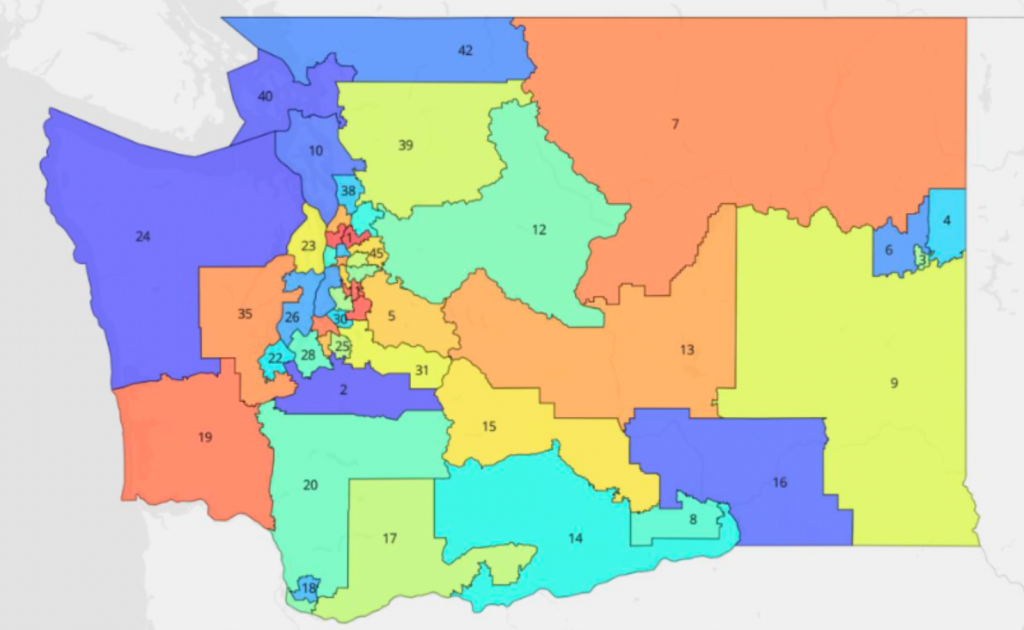
The controversial revamp shifted more than 300,000 people across 13 legislative districts in eastern and western Washington, revising boundaries the state’s bipartisan redistricting commission approved in 2021.
Tuesday marked the deadline for the different parties to tell the Supreme Court where they stood on the petition.
Attorneys for Trevino and Ybarra argued that Lasnik’s action was a “racial gerrymander” disallowed under the federal Voting Rights Act. The 9th U.S. Circuit Court of Appeals erred when it upheld Lasnik’s decision and concluded race was not the predominant factor in shaping the redrawn map, they contend.
There is a footnote in their petition pointing out a final decision in Louisiana v. Callais was pending and the outcome could result in a conclusion that the Washington case be reversed or remanded.
When the court ruled in that case in April, it significantly curtailed the use of race in drawing legislative boundaries. That energized opponents who tried, unsuccessfully, to get the Supreme Court to take up their petition right away, arguing it is “the only remaining avenue” to ensure the state legislative map used in Washington’s elections this year is in line with its recent ruling.
Meanwhile, the state had wanted to stay out of a tussle with the Supreme Court. In March it told the court it would not be responding to the petition from Trevino and Ybarra. But the Supreme Court required one.
Most of the state’s brief recaps the process the Washington State Redistricting Commission undertook in drawing the boundaries of legislative and congressional districts, culminating in maps approved by the Legislature. It also revisits the multiple rounds of legal battle.
It concludes by asking the court to grant the petition, vacate the 9th U.S. Circuit Court of Appeals judgment upholding the Lasnik decision and remand the case to that court “for further proceedings consistent with Callais.”
It notes that would be in line with how the Supreme Court dealt with recent redistricting cases in Alabama, North Dakota and Mississippi.
Brown offers no insight on whether state attorneys think the appellate panel will reach a different conclusion.
The original plaintiffs in the case are Latino voters who contested the 15th Legislative District borders adopted by the state’s redistricting commission and approved by the Washington Legislature in early 2022.
They want the Supreme Court to deny the petition. In their filing, they argue that those bringing the challenge have and continue to lack proper standing. And, plaintiffs’ attorney noted, the map approved by Lasnik and upheld by the appellate panel was drawn “without any consideration of race and selected by the district court based on traditional redistricting factors alone.”
Washington Secretary of State Steve Hobbs expressed no position on the petition. His interest in the litigation, the state’s brief reads, “is to ensure that election officials are able to meet election deadlines.”
SOURCE: This article was authored by Jerry Cornfield of the Washington State Standard part of States Newsroom, a nonprofit news network supported by grants and a coalition of donors as a 501c(3) public charity.

Author: Washington State Standard