


LYNNWOOD — Despite historic property and utility tax increases over the last two years, at its work session Monday, the Lynnwood City Council received updates from city departments on how budget cuts have affected service delivery as the city prepares its 2027-2028 biennium budget.
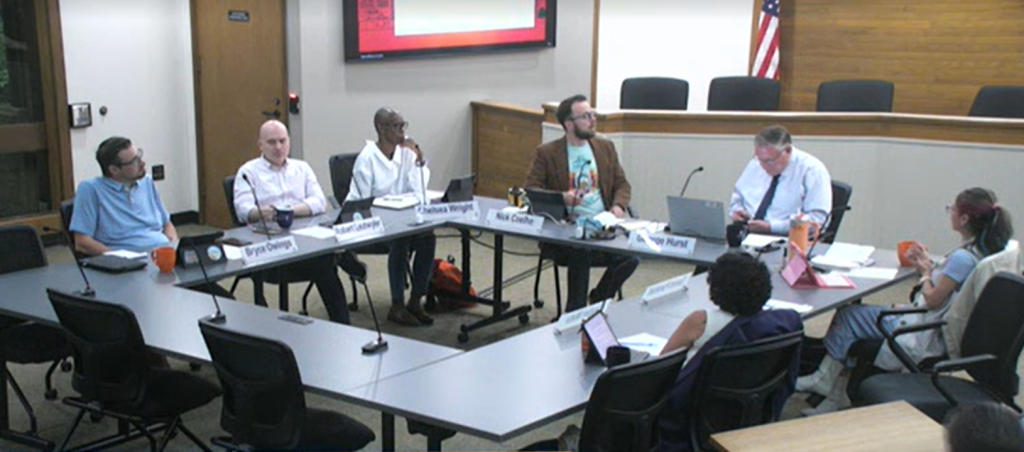
Departments presenting included Development and Business Services, Parks, Recreation and Cultural Arts, and the Police Department.


“Today is not about budgeting, it’s not about solving problems, it’s about understanding the budget cuts that were made and their impacts on local service,” Council President Nick Coelho said.
Development and Business Services



Ben Wolters, director of Development and Business Services, along with Community Planning Manager Karl Almgren and Linda Montano of the department, briefed council members on cuts made to address the city’s deficit and their effects on operations.

In 2024, the council adopted a two-year budget of $14,089,888 for the department and authorized 34.5 full-time equivalent positions. Last September, to help close the city’s deficit, the department froze four positions, laid off two employees (one of whom transferred to Public Works) and implemented other reductions. That trimmed roughly $1.84 million from the budget.
The department had already planned to leave six positions vacant through the end of the year. With three additional departures, it will operate at about 75% staffing — or 25.5 full-time equivalents — beginning Monday, Montano said.
Most of those positions are specialized and cannot be filled interchangeably. The department also made $524,000 in additional cuts, including reductions to dues and membership fees, professional services and contracts, annexation studies, farmers markets and economic development participation. It also scaled back code enforcement garbage cleanup, partially eliminated detached accessory dwelling unit processing, reduced work on the Unified Development Code and cut training, real estate appraisals and records archiving.
While the cuts have reduced efficiency, Wolters said the department has largely maintained day-to-day service levels as measured by permit processing times, the number of permits reviewed, issued and inspected.
“For the most part we’ve been able to maintain our service delivery … however if there’s any unavailability of our staff it immediately impacts that number,” Wolters said. “For example, if someone is out on vacation or calls in sick it has an immediate impact on our service delivery.”
Longer-range planning work — such as updates to the housing action plan and Unified Development Code — has slowed considerably, Almgren said. Customer service has also suffered, with staff less available to walk residents through complex processes such as accessory dwelling unit applications.
Parks, Recreation and Cultural Arts
Parks Director Joel Faber likened the department’s repeated budget reductions to a game of Jenga — “pulling things from the bottom, placing them on the top, and reallocating them to other people … though the structure is getting increasingly wobbly,” he said.
The adopted budget for the department was $21.85 million. Reductions totaled $2.12 million (about 10%) in 2025 and are projected at $465,593 (5%) in 2026. In 2025 the department eliminated 5.75 full-time equivalents, including coordinator, manager and youth/teen coordinator positions. It froze the park planner and a maintenance position, eliminated all travel and training, sold its entire fleet, cut Recreation Center hours by about eight per week (including all holiday hours), reduced program offerings and trimmed part-time staffing.
This year the department kept the Parks Manager and Parks Maintenance Worker positions frozen. The Customer Service Manager retired Monday and will not be replaced, Faber said. The department must also cut an additional 0.75 full-time equivalent in part-time hours, mainly from weight room and fitness studio coverage.
Proceeds from vehicle sales will help offset some reductions, but program cuts will continue. Examples include ending ASL interpretation for “Shakespeare in the Park.” The department has no funding left for community collaborator grants or its Human Services account, which previously provided hygiene supplies and socks for those in need.
Routine work such as vandalism cleanup, mowing Interurban Trail segments, irrigation, park inspections, tree care and parking lot maintenance will go unfinished this year. Other effects include slower customer service, no operational redundancy, a slowed planning process, stagnant innovation and underinvestment in staff development.
The biggest strain is on employees, Faber said.
“We have multiple staff that are doing what two or three staff were doing last year,” Faber said. “We’re spreading it out as best as we can, but there’s a lot of work they haven’t been responsible for in the past and I’m concerned about burnout.”
First-quarter spending in 2026 already exceeded 2025 levels by $27,362 despite fewer staff, driven by higher allocated costs, a 79% jump in insurance ($177,000 increase) and a 54% rise in utilities ($65,800 increase). To help offset revenue losses from reduced programs and hours, the department raised fees 20%.
Police Department
Police Chief Col Langdon outlined how budget constraints have affected the Lynnwood Police Department. For the 2025-26 biennium, the council authorized 128 positions — 80 commissioned officers, 48 civilian and non-commissioned staff, plus three custody officers arriving mid-2026. The budget also included $2.54 million in “vacancy savings,” equivalent to eight unfunded officer positions.
As revenues softened, Langdon paused hiring to preserve funds. The department was later asked to cut an additional 10%, which he said was not feasible because it already covers the $1.1 million photo enforcement contract, jail operations and the city’s 911 dispatch.
The department achieved savings by not extending fleet service life ($1.1 million, one-time), holding vacancies ($900,000), trimming training, academy, equipment, education and legal costs ($418,000) and transferring $924,000 in traffic safety fees to the general fund.
Current vacancies include one clerk, one records program technician, 1.5 crime prevention specialists, three custody officers, one animal control officer, two funded commissioned positions and 10 authorized commissioned vacancies. The department currently has 70 commissioned officers. To reach full authorized strength it would need to hire two more officers, Langdon said.
Fewer patrol and specialty officers mean higher call volumes per officer, longer response times and reduced capacity to handle traffic, gang activity, drug investigations, community engagement and quality-of-life issues. Staff also absorb extra duties such as animal control calls, public records requests (the department receives the majority of the city’s requests) and court-mandated filings. In 2025 the department handled 44,673 calls for service, 630 animal control calls, 1,400 shoplifting calls, 400 simple and aggravated assaults, and 3,220 public disclosure requests.
Jail and patrol shortages require significant overtime to keep operations safe. Langdon described the environment as a “pressure cooker,” especially after record call volumes.
“I have less staff, working in record-breaking years, to do this work and it is a real pressure cooker for them. They’re doing great because we’re lucky to have professionals, a great Sargeant, and a talented clerk supervisor,” said Langdon. “We are operating in really tight margins.”
Langdon shared a story about a suspect, who was arrested on a “very serious domestic violence charge” needed to be transferred to Lynnwood Jail from Western State. When it was disclosed that this suspect had a communicable disease, they needed to have him hospitalized, speak with attorneys, and use other resources costing $10,000 in overtime costs.
Compared with similar-sized cities, Lynnwood consistently sees higher workloads. In 2025 the department recorded 46,700 total incidents versus 27,400 in Edmonds and 24,800 in Lake Stevens. Retaining officers is also critical; each departure costs roughly $250,000 to replace, Langdon said adding “The public safety sales tax will be an interesting conversation in the future.”

Author: Kienan Briscoe




2 Responses
Seriously?
This council is more concerned about banners being placed in more visible areas than safety at the parks. I am worried about going in for open swim, it sounds like if you ask for a towel the staff might snap and breakdown. Did somebody take the park directors toy away and tell him to work? Turn that frown upside down, it may get worse before it gets better. Time to add a grief counselor to the city staff.
“Routine work such as vandalism cleanup, mowing Interurban Trail segments, irrigation, park inspections, tree care and parking lot maintenance will go unfinished this year.”
So after they’ve pretty much destroyed Scriber Lake Park they’re not even going to open it up? And if they do, does that mean that they’re not going to plant anything after everything that they’ve taken out of it? They’ve taken out hundreds of trees and all the habitat, the two coyotes that used to live in there relocated, and all the Red Wings are located in my part of the neighborhood now, lived here 15 years and never had one until they went in there and started messing with the park. They took out way more than they needed to put those walkways in. Now it’s strictly ornamental and very sterile looking. Where Shrubbery used to be it’s just mulch and a few tiny shrubs if anything. All spaced widely apart, not even a sparrow could use it. It’s strange that they had the money to destroy it, but now that it’s time to put a little back in of what they’ve taken out, all of a sudden they’ve got no budget for it. But of course! Very poor planning. I think that was probably the whole point anyway to destroy our parks, it was so unnecessary. It will take decades for any trees to grow back naturally. Assuming they let them.