

LYNNWOOD— As Allied forces stormed the beaches of Normandy on June 6, 1944, helping turn the tide of World War II, 9-year-old Barbara Tillman was hiding from Nazi persecution in occupied Poland. Eighty-two years later, the Quail Park Lynnwood resident still remembers the phosphorous bombs that lit the night sky, the smell drifting from a nearby concentration camp, and the constant fear that her family would be discovered. Her survival through war, displacement and trauma would ultimately inspire a 50-year career helping others heal from their own hardships.
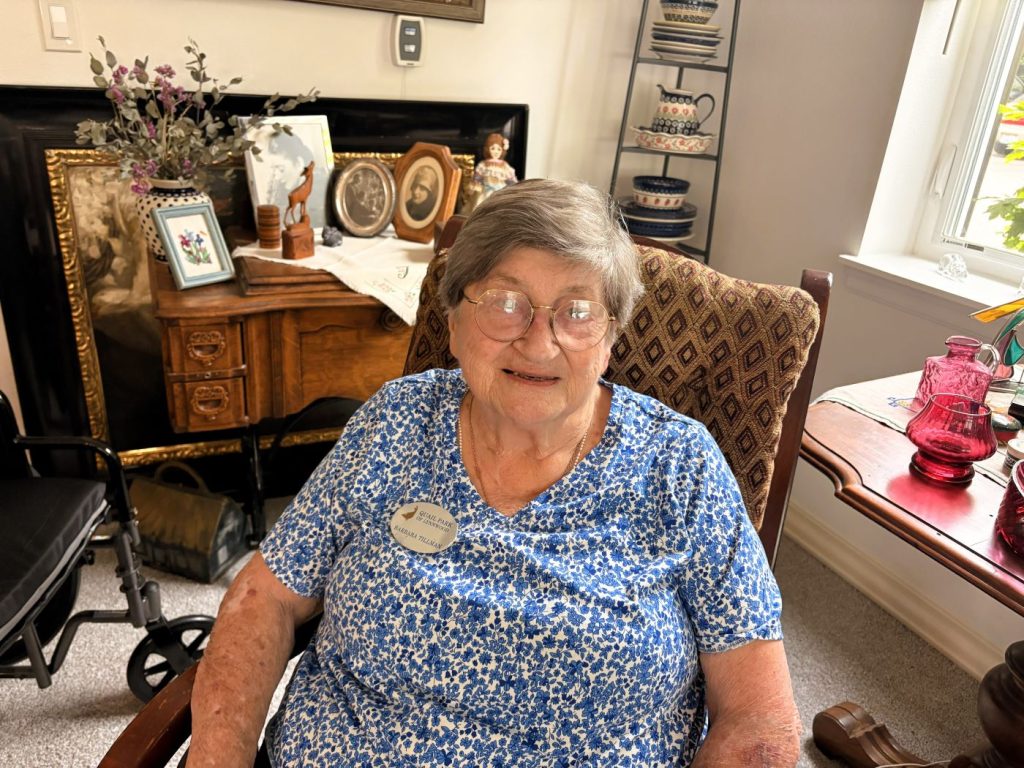
Tillman was born in 1935, four years before the start of World War II. As a girl she recalls vividly the day Germans entered her home country of Poland. She was staying at her grandparent’s house at the time, who hid her in the bathtub filled with a mattress and pillows. After a while she emerged from the bathroom, shocked to see that it was “daylight” outside, though she was certain it should be night. She later learned that this “daylight” was the effect of phosphorous bombs – so soldiers could see where the railroads were in an attempt to destroy them.



Tillman’s mother was Jewish but converted to Catholicism when she married. Still, being ethnically Jewish, and having brown eyes, the Nazis didn’t care.
“I didn’t learn of my heritage until after the war. But I knew my eyes being brown, they would pick you up and take you to a concentration camp, or just execute you somewhere,” said Tillman. “Brown eyed people they felt were either Jewish, or gypsy, or something. So, you weren’t going to survive.”




Her family escaped to Lublin shortly after, where they lived in an abandoned apartment building with no heat. Tillman recalls the days living here as sitting on the floor, next to her mother, buried in fur coats to keep warm.


“I still had frozen cheeks,” Tillman said.


From Lublin her family moved to Warsaw, where they lived until the end of the war.
“The name of the game was to move around constantly so they couldn’t pick us up. My father, and my mother, and everyone would have been shot because my father knew of our heritage. He moved us around from place to place. It was a constant move, but we stayed safe,” said Tillman.
Both Tillman’s parents were members of the underground, working relentlessly to usher people from cities to the nearby woods, or false bathrooms, to hide out, bringing them food every now and then.
Tillman was unable to get a proper education during the war, with almost every academic institution kicking her out the minute they discovered she was partly Jewish – afraid the Germans would infiltrate the class and kill the children.


Consequently, Tillman’s mother hired a governess to teach her in a secret school, alongside other brown-eyed girls, for the next three years. This governess, who Tillman remembers was “very smart”, taught her a basic education, including how to speak French.
Throughout the war Tillman remembers the shortage of food yet still being required to feed the soldiers who would help themselves to their home – often with guns drawn.
“We had a barrel of sauerkraut, some pickles, turnips, oatmeal, and flour to make bread,” said Tillman. “It was really difficult to feed five or six soldiers when we could barely eat ourselves.”
Tillman has had back problems most of her life, which she later learned from a doctor that it was due to malnutrition as a child. She also remembers having a family dog who was trained to lie down whenever soldiers entered, or else he’d be shot. When the soldiers would enter Tillman remembers seeing them from the reflection of the bathroom mirror where she would be hiding.
“They’d put a gun to your head and you do whatever they say,” said Tillman. “I remember from my second story window I could see, from an empty field, where they built a concentration camp. If you opened the window, there would be this awful smell that I can still smell to this day. After the war I learned that they had an oven at this camp where they were burning people…that smell was just always with you.”
Tillman shared with the Lynnwood Times that to this day she can’t eat gravy because it reminds her of the smell. She also, to this day, gets shivers whenever she hears the sounds of boots on cobblestone.
“There’s things that just stay with you and you can’t forget them,” said Tillman.
Tillman recalls where she was when the allied forces stormed the beach of Normandy on June 6, 1944, and where she was when the war came to an end in September of 1945. Her aunt, she recalled, had a radio buried in the woods outside town and would occasionally head out into the woods to get updates.

The amphibious Normandy invasion (a.k.a. D Day) was especially memorable to Tillman because it just so happened to be the first day she ever got drunk, she shared. Her uncle had been making his own liquor out of fermented fruit and Tillman helped herself to some of the cherries used – her favorite fruit – not knowing they would have the effects they did.
Even after the war was declared over things didn’t immediately return to normal though. Russian soldiers remained in Poland for some time, Tillman remembered. Though the German soldiers were mostly educated, to some extent, according to Tillman the Russian soldier was not.
“They were very crude,” said Tillman.
Tillman remembers the soldiers forcing people to dig a ditch before they would be shot. The sounds of people crying, she shared, have forever been etched into her memory. She didn’t believe it was even real until years later when she met with a cousin in Poland and asked if she had the same experience.
The first time Tillman saw the words “U.S.A.” was when American tanks entered her city to liberate it. At the time, she had no idea what the acronym meant. Tillman’s mother was awarded the Medal of Righteousness for the work she did working in the underground and saving countless Jews from concentration camps.
Tillman’s family eventually relocated to Sweden, then Canada, and eventually New Jersey, U.S.A. in 1947, where she enrolled in a Polish-speaking school. It was here where she learned English for the first time. After completing her education Tillman enrolled in college at Kansas City University, where she studied Psychology, and received her master’s degree at California University in Clinical Social Work.
“I had gone through quite a few experiences, and I thought there was a reason why I was still alive, and I figured I needed to learn a little bit more about me,” said Tillman of her decision to study Psychology.
Tillman was the only one of her childhood friends who survived the war. Years after the war she continually asked herself the question “why didn’t I die?” She figured that she had to have a purpose in life.
She remembered visiting a Jewish bakery, years after the war, where she saw the bakers bearing tattoos which they had gotten from Auschwitz. She thought “if they survived Auschwitz, why do they want to bake bread?” But then, on the drive home, it hit her. They baked bread because that’s what they knew. But people like Tillman enjoyed their bread and was grateful that they did.
“But that wasn’t enough for me. I needed to do more than that,” said Tillman.
Tillman became a social worker – where she worked for 50 years, including 20 years with her private practice. Through her work she helped numerous abused women and children, wanting to use her second chance at life to help others undergoing trauma.
Through her work unraveling the complexities of trauma Tillman developed a theory, which she calls the ‘Lemonade Theory.’
“If you try to drink a lemon you can’t do it, and that’s the abuse. But if each day you put in a little bit of water, and a spoonful of water, by the time the pitcher is full you will have lemonade and you can drink it. It doesn’t mean that the abuse didn’t happen, but it might mean that you could live with it,” said Tillman.
For years Tillman couldn’t talk about her experience in World War II without crying and experiencing PTSD. These days she chalks up her courage to her lemonade theory.
“At the same time. You heal slowly,” said Tillman.
Aside from building her own social work career, Tillman married her husband Charles in 1957. Together they had four children but both their oldest, and youngest, tragically died of cancer. The couple moved to Lynnwood, at Quail Park Assisted Living Center, to be closer to their son who works at Microsoft in Bellevue. Their other son currently lives in Pennsylvania and serves as active military.
Barbara and Charles Tillman were married for 68 years until his death last in 2025.

Author: Kienan Briscoe