
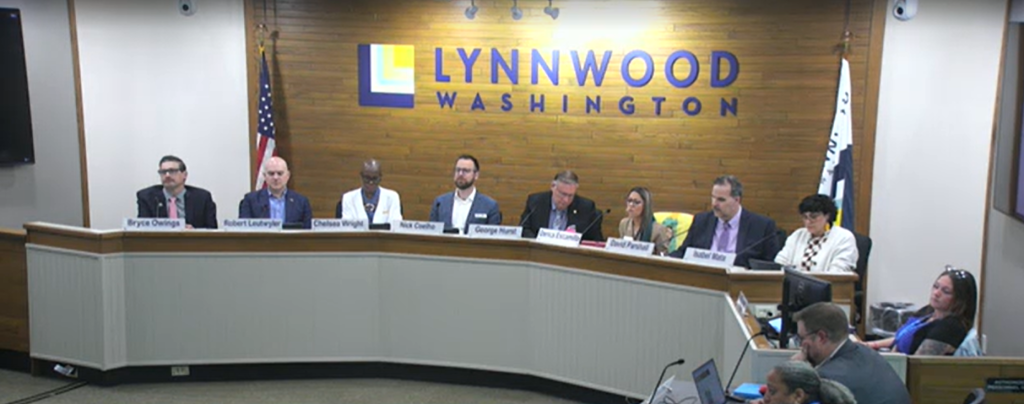
LYNNWOOD— The Lynnwood City Council held a public hearing on its 2026 Comprehensive Plan Amendment List (PAL) and was briefed on its Economic Development Infrastructure Fund (EDIF) at its Business Meeting on Monday, June 8.
Economic Development Infrastructure Fund (EDIF)
Public Works Director Jared Bond and Development and Business Services Director Ben Wolters led a discussion on the city’s Economic Development Infrastructure Fund (EDIF).

The EDIF was enacted in 2015 to fund infrastructure improvements that make development projects more feasible and attractive. It supports transportation, utility, streetscape, and other public facility projects tied to economic growth, while encouraging development and higher-density mixed-use development in targeted areas and leveraging public investment to stimulate additional private-sector investment and job creation.
The way it was structured in 2015 was through two funding sources: first, a construction sales tax (from building and heavy construction projects), with annual revenue above $1 million transferred into the EDIF; and second, building permit revenue—which was effectively removed in 2020.




“As the council considers future infrastructure investments, that linkage between economic development, infrastructure, and placemaking—creating places where people and businesses want to be—really starts to tie together. That’s certainly the basis for the strategies in place to realize the City Center vision, and if there’s an opportunity for the city to recreate some version of EDIF, one of the greatest advantages of that fund is it provided a lot of financial flexibility that helped advance projects,” said Wolters. “It’s that flexibility that makes us more competitive for grant opportunities, which has really played an important part in Lynnwood for some of the big projects we’ve been doing.”

On the other hand, Wolters noted that there is a catch to relying too heavily on tax revenue to provide basic services.

Construction is the third-highest revenue source for the City of Lynnwood, after retail and vehicle sales, generating approximately $2,490,000 in 2025.
From 2016 through 2019, while EDIF was in place, about $5.9 million was brought into the city over four years, while $4 million went to the General Fund. It also generated about $640,000 in interest.
However, EDIF was permanently placed on hold by the council in 2020 during the 2021–2022 budget process due to concerns over potentially lower sales tax revenue during COVID and to preserve flexibility during a financially uncertain period.
To date, revenue generated by EDIF has been spent on: Fund 357 (Other Government Capital) – South Lynnwood Improvement Project; Fund 360 (Transportation Capital) – the 196th Street Southwest Improvement, EVLE Lynnwood Corridor (33rd Avenue and 184th Street future light rail station), 42nd Avenue West (City Center grid street), 198th Street Southwest and 44th Avenue West right-of-way acquisition, ADA Ramps and Sidewalk Program (sidewalk along Veterans Park), Beech Road Improvement, 33rd Avenue Ring Road (Costco traffic), and 38th Avenue West and 194th Street Southwest Ring Road (PFD redevelopment); Fund 370 (Facilities Capital) – City Hall, NAB, DBS Move Project; and Fund 380 (Parks and Recreation Capital) – Scriber Creek Trail.
These projects were determined through public outreach initiatives, as well as by identifying projects that would give the city grant leverage and advance the city’s economic goals while attracting new investment.
Potential next steps for the council’s consideration include reinstating EDIF by ordinance or adjusting the funding “bar” to a level higher than $1 million annually.
The goal, according to Bond, is to set the “bar” at a level that does not inadvertently negatively affect the General Fund and uses unplanned excess revenue to reinvest back into the community and potentially spur additional growth.
The council has six options for raising the bar, beginning with keeping it at $1 million, which would generate approximately $1.7 million in annual revenue, to raising the bar to $3.5 million, which would generate $0 in annual revenue.
Bond said that reinstating the EDIF could potentially fund the Events Center Redevelopment, City Center Town Square Park, 42nd Avenue West Grid Street, and Northline Village, though he added that the possibilities are virtually limitless.
Ultimately, city staff recommended that the council reinstate EDIF but wait until the fourth quarter of 2026 because, based on the 2027–2028 budget process, staff will have a better understanding of future sales tax forecasts and where to set the “bar.”
Additionally, by the end of the year, the city may have a Finance Director who, Bond said, would have valuable insight during the decision-making process.
“There’s really no rush on this,” said Bond.
Comprehensive Plan Update Amendments
The City Council was also briefed by Community Planning Manager Karl Almgren about current Comprehensive Plan updates during a public hearing.
According to Almgren, the only applications for amendments to the city’s current Comprehensive Plan involve annual updates to information such as demographics, though the city is officially putting out a call for the public to apply for any additional amendments, such as zoning changes.
The Comprehensive Plan update is currently in its “docket” process, or PAL. Prior to Monday’s meeting, the council was briefed by the Planning Commission on April 23, was presented with a memo on May 4, and heard the Planning Commission’s recommended changes on May 14.
The next steps are for the council to move forward with and approve the PAL at its June 22 meeting.
Analysis and environmental review of each amendment will be conducted after the docket (PAL) is established by the council.
Public hearings will continue to be held by both the Planning Commission and City Council for each amendment in the fall of this year.
Despite it being a public hearing, there were no comments from either the public or council members, and the hearing was adjourned fairly quickly.

Author: Kienan Briscoe