


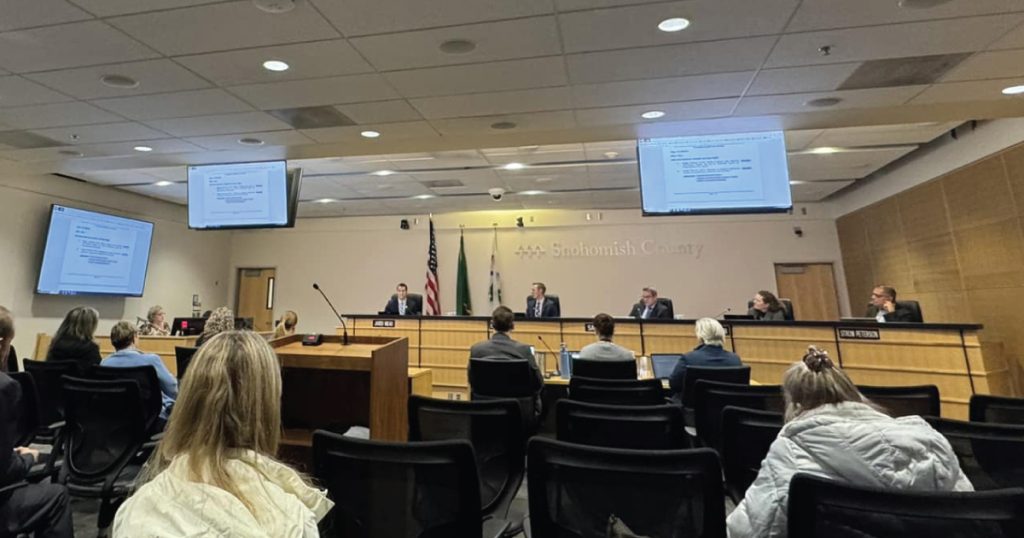
EVERETT — The Snohomish County Council on June 10 approved two ordinances aimed at expanding treatment-focused approaches to addiction and housing while protecting children from fentanyl exposure, but postponed a third measure that would have carved out dedicated funding for behavioral health facilities.
“These ordinances represent a step in the right direction for our fight against the epidemic of drug addiction in Snohomish County,” Councilmember Nate Nehring sponsored the measures as part of a three-bill package intended to provide accountability and recovery within the behavioral housing support model, told the Lynnwood Times. “As a community, we must be focused on balancing compassion with accountability to protect the most vulnerable among us. This morning, we affirmed our shared commitment to that cause.”



After more than three-and-a-half hours of public testimony and extended debate, the council voted 3-2 to pass Ordinance 26-019, which adds a new section to county code governing how local housing funds are allocated. It passed Ordinance 26-016 unanimously, creating a new gross misdemeanor for exposing children or dependents to controlled substances.
Ordinance 26-018, which would have directed 20% of revenue from the county’s Affordable Housing and Behavioral Health sales tax into a new Behavioral Health Facility Expansion Fund starting in 2027, was sent back to the Human Services Committee without a vote.




Ordinance 26-016: Child Endangerment Protections
Ordinance 26-016, approved unanimously, adds Chapter 10.50 to the Snohomish County Code, creating the offense of “Endangerment with a Controlled Substance.” The measure makes it a gross misdemeanor to knowingly or recklessly permit a child or dependent person to ingest, inhale, or have contact with any controlled substance, with exceptions for valid prescriptions issued to the child or dependent and for cannabis.



“I want to thank the City of Everett for passing their ordinance, which was used as a model for this county legislation,” Nehring said. “My hope is that with a renewed focus on holding those who expose children to drugs accountable, we can save lives.”
State law under RCW 9A.42.100 already treats similar exposure to methamphetamine and certain precursor chemicals as a Class B felony. The new county ordinance fills the gap for other substances, including fentanyl, by establishing a lower-level misdemeanor offense with penalties of up to 364 days in jail, a fine of up to $5,000, or both. The chapter includes aligned definitions from state law and a severability clause.
Public testimony strongly favored the change, with speakers describing it as common sense protection for children.
Everett resident and former Lake Stevens Councilman Todd Welch shared that the ordinance applies the same legal principle already used in state law for firearms storage and DUI cases involving minors.
“If you knowingly or recklessly allow a child to ingest, inhale, or come in contact with a controlled substance, that is a crime,” Welch said.
Similar local ordinances exist in the city of Everett, which passed its version in March 2026, and in Pierce County, which adopted comparable language in 2024. Spokane Valley has also advanced related measures.
Ordinance 26-019: Housing Funding Rules
The measure passed 3-2, with affirmative votes from Nehring, Councilman Jared Mead, and Council Vice Chair Sam Low. Chair Megan Dunn and Councilman Strom Peterson voted no.
“With this legislation, we can be sure that local county dollars will be focused toward programs that deliver the best results rather than prioritizing programs based on ideology,” Nehring told the Lynnwood Times.
Ordinance 26-019 adds Snohomish County Code 2.400.066, titled “County Funding for Housing.” The measure prohibits the county from using its own funds or pass-through state and federal dollars to require, incentivize, or give priority to housing providers that offer temporary or permanent housing with no or minimal entry or participation requirements. It also bars the county from prohibiting, discouraging, or giving lower priority to providers that include requirements for sobriety, treatment, counseling, or illicit drug testing.
The restrictions apply to solicitations, scoring metrics, subrecipient agreements, and contracts. A subsection provides an exception if a state or federal grant or contract would require the prohibited approach and the county would otherwise lose funding.
The ordinance does not create criminal or civil penalties for individuals; noncompliance would result in administrative or legal consequences for county funding decisions.
During debate, Councilman Peterson expressed concern that the ordinance would impose new administrative burdens on nonprofit housing providers such as HASCO, requiring additional paperwork and staff time without changing current practices.
“I think every dollar is critical in this space, and any dollar that we have to spend to support a staff member at HASCO or a staff member at Housing Hope or a staff member at Catholic Community Services or the YWCA or the Salvation Army to make sure that certain things of paperwork are filled out correctly is not a good use of resources,” Peterson said.
He continued, ““It [Ordinance 26-019] does change how much our nonprofit housing providers are going to have to spend in order to fulfill what’s inside this ordinance. That concerns me, so I would not want to support this ordinance now if it doesn’t really change what we’re doing, but it costs more money on the back end for these housing providers that are doing incredible work in Snohomish County.”
Councilman Nehring pushed back directly to Peterson’s assertions.
“It doesn’t change what we’re doing, then it shouldn’t cost more money,” Nehring said. “We’ve heard very clearly from human services in committee that this would not add staff time on their end. I think the idea that on the nonprofit side it would add staff time is just frankly incorrect. Right now, anybody can apply… This intends to codify maximum flexibility.”
He continued, “So the idea that HASCO or anybody else would need to add staff to go through essentially a more bureaucratic process is just incorrect. It would be going through the same process they go through right now.”
Councilman Mead supported the measure, arguing that government often focuses too heavily on process over outcomes.
“We don’t look at people as humans when we’re talking about these funds,” Mead said. “We’re talking about them as data points. And we talk about heads in beds. We talk about the studies, and we kind of have the conversation on this academic realm. And that lends itself to us having the debate on the political realm as opposed to on the human realm of rationality and honesty.”
Mead then went on to share a very personal story—his lived experience with addiction—to as to why a spectrum of housing options are needed. He described his mother’s recovery through rehab and detox, his brother’s ongoing efforts with Suboxone, and his biological father’s death from a fentanyl overdose alone in a homeless encampment three years earlier.
“My dad, my blood father, left my family when I was six years old. He stuck around for a few years doing the weekend dad thing, but after 10, I didn’t see him for 21 years until a few years ago,” Mead shared. “I tracked him down and found him in a homeless encampment in Southwest Washington. And I actually went and spoke with him, sat with him for seven or eight hours and showed him pictures of his grandkids. And we cried together and shared our stories and he told me about his life. And we made plans to reconnect later in the year and let him meet my wife and let him meet his grandkids. And then three months later, I get a call from the King County coroner’s office asking me if I wanted to come pick up his body. He had died of a fentanyl overdose. This was three years ago in a tent by himself in the woods. And that is the story of his life through addiction.”
Mead shared that “addiction is different” for everyone and that a spectrum of services is needed beyond the Housing First model.
“So, my point is that we should have a spectrum of services. We should have Housing First options and treatment first sober housing options. And with a policy like this, that’s all that is codifying,” Mead said.
Council Chair Dunn, who championed creating the 1590 behavioral health fund, opposed the measure, pointing to legal and operational ambiguities raised by Housing First providers.
“It’s really a spectrum, and we need to be able to be flexible to meet the most urgent need,” Dunn said. “Unfortunately, I feel like this ordinance is creating a false binary that is putting housing stability against accountability, and it’s not going to be serving our community. In my opinion, this ordinance isn’t offering results or solutions, and it’s relying on misinformation.”
Peterson further pointed to Trump administrations shift in federal policy on homelessness funding away from Housing First as more of reason to protect those funds at the local level.
“I think certainly the Trump administration is moving away from the housing first model,” Peterson said. “I haven’t seen a study yet that has shown that the housing first model is not broadly more effective than others. And I’m not, this does not mean that every type of housing should be housing first, but the housing first model is broadly the most effective model. And again, the Trump administration is quite radically changing the funding stacks for those, and that is troubling.”
Ordinance 26-019 aligns more closely with the direction of the federal changes by ensuring local dollars are not restricted to just a single model but a spectrum of options.
Since 2025, the U.S. Department of Housing and Urban Development (HUD) under the Trump administration has moved away from strict adherence to the Housing First model, which provides permanent housing without preconditions such as sobriety or treatment participation.
HUD has prioritized transitional housing, outpatient addiction treatment, job training, and programs with greater accountability, stating that the current Housing First model fails to address root causes like illicit drug use and mental illness which creates long-term dependency. The FY 2026 Continuum of Care Notice of Funding Opportunity, published June 1, 2026, reflects these priorities.
Washington Attorney General Nick Brown is co-leading a multi-state lawsuit filed in November 2025 challenging HUD’s changes as unlawful and lacking proper authorization. A federal judge issued a preliminary injunction in December 2025 blocking implementation of the new rules, and HUD has appealed. The full shift currently remains partially blocked by the injunction.
Many speakers with lived experience in recovery, during extensive public testimony Wednesday, described Housing First approaches as enabling ongoing addiction, contributing to property degradation and overdoses inside facilities, and creating a revolving door back to the streets.
South County Fire Commissioner Joseph Wankleman described conditions in one county-funded building, including buckets of human feces and photographs of deceased residents.
Carol shared King County data showing a 282% increase in overdose deaths inside permanent supportive housing between 2020 and 2023.
Edward, a recovering fentanyl user, said he failed multiple attempts under low-barrier approaches until receiving detox and treatment. Mike Kersey, who has helped more than 1,000 people access treatment, said the Housing First model “doesn’t work” and called for greater accountability.
Opposition came mainly from affordable housing nonprofit representatives, who argued that the ordinance solves a problem that does not exist because the county does not currently prioritize low-barrier programs and that vague language around “minimal” requirements would create administrative burdens and slow projects.
Ordinance 26-018: Behavioral Health Facility Funding
The council did not vote on Ordinance 26-018 that would have amended Snohomish County Code Chapter 4.126 to create a Behavioral Health Facility Expansion Fund.
The measure proposed would have allocated, beginning January 1, 2027, 20% of revenue from the county’s 0.1% Affordable Housing and Behavioral Health sales tax to be deposited into a new fund and earmarked to be used for purchasing, constructing, or acquiring land for behavioral health facilities.
Peterson was not comfortable supporting the measure because it lacked input from housing providers.
“Not only do we involve staff, but we involve some of the people that I think are, you know, we have housing providers that have been, using this fund, I think, fund collectively and well to kind of get a sense from them as to the best way to spend money,” Peterson said.
Dunn expressed concern about locking up funds and delaying their use in the community.
“So we know we need more options for treatment. We need more housing. We need more dollars for all of this… So, my concern was more around the urgency and the need to get the dollars out into community and not hold dollars back because the amount of funding needed for a facility was upwards of $40 million, and that would take decades using the set-aside,” Dunn said.
A clear majority of public speakers supported earmarking 20% of revenue from the county’s 0.1% Affordable Housing and Behavioral Health sales towards facilities, arguing that the county lacks sufficient brick-and-mortar treatment capacity and that dedicated funding would create permanent infrastructure rather than temporary grant-dependent programs.
Mark Hanson shared Snohomish County’s own homeless count data showing more than 48% of surveyed adults reported mental health issues and more than 41% reported substance use disorders.
Todd Welch shared that “housing alone does not fix addiction” and that Washington state leads the nation in fentanyl-related emergency room visits. He argued the 20% carve-out would create permanent infrastructure rather than temporary grant-dependent programs and would position the county to leverage future state and federal matching grants.
Several speakers said they would prefer a larger percentage but viewed 20% as a necessary first step.
Opposition came from Rachel Downs, speaking for Housing Hope and the Snohomish County Partnership to End Homelessness, saying that the change would restrict the county’s only local capital source for deeply affordable housing at a time when the comprehensive plan calls for more than 84,000 new units affordable to households below 60% of area median income by 2044. She urged the council to reject the measure.
Similar concerns about reduced flexibility and project delays were also raised by representatives from the Housing Authority of Snohomish County and other housing organizations.
Councilman Mead moved to send the measure back to the Human Services Committee for further review, which was agreed upon unanimously.

Author: Mario Lotmore





One Response
Kudos to those brave enough to pass this. It’s a start. I have a relative in Seattle that lives under the housing first model. I am always meeting new “friends” when I visit. Unfortunately, there’s a death sentence hanging over the addicted and drunk inhabitants of the housing first abodes. To Strom and Megan, you are not serious people, and you have no business being in your positions, retire.