

NEW YORK — SpaceX marked its entry into the public markets (SPCX) Friday with dual ceremonies that spanned New York and Texas, as the company that pioneered reusable orbital rockets completed the largest initial public offering (IPO) in world history. At the offering price, SpaceX carried a valuation of about $1.77 trillion. By the close, its market capitalization exceeded $2.1 trillion—equivalent to the economy of Brazil or Canada.
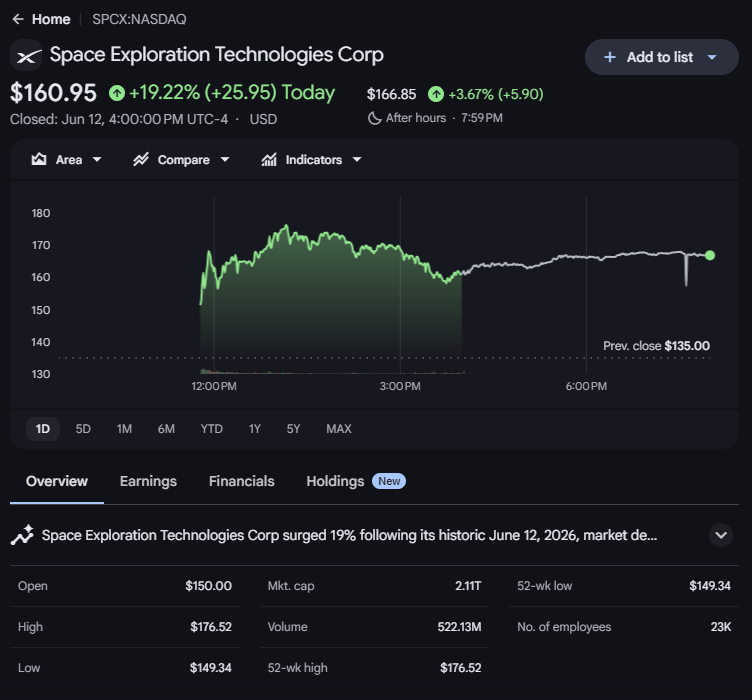
SpaceX priced its IPO at $135 per share Thursday evening, selling 555,555,555 shares and raising a record $75 billion. Trading began under the ticker SPCX. The stock opened at $150, an 11% increase, and closed at $160.95, a gain of $25.95 or 19.22%. It reached an intraday high of $176.52.


More than 500 million shares changed hands during the session. The offering included an overallotment option allowing underwriters to sell up to an additional 83.3 million shares. Morgan Stanley served as joint lead bookrunner and sole stabilization agent, working alongside Goldman Sachs.
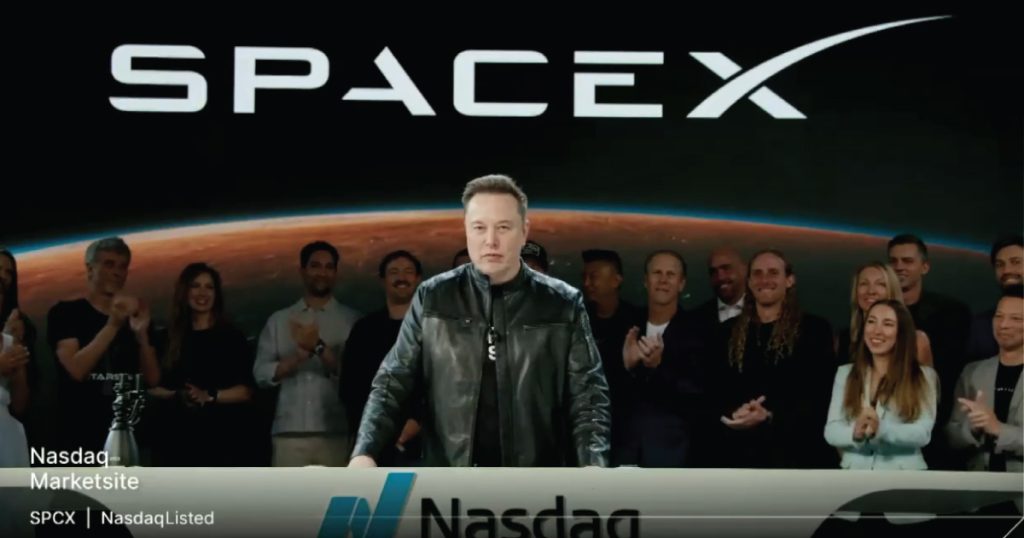
Elon Musk, the company’s founder, rang the Nasdaq opening bell remotely via video link from Starbase, Texas, where he stood with thousands of employees. In New York, at the Nasdaq MarketSite, President and Chief Operating Officer Gwynne Shotwell joined other executives for the on-site ringing.




“Today we make history again,” Shotwell said. “We have a history of making history. So, I want everyone to know that we did open this morning in a rather exciting way. We launched. Falcon 9 launched Starlink satellites to orbit. So what company would do such a thing on the day that they open in the public market? SpaceX would, right?”


She shared the company’s milestones since Musk’s founding in 2002 to building rockets and spacecraft capable of taking humans to Mars, the Moon and beyond.
Shotwell pointed to the 2008 Falcon 1 success that put the first privately developed liquid-fueled rocket into orbit, followed by Falcon 9 reaching orbit two years later. She then praised the company’s achievement of sending the first private crewed mission to the International Space Station and the 165 launches in the prior year.
Shotwell also referenced the acquisition of xAI, which she said gave the combined group “the largest coherent gigawatt class compute on the planet, which will help us truth seek and understand the universe.”
She then praised SpaceX’s 23,000 employees, of which more than half bought additional stock in the IPO, totaling almost a billion dollars, and thanked families for supporting the demanding workload to being the best spacefaring company in the world.

Musk, appearing by video from Texas, thanked Shotwell for her long partnership.
“It is certainly hard to believe that a little company that started in a warehouse in El Segundo is now going public with the largest IPO ever,” Musk said. “I gave SpaceX less than a 10% chance of succeeding at all, to be clear. In fact, I told people this. I said, look, we’re probably going to fail, but we should give it a try. Because if we don’t, if there’s not a new company that enters space, we will never be a truly space-bearing civilization.”
Musk stressed the company’s goal of making Humanity a multiplanetary species.
“We want to be able to take anyone who wants to go to the moon, anyone who wants to go to Mars, or anyone in the solar system, and maybe beyond the solar system at some point, we want to be able to take you there,” Musk said. “Not just a few astronauts, I mean you, literally you.”
SpaceX designs, manufactures and launches advanced rockets and spacecraft. Its core technologies include the Falcon 9, whose first-stage booster routinely returns to Earth for reuse, and the larger Falcon Heavy.
The Dragon spacecraft has carried cargo and crew to the International Space Station.
Starship, the fully reusable next-generation system, is designed for heavy-lift missions to the Moon, Mars and beyond and remains in active testing. Starlink operates the world’s largest satellite constellation, delivering broadband internet from low Earth orbit.

Author: Mario Lotmore