

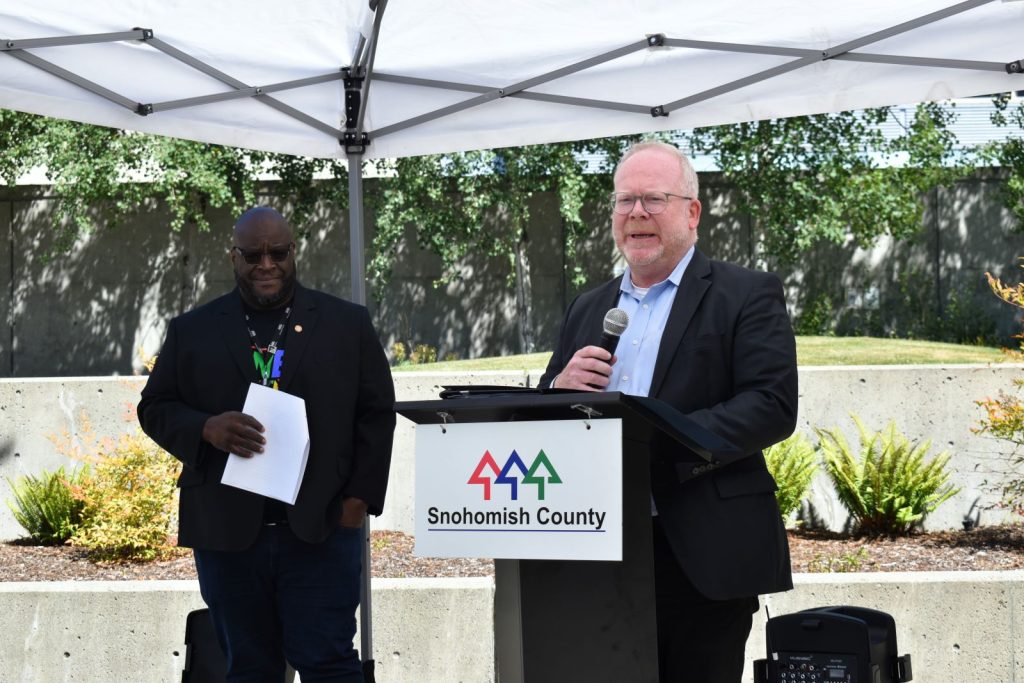
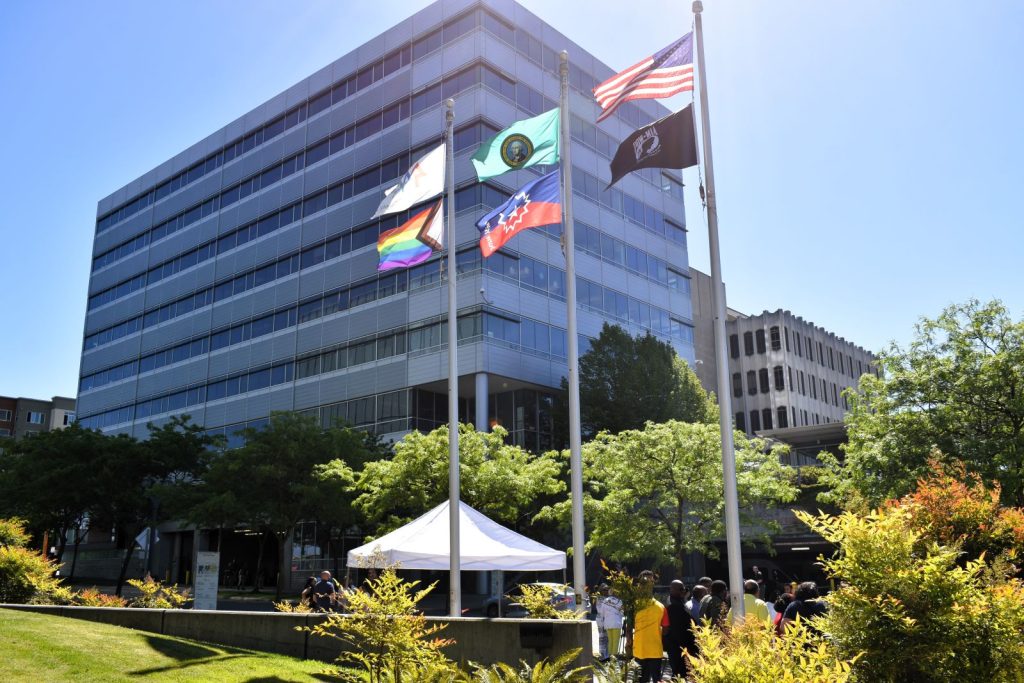
“When I thought about Juneteenth, I think of the insidious evil of those who knew what had happened [Emancipation Proclamation that freed slaves] in Texas and stayed silent [keeping Blacks enslaved]… So that’s what freedom means to me: we cannot be silent,” opened Kent Patton, Snohomish County Deputy Executive, during the fifth Juneteenth proclamation and flag-raising event at the County Campus on Thursday, June 18.
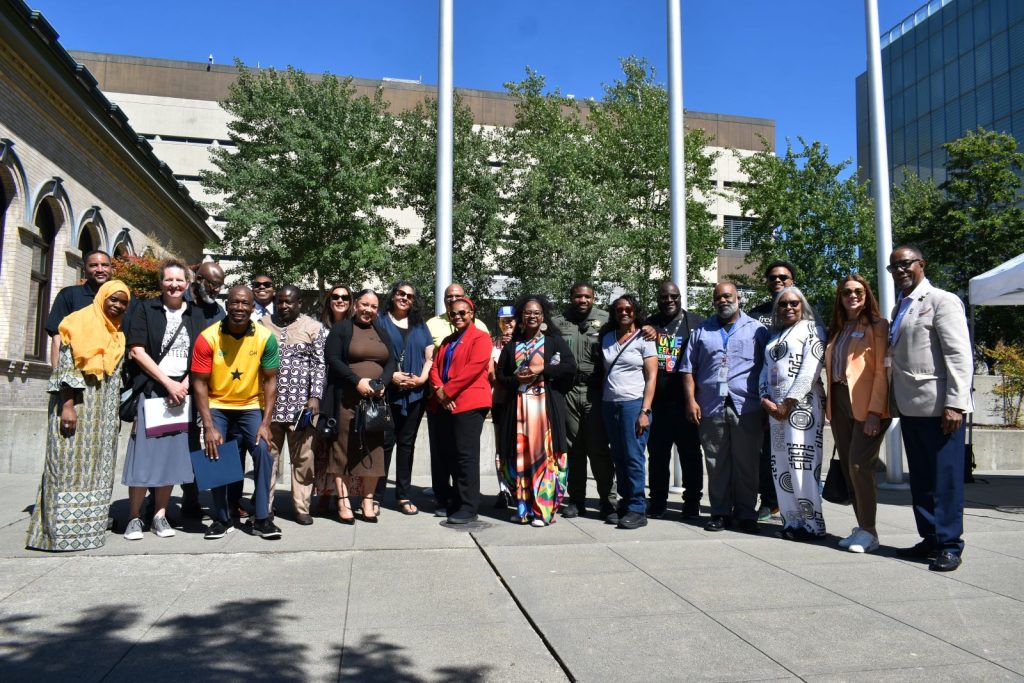
Snohomish County was the first county in Washington State to fly the Juneteenth flag in 2022 at its county campus, just days after then-Governor Jay Inslee, along with members of Blacks United in Leadership and Diversity (BUILD), held the State’s official first Juneteenth flag raising ceremony on the State Capitol Campus in Olympia. Snohomish County Councilmembers Jared Mead and Sam Low, along with Senator John Lovick championed the inaugural county effort.



In 2021, the Washington State Legislature approved HB 1016, sponsored by State Representative Melanie Morgan (D-Parkland), to establish Juneteenth as a legal state holiday. It was then signed into law by Governor Inslee on May 13, 2021, just over a month before Congress passed the Juneteenth National Independence Day Act, that established June 19 as the 12th U.S. public legal holiday. The federal bill was signed into law by President Joe Biden on June 17, 2021.
Thursday’s commemoration marked 161 years since the news of the Emancipation Proclamation reached the deepest parts of the former confederacy, specifically Galveston, Texas. Black Americans have been celebrating Juneteenth for generations, and the first recorded celebration of Juneteenth in the Pacific Northwest was in Kent, Washington, in 1890.




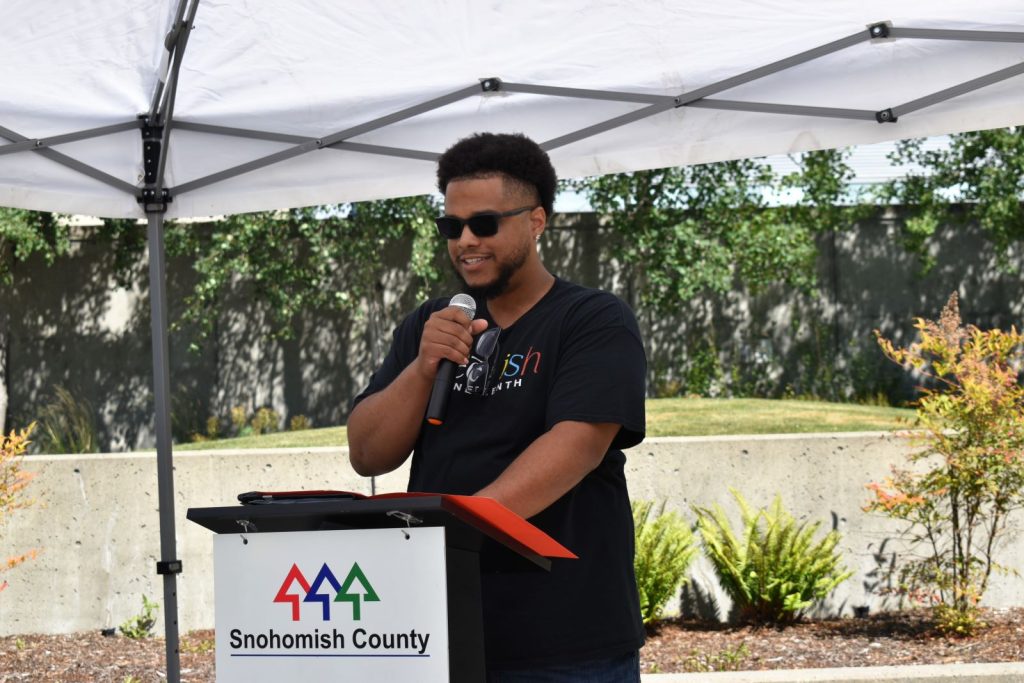
“Freedom is a God-given privilege that one human should never be able to take away from another,” said Delon R. Lewis, Program Specialist at Everett Community College. “Freedom requires courage. Freedom demands that we speak when others are silenced, that we confront injustice rather than ignore it, and that we refuse to be comfortable while others remain oppressed.”


John Aja-Pong, President of the Snohomish County NAACP Chapter, urged county officials to maintain funding for equity programs, specifically the Office of Social Justice, that acts as a “conduit” that confronts injustice and preserves freedom of marginalized people.

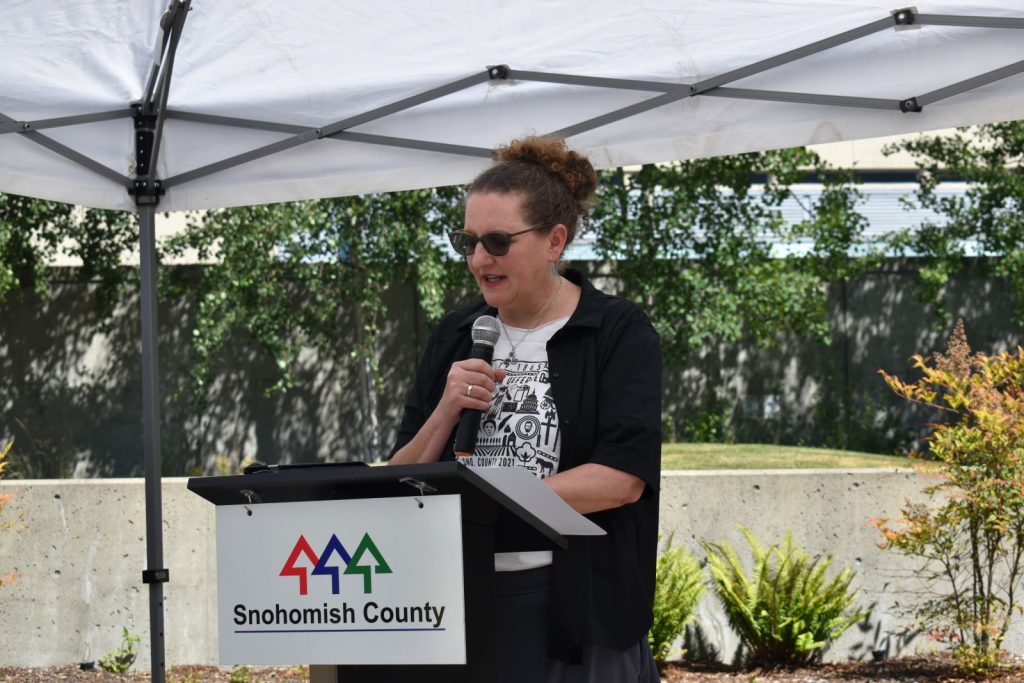
Snohomish County Council Chair Megan Dunn said Juneteenth reminds residents that freedom must be lived through participation, voice, and belonging.
“Freedom is more than a declaration,” Chair Dunn said. “Freedom becomes real when people have the opportunity to participate in their communities, to have their voices heard, and to help shape the decisions that affect their lives.”
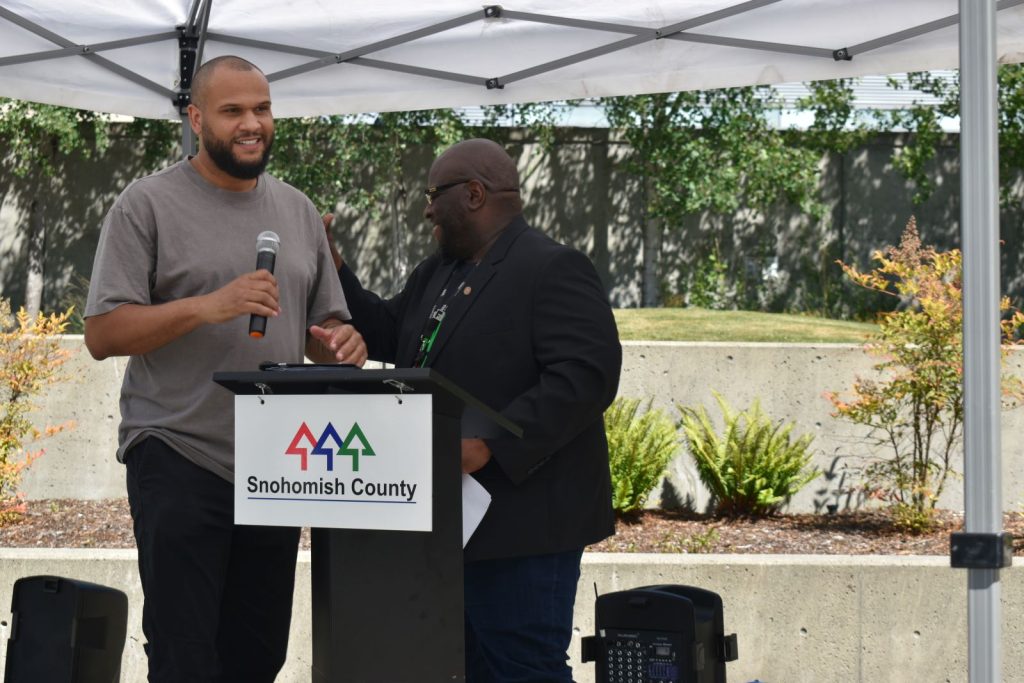
Community member Craig Chambers, born and raised in Everett, shared a personal family story about his surname “Chambers,” which originated from enslavers in the South. He described wrestling with carrying that name and ultimately reframing it as a symbol of “overcomers”, “survivors” and “perseverers.”
After slavery ended in 1865, millions of formerly enslaved people needed official surnames to be legally recognized to enter into contracts, marriage, enlist in the military, and be counted as a person in the U.S. Census. Prior to emancipation, enslaved Blacks were generally not allowed to have legal last names. Once freed, many took on their enslaver’s surname.
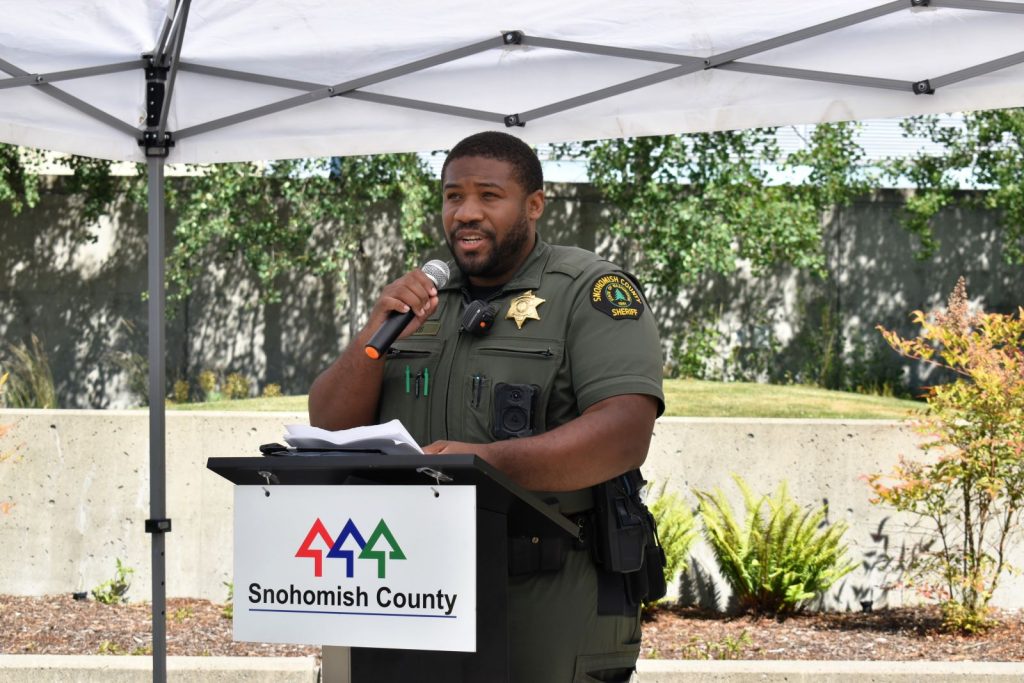
Deputy Sheriff Taylor Davis, who grew up in Trenton, New Jersey, and played hockey in Canada before joining the Snohomish County Sheriff’s Office, said his presence as a Black law enforcement officer represents progress and an opportunity to build trust and be part of the solution to show Black youth that they can succeed in any field to be a model public servant.
“Being a Black police officer is an opportunity to be part of a solution,” Davis said. “It means showing young Black kids that public service is a noble profession, and if I can do it, so can they.”
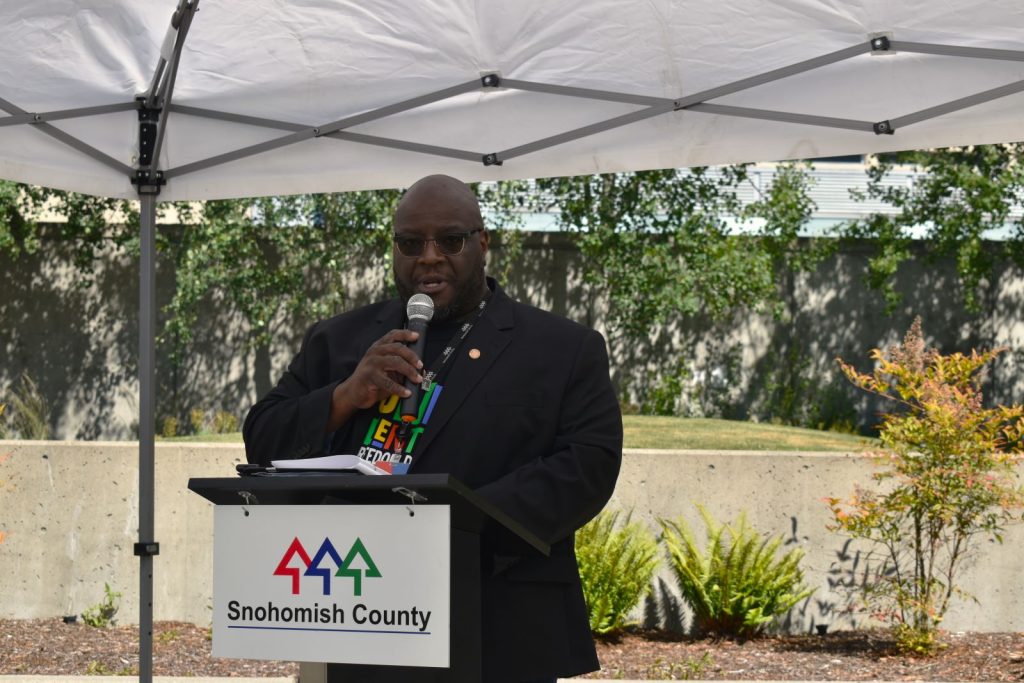
The fifth annual Juneteenth flag-raising was hosted by Will Johnson, Office of Social Justice’s Chief Diversity, Equity, and Inclusion Officer for Snohomish County.
“Today, I hope you leave reflecting on the question, what does freedom mean to you?” he closed. “Juneteenth is rooted in community. Together, we remember the harsh legacy of slavery. We celebrate the pursuit of freedom and we reflect on our continued progress.”
Emancipation Day and How We Got Here
The flag raising at Snohomish County commemorating Juneteenth is because of the efforts of millions of people over five centuries, many of whom no one will ever know, whose tenacity for moral justice prevailed.
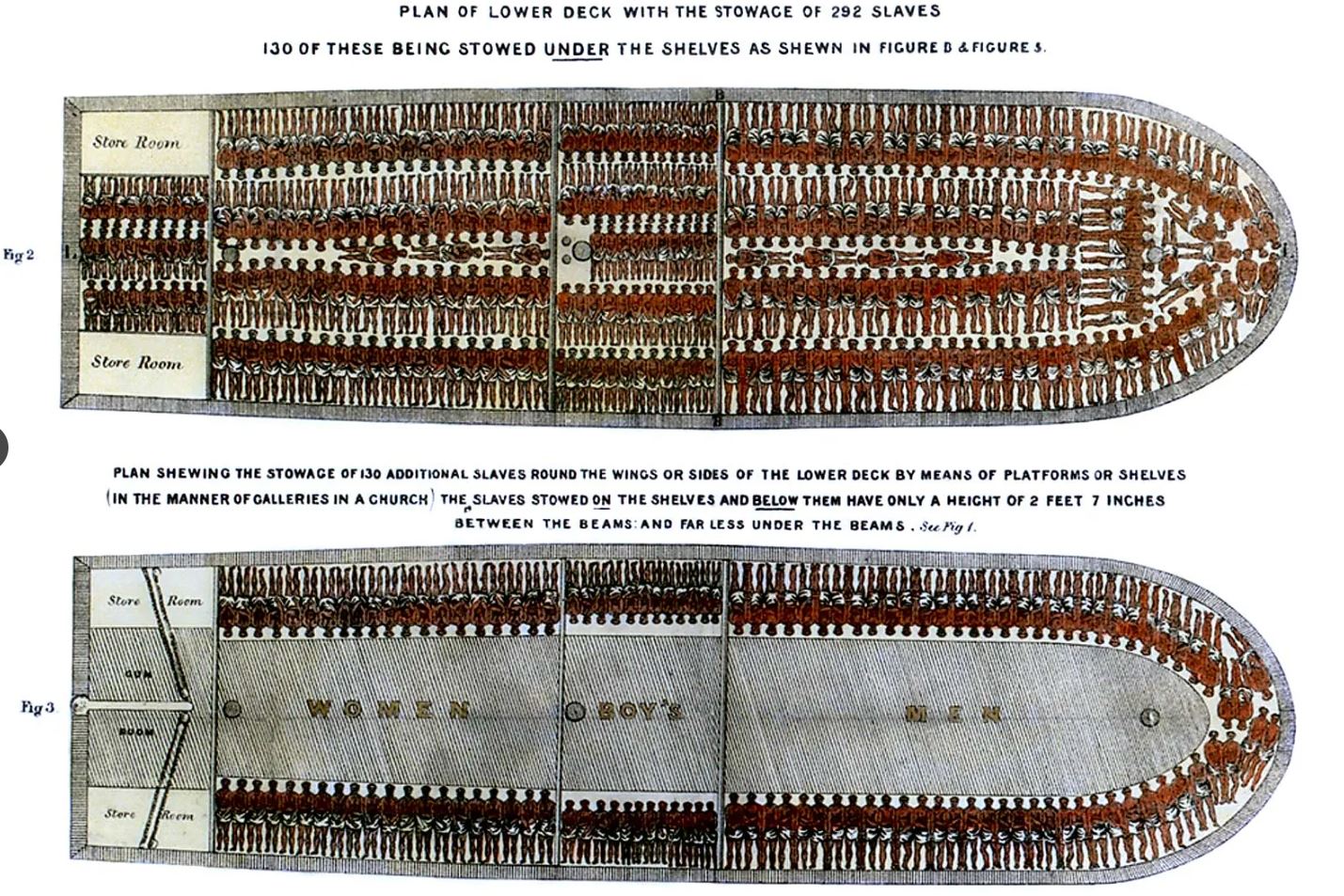
Following the genocide of indigenous peoples in the Caribbean, European powers then transported an estimated 12 million Africans across the Atlantic, with roughly 2 million dying during the two-to-three-month voyage in what is called the “Middle Passage.” The captive Africans were chained together, lying down on wooden shelves of height 2-feet seven inches and packed like sardines below deck in filthy conditions with little ventilation, food, or water. Disease and starvation were the main contributors of death along with suicide by jumping overboard. The layout of the slaves en route to the Americas was called “tight packing” to fit as many people as possible on each voyage to maximize profit.
Only roughly 4% of all enslaved Africans made it to the continental United States with the Caribbean receiving some 45%, South America (mainly Brazil) receiving 45%, and Central America receiving approximately 5%.
A vast majority of these enslaved Africans were captives in Africa before they were sold to European traders at coastal forts. Waring African kingdoms and ethnic groups at the time conducted raids and sold their captives into the slave trade in exchange for firearms, textiles, and metals. White Europeans at the time (1500s to 1860s) were not immune to the deadly tropical diseases such as malaria and yellow fever of inland Africa and relied on preexisting slave networks established by powerful African kingdoms such as the Kingdom of Dahomey and the Ashanti Empire.
The guns and metals received by African states in exchange for captives, provided a military advantage over their rivals, which encouraged even more wars and raids to capture even more people—a never-ending cycle of death that eventually led to the colonialization of Africa by the very European powers who once provided the now-fallen kingdoms the munitions to kill rivals.

The transatlantic slave trade mainly operated from the West and West-Central African coastal areas of Senegal, Gambia, Ghana, Nigeria, Benin, Togo, Cameroon, Angola and the Congo region.
In 1501, the Spanish Crown officially authorized the transport of enslaved Africans to its colonies in the Americas with the first documented group of enslaved Africans arriving to Hispaniola (current day Haiti and Dominican Republic) in 1502 to work the gold mines. The indigenous Taíno, Arawak and Carib populations were being wiped out by disease (smallpox), enslavement, and many committed infanticide—mothers killed their newborns to prevent them from a life of enslavement.
The Spanish Empire treated the indigenous people who resisted enslavement or failed to meet work quotas with extreme brutality by cutting off hands, noses, and ears. Within a decade, the native people—Taíno, Arawak and Carib—were nearly extinct after Christpher Columbus arrived in 1492.
A Spanish priest named Bartolomé de las Casas in advocating to the Spanish Crown to end enslaving the Taíno people, suggested instead the importation of enslaved Africans. Because enslaved Africans were available through the existing Portuguese slave trade and were seen as better able to survive the tropical and harsh conditions of the Caribbean, the fate of enslaved Africans to the Americas were sealed—Portugal borders Spain.
The Portuguese in the 1440s created its own slave trade along the Atlantic coast of West Africa, 60 years before the launch of the transatlantic trade. Portuguese explorers and traders for decades took enslaved Africans back to Portugal and the Portuguese islands of Madeira and Cape Verde to work on sugar plantations.
Eventually, Portugal became one of the largest participants in the transatlantic trade, transporting millions of Africans mainly to Brazil a county with a current population of 213 million.
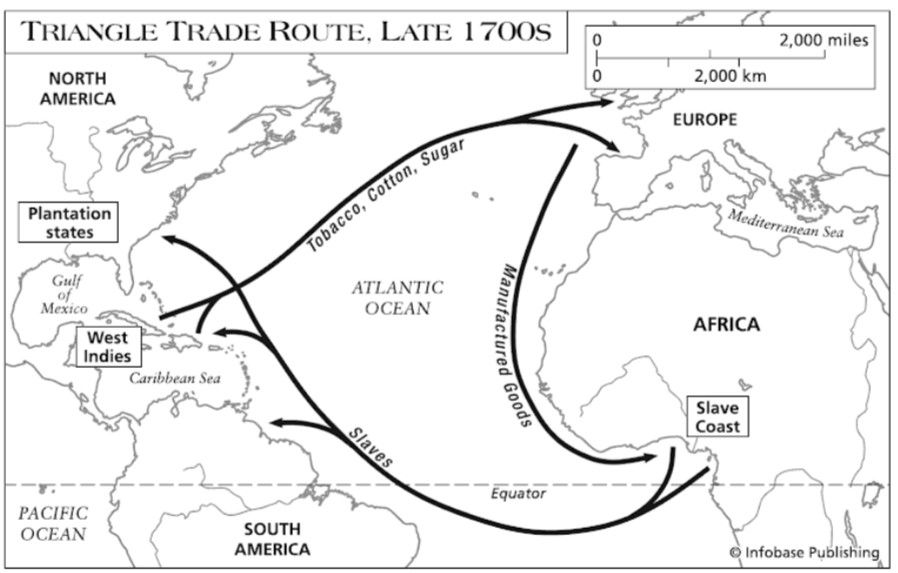
Britain began importing enslaved Africans in the 1560s to Virginia and the Caribbean and became the dominant force during the slave trade’s peak period by the 18th century, transporting more enslaved Africans than any other empire. France and the Netherlands followed suit by the mid-1600s and Denmark and the United Stated by the late 1700s.
These enslaved Africans were exploited to work on sugar, coffee, cotton, and tobacco plantations, as well as in mines. According to historical records relating to slave death rates, sugar plantations were the worst workplaces to be enslaved. The work was backbreaking, and death rates were the highest due to exhaustion, accidents, disease, and mistreatment. Enslaved Africans in the large sugar estates of Brazil, Cuba, Jamaica, and Barbados were known to have some of the worse slave conditions by their overseers with highest mortality rates.
Enslaved people in the French colony of Saint-Domingue overthrew their oppressors and established the independent Republic of Haiti in 1804, becoming the first nation in the Americas to abolish slavery through revolution. However, following the assassination of Jean-Jacques Dessalines, the new nation’s the first leader in 1806, the country split into rival factions which led to civil wars and a massive indemnity of 150 million francs ($21–30 billion in today’s money) to the French Empire for the loss of its colony and enslaved people it considered property.
Haiti to this day, is the poorest nation in the Western Hemisphere with a GDP per capita of approximately $2,143 compared to that of the U.S. at $94,430. Currently, all former enslaved British colonies have a GDP three to 19 times that of Haiti with The Bahamas leading all Caribbean nations at $40,892.
Britain became the first major colonial power to abolish slavery in its Caribbean colonies. The Slavery Abolition Act of 1833 took effect on August 1, 1834, freeing more than 750,000 enslaved people across the British West Indies. A four-to-six-year apprenticeship period followed in most colonies before full freedom was granted on August 1, 1838.
The Apprenticeship Period that took effect in 1834 was enacted to ease the economic transition from slavery and train formerly enslaved people to handle the “responsibilities of freedom” — something the United States never did. During this period, “apprentices” or ex-slaves provided unpaid labor to their former masters for up to 45 hours per week. Because former masters could no longer whip workers directly, they used local magistrates to enforce corporate punishments and jail time for missing work hours.
The Apprenticeship Period was meant to last up to six years, but fierce resistance and advocacy led to its total abolition four years later on August 1, 1838. Enslaved Africans in the Caribbean prior to the Apprenticeship Period already ran sophisticated internal economies—food on private plots, managed internal local markets, and handled their own community structures—so, this period is viewed more of an appeasement to plantation owners by the Crown, who had to suddenly struggle how to manage their plantation business using paid wages instead of forced labor.
France abolished slavery in its colonies in 1794 during the French Revolution, though it was reinstated by Napoleon in 1802. Permanent abolition came in 1848 under the Second Republic, led by abolitionist Victor Schoelcher.
In the Danish West Indies, Governor Peter von Scholten declared emancipation on July 3, 1848, following a slave revolt. The Netherlands abolished slavery in its Caribbean colonies and Suriname on July 1, 1863; Portugal followed in 1869, but full implementation took another nine years.
Spain was the last colonial power to abolish slavery—well after the United States did in 1863. The Spanish colony of Puerto Rico abolished slavery in 1873, while Cuba did so in 1886.
British parliamentarian William Wilberforce led the campaign against the slave trade and slavery in Britain in what become known as the abolitionist movement. Wilberforce introduced the bill in the House of Commons that led to the abolition of the British slave trade in 1807, and he continued fighting for the complete emancipation of enslaved people until his death in 1833, just weeks before the Slavery Abolition Act was passed.
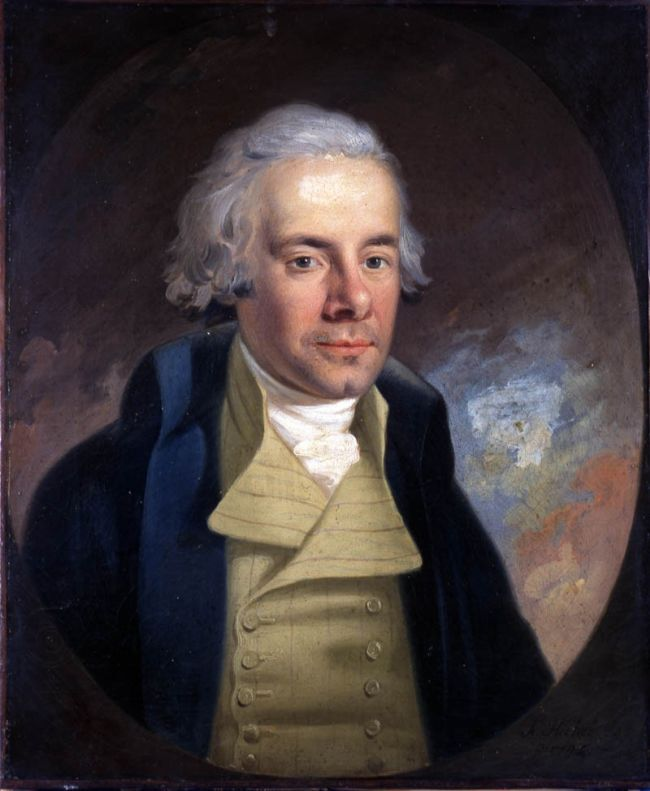
In his argument against slavery, Wilberforce argued that slavery was a sin against God and fundamentally incompatible with Christianity. He further argued that slavery was not just a political or economic issue, but a moral and spiritual evil; that all humans are created in the image of God, and that no person had the right to own another person as property. He saw the slave trade and slavery as a national sin that offended God and corrupted British society.
The abolitionist movement that successfully led the end of Western slavery against enslaved Africans and their descendants were a diverse group of activists, politicians, religious leaders, writers, and formerly enslaved individuals that emerged in the late 18th century. It used public petitions, mass meetings, boycotts of slave-produced goods, the legal system, and the media to turn public opinion into abolishing slavery.
In Britain, key figures included Thomas Clarkson, who gathered evidence of the horrors of the trade; Olaudah Equiano, a former enslaved African who wrote the autobiography, The Interesting Narrative of the Life of Olaudah Equiano, that influenced public opinion which helped secure passage of the British Slave Trade Act 1807; and Granville Sharp, an early legal campaigner against slavery.
In the United States, the movement included prominent voices such as Frederick Douglass, Harriet Tubman, Sojourner Truth, and William Lloyd Garrison. These individuals came from different backgrounds but shared a strong moral opposition to slavery also rooted in deep religious beliefs, particularly among Quakers and evangelical Christians. Ultimately, it was the U.S. Civil War and the passage of the 13th Amendment in 1865, which finally ended legal slavery in the United States.
Today, Emancipation Day is observed on or around August 1 in most English-speaking Caribbean nations. Just as Juneteenth in America, celebrations include cultural events, reflections on the legacy of slavery, and recognition of ancestral resilience during oppression.
Juneteenth background
In 1619, twenty captured Africans were brought to Virginia as enslaved people by the British Crown, ushering in 246 years of slavery in what will become the United States. By 1680 as the number of indentured laborers of European descent declined, the enslavement of Africans was widely accepted, and the labor of these human souls became highly profitable in the United States, specifically Southern states.
The Emancipation Proclamation of 1863 issued by President Abraham Lincoln freed enslaved people in the 11 Confederate states at war against the Union; however, it wasn’t until December of 1865 when Congress required the Confederate states to ratify the 13th Amendment, thereby abolishing chattel slavery and involuntary servitude.
Still, slavery remained relatively unaffected in Texas until June 19, 1865, when Union troops, led by Major General Gordon Granger, arrived in Galveston, Texas to take control of the state and free all enslaved people.
The news of the end of the Civil War and that the slaves were free was known as General Order Number 3. This news was two-and-a-half years after the Emancipation Proclamation of January 1, 1863, which didn’t impact Texas since there were very few Union soldiers to enforce the proclamation.
General Order Number 3, reads as follows:
The people of Texas are informed that, in accordance with a proclamation from the Executive of the United States, all slaves are free. This involves an absolute equality of personal rights and rights of property, between former masters and slaves and the connection heretofore existing between them, becomes that between employer and hired labor. The Freedmen are advised to remain at their present homes and work for wages. They are informed that they will not be allowed to collect at military posts; and they will not be supported in idleness either there or elsewhere.”
The surrender of General Lee in April of 1865 coupled with the arrival of Granger and his regiment finally provided the influence necessary to enforce the Emancipation Proclamation.
Juneteenth became a federal holiday on June 17, 2021, and the first known official movement to make Juneteenth a federal holiday began in 1994. All 50 U.S. states and the District of Columbia recognize Juneteenth either as a state holiday, a ceremonial holiday, or a day of observance.

Author: Mario Lotmore