

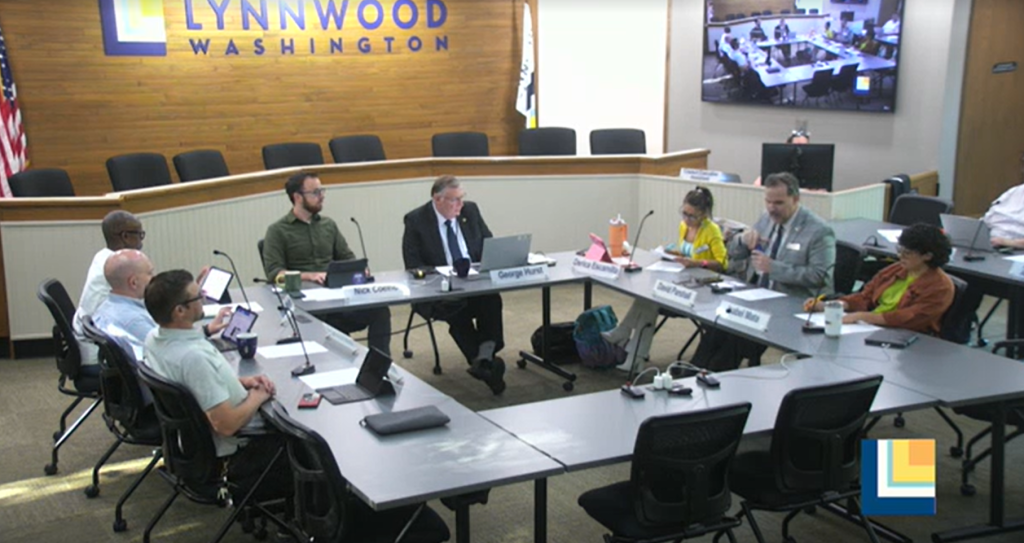
LYNNWOOD— Ehsan Shirkhani, Public Works Manager, and Debra Tseng, Project Manager, briefed the Lynnwood City Council on the city’s 2026 Water System Plan, a long-range roadmap for maintaining and expanding the city’s water distribution system, at its Work Session Monday, August 3.
The City of Lynnwood owns and operates a water system that provides water to Lynnwood residents. State law requires that all water systems provide a plan – that includes construction, improvements of new and existing water systems – and these plans are required every 10 years. Lynnwood last created a plan in 2012, which was amended in 2018.


The focus of the water system plan this year is to reassess the changes in water system in terms of both physical infrastructure and system improvements needed for the current system and future needs.
As part of this effort, the City hired RH2 Engineering to complete a system wide assessment and identify the improvements necessary to ensure long-term reliability and capacity.




A prior phase of this work was brought to Council for approval, authorizing RH2 to begin development of the Water System Plan update and associated technical analyses. Since that approval, RH2 has completed the system evaluation, identified priority capital improvements, and estimated annual cost to address these improvements and repairs. These adjustments have resulted in changes to the overall projected cost of the recommended improvements, which are incorporated in the final Water System Plan and future capital planning efforts.


The Council approved the award of a contract to RH2 for the development of Lynnwood Water Comprehensive Plan on December 13, 2021, for a total amount not to exceed $309,384.00.


Lynnwood’s water system is not an isolated utility, it’s part of a regional supply network where water is purchased wholesale from Alderwood Water and Wastewater District and Alderwood receives water from the City of Everett, which is then sourced from the Sultan River Basen and treated at Everett’s Water Filtration Plant. Lynnwood’s role is simply distribution that provides water to 35,000 residents through 160 miles of water mains.
The major challenges Lynnwood’s water system is facing today is aging infrastructure, with a significant portion of the system being built decades ago (including the reservoirs and a big portion of the water mains), and capacity, with future demand increases demanding additional storage capacity.
The 2026 water plan looks at how many people will call Lynnwood in the near future, how many jobs will be in the area, and where that growth will occur specifically.
The year 2022 was used as a baseline for the plan in which city population was approximately 39,625 residents of which the water system served 35,330 of those. Employment population served was approximately 27,881 jobs and housing units served was approximately 16,246 with an average household size of 2.53 persons per household. This is an 8% increase between 2010 and 2022, and the population is expected to increase at a higher rate between now and 2040.
“Lynnwood currently has adequate water supply but projected population growth, employment growth, and density around City Center are expected to increase water demand substantially. The current system must be expanded to meet future needs and demand, fire flow requirements, and reliability standards,” said Tseng. “While conservation programs will help reduce demand growth it will not eliminate the need for significant infrastructure improvements over the next 20 years.”
Shirkhani, Wastewater Treatment Plan Manager, said improvements were evaluated by a set of priority criteria such as fireflow, existing pipe material, and break history. The improvements evaluated are estimated to cost $53 million.
In response to a question by Lynnwood Council President Nick Coelho, who asked why water wouldn’t invest in these improvements sooner rather than later to potentially avoid higher price tags, Public Works Director Jared Bond replied that water is remaining conscious of utility costs to residents.
As far as essentialness and priority, Bond noted that replacing the oldest water lines in the city (which are steel lines that leak constantly, according to him). Bond continued that doing things in-house, such as rebuilding the Booster Station up by the tanks which could save the city $1.5 million. Replacing water mains, and sanitizing them, are specialized work that are typically contracted out.
“We’re looking at efficiencies, cost savings, because it’s never just as clear as this is the plan and this is how you have to go about doing it,” said Bond.
Bond clarified that the improvement costs come from the city’s enterprise funds, not the general funds, which are entirely self-supporting. In other words, the water bills residents pay go towards the improvements.

Author: Kienan Briscoe