

BOSTON — In the latest development in the legal showdown involving President Donald J Trump’s Executive Order 14399 on “Ensuring Citizenship Verification and Integrity in Federal Elections” that reforms vote-by-mail nationwide, U.S. District Judge Indira Talwani Thursday evening granted a 14-day temporary restraining order blocking the U.S. Postal Service (USPS) from enforcing core parts of its newly finalized mail-ballot rule for the November 3 midterm elections, delivering a short-term victory to voting-rights groups and a coalition of states co-led by Washington AG Nick Brown.
“The Postal Service’s attack on voting rights is blocked for now thanks to states like Washington stepping up in court,” AG Brown told the Lynnwood Times. “The fight will continue against the president’s unconstitutional overreach on elections, and the states will win.”


Judge Talwani issued the order in two related cases: League of Women Voters of Massachusetts v. Trump and the new lawsuit filed Wednesday, August 26, by Attorney General Brown and more than two dozen other states and jurisdictions against the Postal Service. The ruling stays implementation of mandatory envelope-design standards, required registration in a USPS electronic portal, mandatory voter-data uploads, and provisions allowing the agency to refuse to mail noncompliant ballots.
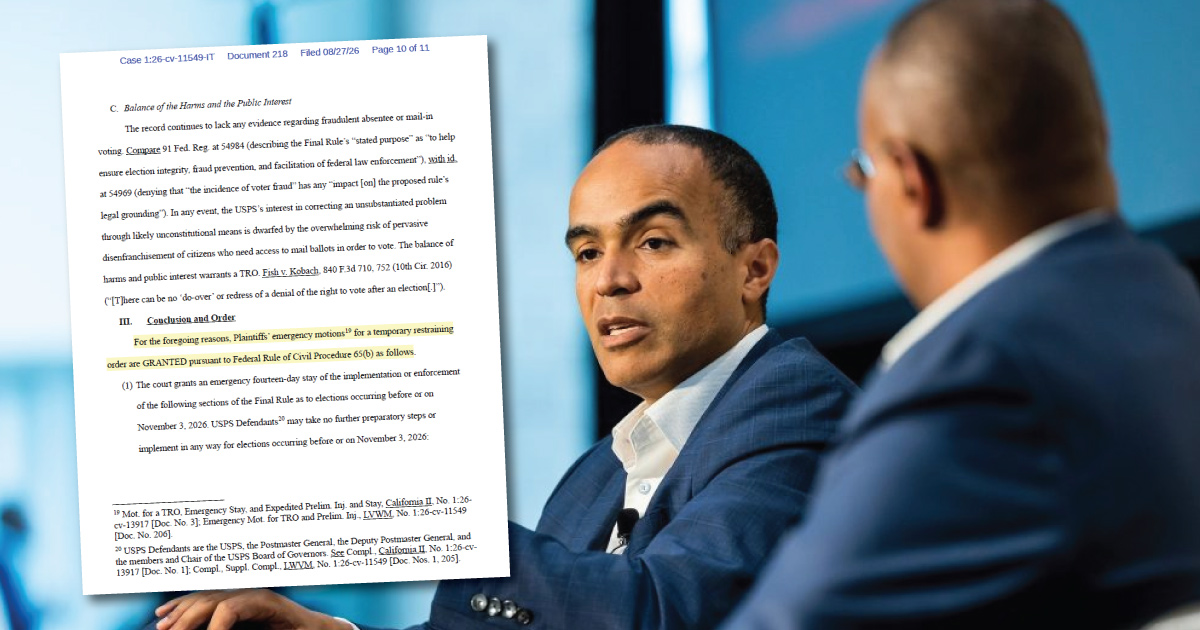
“The court grants an emergency fourteen-day stay of the implementation or enforcement of the following sections of the Final Rule as to elections occurring before or on November 3, 2026. USPS Defendants may take no further preparatory steps or implement in any way for elections occurring before or on November 3, 2026….Defendants’ counsel must, within 24 hours after receiving service of this Order: (i) provide written notice of this Order to the USPS Defendants and their employees…,” the order states.



Motions for a longer preliminary injunction remain under advisement, with a hearing scheduled for September 3, 2026.
Judge Talwani wrote that the states face irreparable harm because they “are required to comply with a likely unconstitutional regulation for which compliance is practically impossible as to the 2026 midterm elections, now little more than two months away.”
She found the plaintiffs likely to succeed on claims that USPS lacked statutory authority to issue the rule, that the rule unconstitutionally imposes requirements on the states, and that it unconstitutionally bars noncompliant officials from using the mail to send ballots.
Talwani added that most plaintiff states have already ordered their ballots and that some are required by state law to begin mailing them as early as next week.
“If Plaintiff States are unable to comply with the Final Rule, an outcome that seems unavoidable given the timeframe, they will violate their obligations under the Constitution and State laws to administer elections,” she wrote.
She noted that the new USPS final rule, “Ballot Mail for Federal Elections,” published August 26, doesn’t contain a deadline for USPS approval of envelope designs.
Talwani also observed that “the record continues to lack any evidence regarding fraudulent absentee or mail-in voting.”
She concluded that any government interest in addressing an “unsubstantiated problem through likely unconstitutional means is dwarfed by the overwhelming risk of pervasive disenfranchisement of citizens who need access to mail ballots in order to vote.”
The League of Women Voters case began in April of 2026. After the U.S. Supreme Court on August 24 lifted an earlier injunction in a related states’ lawsuit (State of California et al. v. Donald J. Trump et al) because the challenge to President Trump’s March executive order was premature, Talwani vacated her own nationwide preliminary injunction in the League case on August 26. The voting-rights groups then filed a supplemental complaint and emergency motions targeting the now-final USPS rule rather than the original executive order.
Washington state and the other states filed their new complaint also on August 26, which happened to be the same day the new USPS rule appeared in the Federal Register.
Brown, who co-led the coalition with attorneys general from California, Massachusetts and Nevada, said at a Seattle news conference Wednesday that the rule “was written to satisfy the president’s continued desire to control our vote, but the U.S. Constitution is clear: States control elections.” He called the requirements “illegal, it is costly and it is frankly impossible to implement.”
Washington Secretary of State Steve Hobbs said the state has contingency plans if the rules take effect but expressed confidence the new lawsuit would succeed.
“I will continue fighting this administration’s efforts to dismantle vote-by-mail elections and disenfranchise voters,” Secretary Hobbs wrote in a statement. “Elections are the lynchpin of our democracy, and my office remains dedicated to ensuring every voter can participate and make their voice heard.”
Brown’s complaint argued that the rule exceeds USPS authority, violates the Privacy Act and federal voting-rights statutes, and was issued without required review by the Postal Regulatory Commission.
Judge Talwani has been the sole judge assigned to all three related challenges to President Trump’s mail-voting Executive Order 14399. The cases were filed in the District of Massachusetts and have proceeded on overlapping emergency schedules before her:
- League of Women Voters of Massachusetts v. Trump, No. 1:26-cv-11549, filed April 2, 2026, by voting-rights organizations challenging Section 3 of Executive Order 14399 and later the finalized USPS rule.
- State of California v. Trump (California 1), No. 1:26-cv-11581, filed April 3, 2026, by a coalition of states and the District of Columbia challenging the executive order; the Supreme Court later stayed Talwani’s injunction in that case.
- State of California v. United States Postal Service (California 2), No. 1:26-cv-13917, filed Aug. 26, 2026, by Washington Attorney General Nick Brown and other states targeting the published USPS “Ballot Mail for Federal Elections” rule.
Editor’s Note: Article updated 11:58 a.m., August 29, 2026, with statements from AG Brown and Sec. Hobbs.

Author: Mario Lotmore