

ANDØYA, Norway — Isar Aerospace, a German private rocket company, became the first to successfully launch a payload into orbit from continental Europe.

“Onward and Upward” Mission of Isar Aerospace. Source: https://www.youtube.com/live/Ss1DUqLjecc
“We achieved within a few years what had taken the European space industry decades before. Europe now has sovereign access to space. We have entered into a new chapter for European spaceflight. I am incredibly proud of our team, that has made this success story from Europe possible. We will now focus on rapidly scaling launch vehicle production, deliver on our order pipeline, and meet surging global demand”, said Daniel Metzler, CEO and Co-Founder of Isar Aerospace.



Under mission ‘Onward and Upward,’ Isar Aerospace’s Spectrum lifted off at 8:12 p.m. UTC from Andøya Spaceport, in Norway approximately 190 miles inside the Arctic Circle. The vehicle successfully transited MaxQ, completed MECO and stage separation, and then ignited second stage as planned. It crossed the Kármán line at an altitude of 100 kilometers and jettisoned the payload fairing before reaching orbital velocity. After completing circularization burn, spacecraft separation was completed successfully.
Orbit Achieved. Payload Deployed.
Mission 'Onward and Upward' delivered our first customer satellites to orbit, achieving major milestones:
✅ MaxQ
✅ Stage separation
✅ Stage 2 engine ignition
✅ Fairing separation
✅ ORBIT
✅ Second engine cutoff and transfer orbit injection… pic.twitter.com/gEa99hJyAf— Isar Aerospace (@isaraerospace) September 6, 2026
The mission’s payloads were selected through the Microlauncher Competition of the German Space Agency at DLR that provides educational institutions and start-ups with low-cost access to space. The Microlauncher Competition is funded through ESA Boost!


No privately developed European rocket had ever made orbit from European soil before and the Spectrum rocket did it on only its second flight. The first attempt, in March 2025, lasted about 30 seconds before the rocket tumbled into the sea.


Europe has sent satellites to orbit for decades but almost always from Kourou in French Guiana.
Spectrum’s “Onward and Upward” mission put its CubeSats into a sun-synchronous orbit about 500 kilometers up. That is a special kind of low Earth orbit. The path is nearly polar — Andøya can reach inclinations of about to
— and it is tuned so the satellite crosses the same place on Earth at the same local time every day. Noon stays noon. Shadows fall the same way on every pass. For cameras, climate sensors, and student experiments, that consistency is gold.




Other Main Orbit Types
Space-based platforms can be placed in several types of orbits around Earth. The here are the common classes of orbits around the Earth:
Low Earth orbit (LEO) lies roughly 160 to 2000 km above the ground. The International Space Station is in LEO and as well as Starlink and most CubeSats. Advantages of LEO is that it is easy to reach, offers high-resolution views of Earth, and provides a short radio delay for transmission. However, LEO orbits induce atmospheric drag on satellites, so it must reboost or will fall back to earth; it only sees a stripe of Earth at a time; and it races around the planet every 90 minutes, so a ground dish must keep track of it.


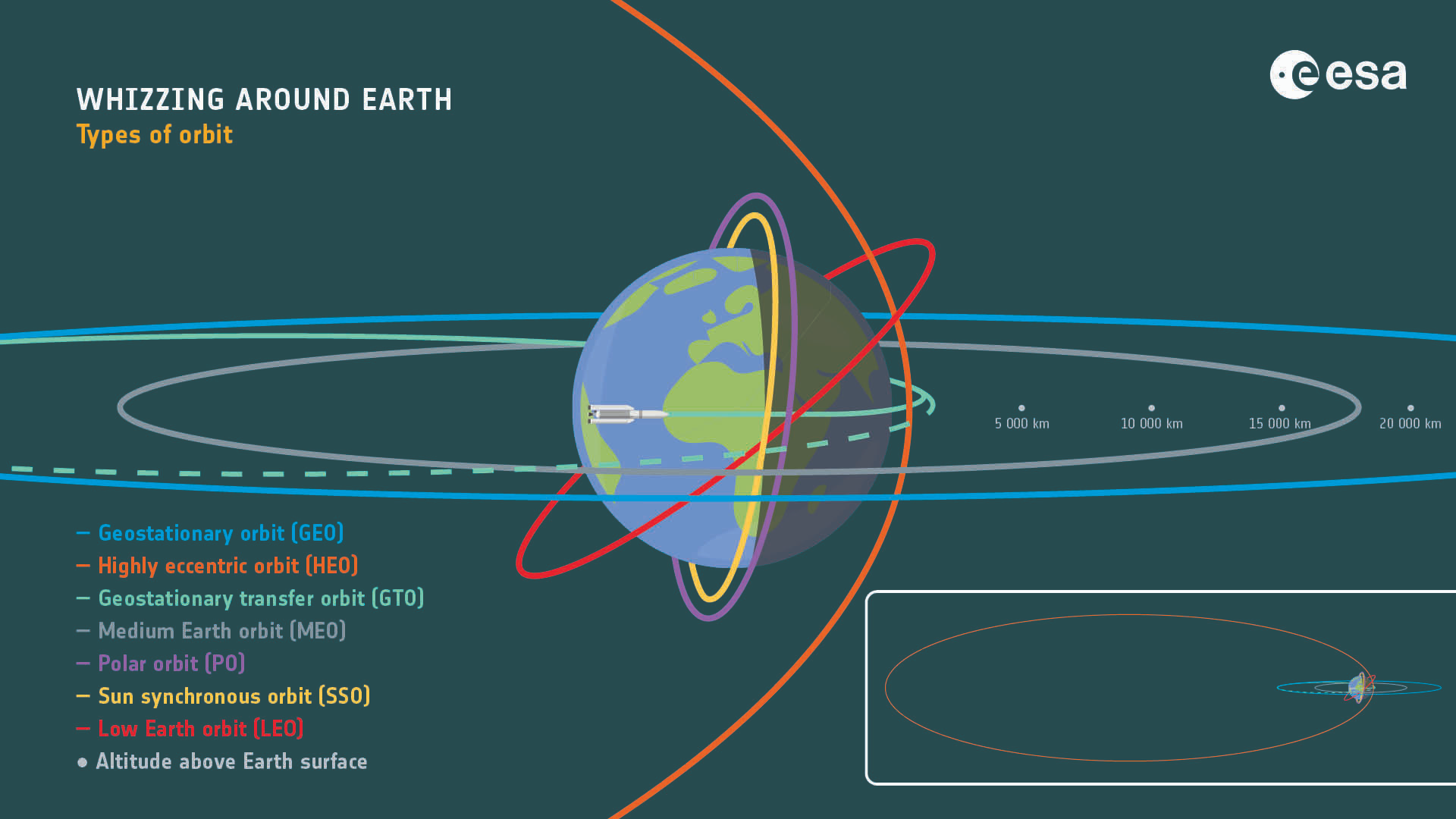
Polar orbit, is like sun-synchronous orbit (SSO) without the lighting trick. Objects at polar orbit eventually sees the whole globe, including the poles. On would need a high-latitude pad or a fuel-burning dogleg to achieve PO and there is no fixed local time, so photographs of the same area will look different from each.
Medium Earth orbit (MEO), are thousands of kilometers above the earth. GPS and Galileo, Europe’s global navigation satellite system, lives here. Advantages of MEO is that a satellite sees more of Earth than in LEO but it is a more challenging and expensive orbit to reach. Also, satellites in MEO receive more radiation from the Sun and there is longer signal transmission delay than LEO with the earth.
Geostationary orbit (GEO), is over the equator. The satellite’s period matches Earth’s day, so it appears parked in the sky. Advantages of GEO is that one satellite can cover a third of the inhabited world and home satellite dishes can be stationary without tracking the satellite. However, it is the farthest and most expensive orbit to reach; weak for high-resolution Earth photos; and useless over the poles.

Author: Mario Lotmore