
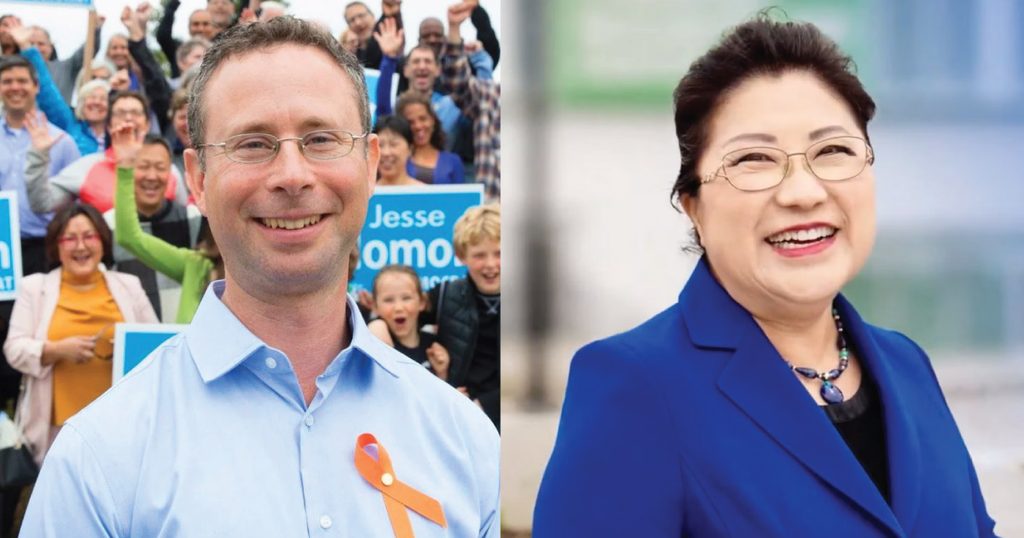
SHORELINE — In a KUOW debate for the 32nd Legislative District Senate seat, Rep. Cindy Ryu (D-Shoreline) said on Thursday that Washington’s new income tax should not stop at millionaires but should tax household net income starting around $250,000 and that companies should be subject to a progressive income tax as well.
“Do you really need more than a million dollars to live well in Washington state?” Rep. Ryu said. “I think not.” She then walked the number down to $250,000.

Middle income, she said, is already over $100,000, “so maybe not $100,000. Let’s look at… about $250,000. Can we live well on $250,000 a year?”
Ryu called that figure “an arbitrary number,” and said the 9.9% income tax rate is “very offensive” to people taxed only on the second million. Households at that level, she conceded, “absolutely may have options to move out of state. We do not want that.” She said the state should want people to stay “and yet be able to afford to pay for the basics.”




Her opponent, incumbent Sen. Jesse Salomon (D-Shoreline), voted for the same underlying tax but does not accept Ryu’s new threshold of $250,000.


On KIRO’s John Curley show, Salomon called $250,000 “incredibly out of touch,” and said a cut that deep would have to go back to voters and would be voted down. He added that the Senate does not have the votes to even pass such a tax threshold.
In the KUOW debate with host Libby Denkmann, he offered a different next step, and only as the one the Legislature had already missed forgoing tax relief for general fund revenues instead: a threshold of $750,000, traded dollar for dollar for property-tax relief for seniors whose tax bills rose with home values they are not selling.
Senate Bill 6346, signed by Gov. Bob Ferguson on March 30, imposes 9.9% on Washington taxable income above a $1 million standard deduction. It applies to tax years beginning in 2028, with the first returns due in 2029. Legislative estimates put the payers at roughly 20,000 to 25,000 households, under 1% of the state, and the expected revenues at about $3 billion to $3.5 billion a year. Voters will decide in November whether to repeal the income tax through Initiative 645.
The new income tax is on people and not on C-corporations. A resident is taxed on taxable income from anywhere in the world. A nonresident is taxed only on Washington-source income, but the $1 million deduction is prorated by the share of total income that is earned in Washington state, so a high earner can owe tax on Washington income even if that income is well below the $1 million threshold.
For example, if a nonresident person earns $2 million of federal adjusted gross income of which $300,000 is for work performed in Washington. The Washington taxable income is $300,000 minus $150,000 ($1 million x [$300,000/$2 million]) or $150,000; for a tax bill of $14,850 (9.9% x $150,000).
Spouses and registered domestic partners share one deduction; it is not for each individual person. Pass-through profit from a partnership, LLC, S-corporation, or sole proprietorship is included on the owner’s return and is subject to the income tax. The legislation, however, does offer these business owners credit for their share of business-and-occupation (B&O) and public-utility tax, and an option for the business to pay at the entity level.
Sales of real estate, including a home, are currently excluded from being taxed, as are sales of qualified family-owned small businesses and other long-term gains already exempt from the state’s capital-gains tax. Also, qualified Roth distributions generally stay out because they are not in a federally adjusted gross income.
Ordinary wages, interest, dividends, rental income, federal taxable portion of social security, traditional pension payments, and taxable retirement distributions such as Traditional IRA and 401(k) withdrawals are all subject to the new income tax written as is.
The income tax bill also amended the state statutes that had long exempted public pension benefits from state and local tax, so that exemption does not apply to the new income tax.
The final bill report for SB 6346 says the bill modified those pension statutes “to specify that pension income is not exempt from the new tax.”
A House amendment to keep public pensions out of being subjected to the new income tax failed to pass the House Finance Committee. A typical PERS or TRS pension, on the order of $60,000, still does not by itself cross $1 million, however, it will be subject to the tax only if the rest of the household’s income crosses the deduction threshold.
Ryu’s proposed $250,000 new threshold would change the scale of that tax, not merely the rate. The Census Bureau does not publish a household-income bracket at $250,000; the top published upper bound bin is “$200,000 or more.”
In using that bin is an upper bound on who would clear a $250,000 taxable-income line, about 18.5% of Washington households, roughly 568,000, were in the “$200,000-or-more” group in the latest American Community Survey.
In the cities in and around the 32nd District, the percentage of households that would qualify for an income tax at Ryu’s $250,000 proposal were even higher:
- Seattle: 29% (within the LD32)
- Shoreline: 25% (within the LD32)
- Edmonds: 30% (within the LD32)
- Mill Creek: 31%
- Mukilteo: 34%
- Mountlake Terrace: 26% (within the LD32)
- Lake Stevens: 23%
- Woodway: 54% (within the LD32)
Only the city of Lynnwood was lower, at 15%. Just for reference, the current tax starting at 1 million impacts less than 1% of households in Washington state.
SmartAsset’s 2026 study, using the 50/30/20 budget rule, put the income needed to live comfortably in Washington state at about $110,614 for a single adult and a little over $281,798 for a family of four. An earlier SmartAsset city study in 2025 cited by KUOW put Seattle at $128,211 for a single adult and $327,475 for a family of four. Those family figures sit at or above the threshold Ryu called “can live well on $250,000.”
According to median household income in Washington state, Ryu’s “live well” claim is somewhat concrete as half of households earn less and half earn more than $99,389, in the cities comprising LD32:
- $118,745 in Seattle
- $103,604 in Shoreline
- $120,158 in Edmonds
- $76,250 in Lynnwood
- $200,756 in Woodway
The political case for the new income tax has been Washington’s regressive code. The Institute on Taxation and Economic Policy’s Who Pays? report ranks the state as the second most regressive in the United States. In that model the bottom fifth of households pays 13.8% of income in state and local taxes, the middle fifth 10.2%, and the top 1% of earners pay 4.1%.
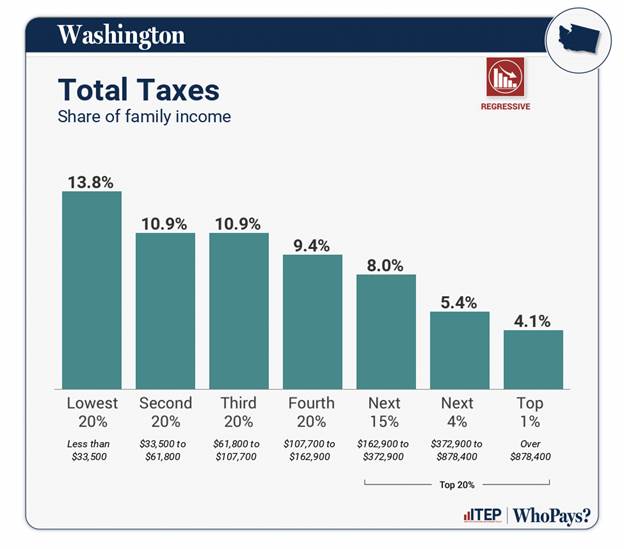
The chart by ITEP conveys that lower income people pay a larger proportion of their income in state and local taxes than higher income residents. Because Washington has no broad income tax system, it raises much of its revenues from sales taxes, excise taxes, property taxes, and the B&O tax on gross receipts; resulting in a household at a lower income bracket spending most of what is earned on taxable goods.
Washington’s tax on income over $1 million is aimed at the income group on the tail end of the income distribution while not impacting that bottom fifth income bracket. The tax adds a charge at the top, where ITEP says the share of income is paid smallest for what supporters say is a more equitable approach. Whether that is good policy is a separate argument; however, for the income tax to currently target income of $1 million or more, it at least matches the group the ITEP ranking identifies. An income tax that starts at $250,000, Ryu proposes, does not.
Households at $250,000 are nowhere near the top 1%. In the cities around the 32nd District they are well above the median, but these households already pay the sales tax, the property tax, and prices marked up for the B&O tax that create the regressive shape in the first place. Therefore, lowering the deduction to $250,000 does not reduce the sales tax paid by the bottom fifth and now opens the income tax to well over half a million households ITEP’s very own ranking never identified as the regressive gap.
Sen. Salomon shared that he was disappointed that the House version of the income tax that became the final version enacted into law—Ryu voted for—focused monies collected not on tax relief but on general fund revenue.
“I, along with a lot of my fellow Democratic members [in the Senate], have been talking about the regressive tax system for years that we need to change it,” Salomon said the at the KUOW debate. “I thought that’s what this bill was about. So, I signed on to it. I asked for about 65 to 75% of it to go to tax changes, not new revenue…. And then the House changed it. So, it was mostly new revenue. And I think we really blew a long-term opportunity.”
Also, on KIRO he said the final bill was “more revenue than tax cuts, and so that was not what I was hoping for.”
The Washington Research Council’s reading of the enacted fiscal note is that, after the tax reductions and working-families’ payments, the state keeps about 70% of the income-tax collections for general spending—monies not earmarked for a specific purpose, it is a free-for-all bucket.
The governor’s office has said 41-47% goes back to families and small businesses, but that figure counts spending on early learning, school meals, and local fiscal aid along with the tax cuts. The cuts themselves are an expanded working-families credit, sales-tax exemptions on diapers, some hygiene products, and over-the-counter drugs, and a larger small-business B&O credit.
Ryu did not dispute the shift. She said the final shape was the bargain required to get the governor and “everyone else,” on board.
Nothing in the current income tax law stops a future Legislature from doing what Ryu described—lowering the threshold. Democrats rejected an amendment from Sen. Chris Gildon that would have sent voters a constitutional lock on the $1 million deduction and the 9.9% rate.
Gov. Ferguson has pledged to veto a bill that expands who pays or raises the rate, a promise that lasts as long as he is governor—however, the courts could force his hand.
Senate Majority Leader Jamie Pedersen, the prime sponsor of the income tax legislation, has said he personally “absolutely” supports a universal income tax, yet has also said this Legislature has no desire to expand it. In 2024, he described the statutory ban on state and local income taxes as a “pie crust promise,” easily made and easily broken, because a statute can simply be amended.
According to PDC reports as of October 5, Sen. Salomon has raised $254,351.25 to Rep. Ryu’s $234,808.66 in the tightly contested senate seat.
Both are democrats, both are experienced elected officials with political acumen, and both want your vote. Both voted for the income tax on household income over $1 million; however, they split is what they would do next, and how closely they follow the Democratic caucus.
Ryu, a self-described progressive, has described Salomon as too moderate and too independent for the 32LD. Her campaign site quotes the Progressive Voters Guide calling her “continuously committed to progressive priorities” and citing a slate of progressive bills, including professional licensing for undocumented residents, rent stabilization, and transit-oriented housing. Her five priorities are affordability, fully funding public education, fair taxes for working families, workers’ rights, and small businesses.
Salomon is a Democrat who supports some progressive policies such as the Climate Commitment Act, which he sponsored, and rent stabilization. On housing, he has championed to add rentals, condos, cottage housing, and starter homes to the region. On public safety he argues for reform rather than “tear down and destroy,” defund policies, pairing enforcement with treatment, and points to the RADAR program for mental-health calls.
On education, according to his website, Salomon has advocated for preschool, smaller classes, free meals, and vocational training alongside four-year degrees.

Author: Mario Lotmore