

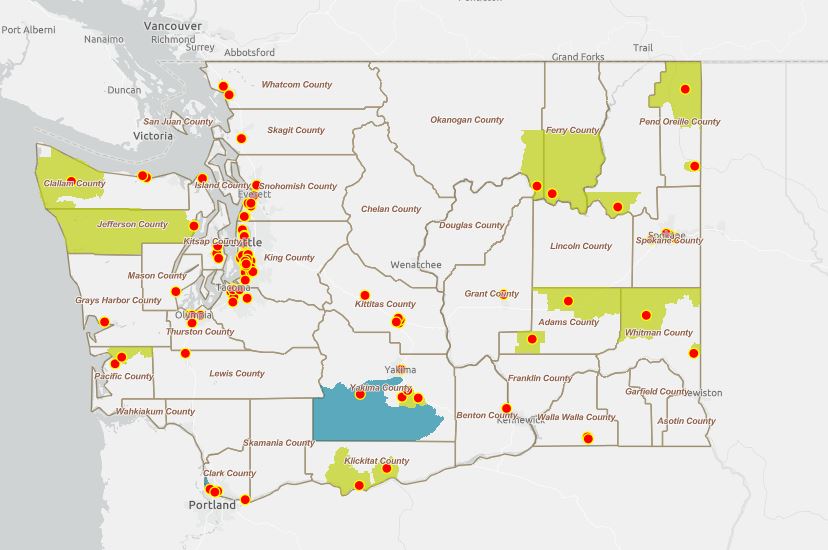
OLYMPIA—Snohomish County has six communities among the 99 low-income and rural areas Governor Bob Ferguson nominated Thursday for the federal Opportunity Zones 2.0 program.
“Washington is a great place to do business,” Ferguson said. “Opportunity Zones help shine a light on communities that have exceptional potential for investors.”


The nominations, covering 27 counties and 17 tribal lands statewide, went to the U.S. Treasury Department on October 8. If certified, the new designations take effect January 1, 2027. The second-generation program offers tax incentives to investors, developers, and financial institutions that put capital into real estate and businesses in designated areas. The first round, launched in 2018, is estimated to have drawn about $100 billion in private investment nationwide.
Washington nominated 139 areas across 36 counties in that first round. For this cycle, the state took public comment and reviewed 152 applications before selecting 99. Thirty-six of those are rural. The Washington State Department of Commerce led the outreach, which included the public, business leaders, and the state’s 29 federally recognized tribes.




Sarah Clifthorne, interim director of Commerce, said the process started with what communities said they need to grow.


“There is immense untapped potential across Washington for private investments to thrive and unlock the next chapter of growth,” said Clifthorne.

The full list of nominations is on the state’s Summary OZ Dashboard.
Snohomish County nominations
Six of the 99 nominated locations are in Snohomish County.
Marysville – Downtown
Marysville was nominated because downtown already has the public groundwork for private development, but not the private capital to match it. The city adopted a Downtown Master Plan in 2021 to support compact, mixed-use growth in the historic downtown and along the waterfront, and it has since put more than $95 million into public improvements. With the population projected to rise from about 76,000 in 2025 to 100,000 by 2044, local leaders are looking for partners who can turn that preparation into housing, shops, and jobs.
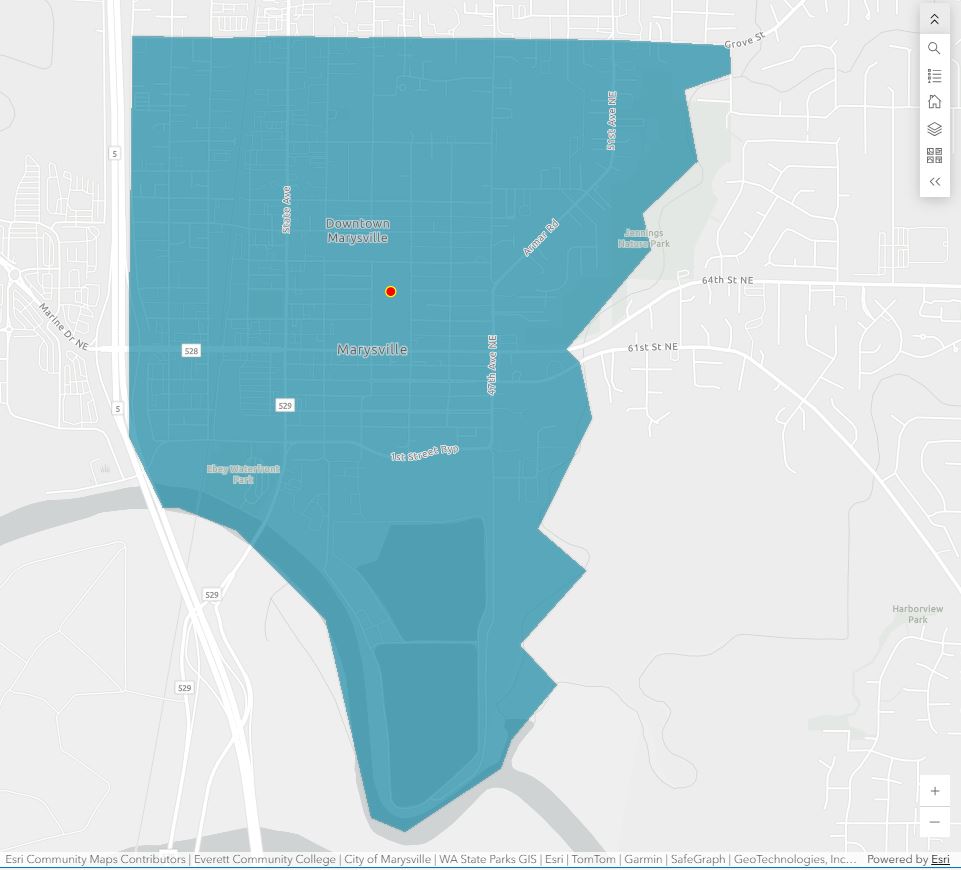
Dashboard materials estimate that projects supported by a designation could add up to 1,764 housing units and hundreds of local jobs. Downtown’s location near the Cascade Industrial Center, a Puget Sound Regional Council employment and innovation hub, is part of the case for why private investment there would reach beyond the neighborhood.
Everett – Metro Downtown
Downtown Everett was nominated as the front door to the county’s growth plans, and as a tract where public investment has outpaced private follow-through. The area includes the county’s transit hub, and planned projects include an outdoor events center, the Downtown Everett light rail station, and reuse of surplus public property, layered onto city and county campuses, offices, entertainment venues, and light industry already there. Growth-targeted zoning, multifamily tax exemptions, New Markets Tax Credit eligibility, and partnerships among the city, county, Port of Everett, Washington State University, nearby tribal nations, and employers from Boeing to Funko are already in place.
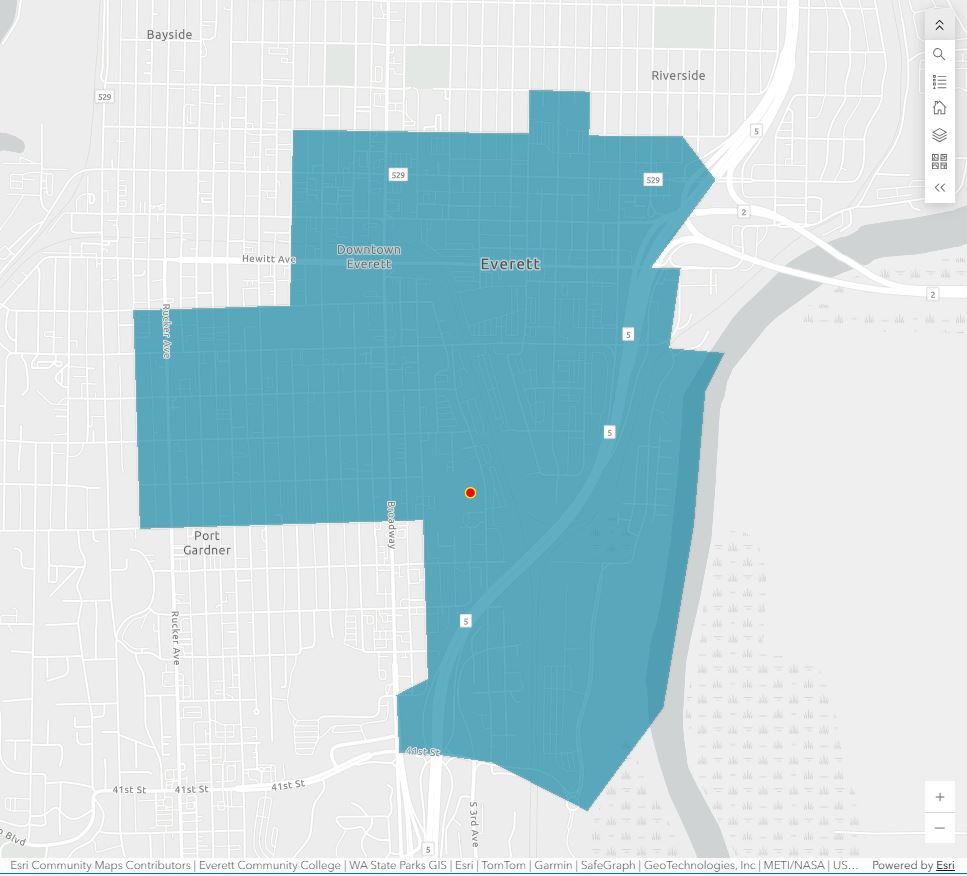
The dashboard case is that relatively low rents have still not drawn the private capital needed to convert underused historic and brownfield sites into jobs and housing, and that an Opportunity Zone designation would fill that gap in the capital stack.
For more information, see census tract profile document.
South Everett — Paine Field and Casino Road
This tract was nominated because it sits at the overlap of airport, aerospace, and transit investment, without a matching level of private development. It lies next to Seattle Paine Field International Airport and Boeing’s Everett assembly plant, and it includes a future light rail station and the Casino Road community.
Sound Transit’s spending lines up with the airport’s plan to expand commercial service, Boeing’s added 737 assembly line, and growth of a clean-energy cluster. Local bus and bus rapid transit routes already cross the area, and transit-oriented zoning, multifamily tax exemptions, and New Markets Tax Credit eligibility are available.
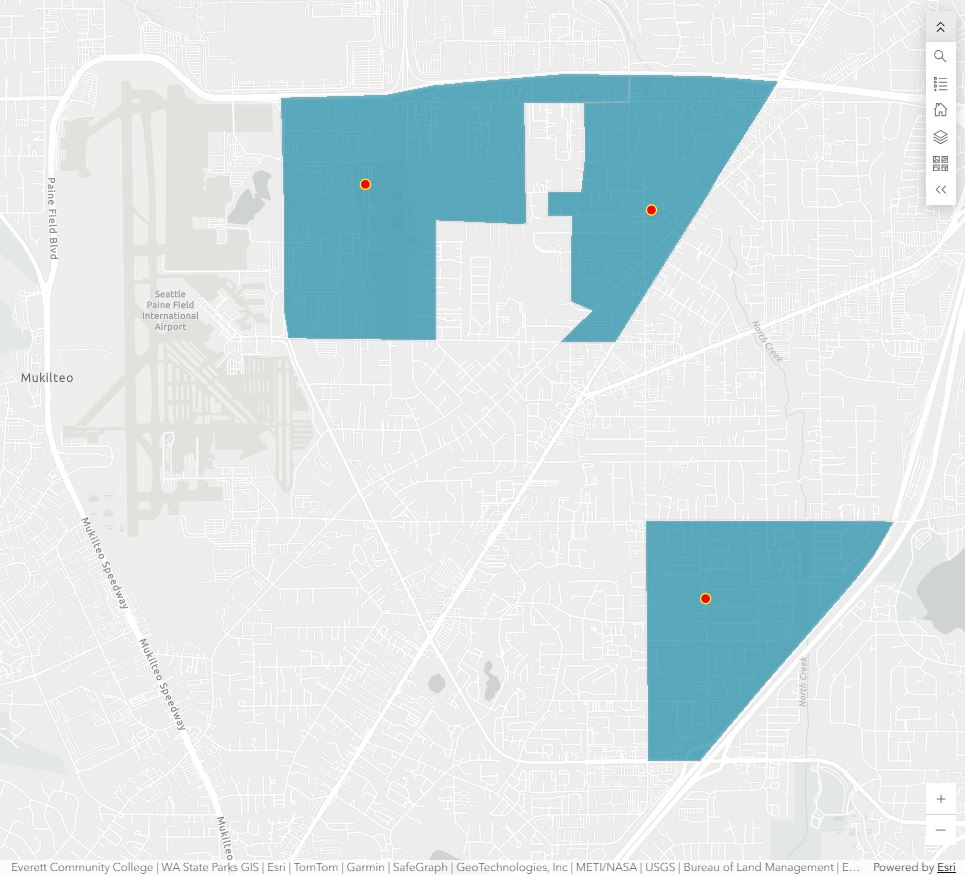
Even so, the nomination argues that private investment is still missing. The city is also considering a public-private redevelopment of Walter E. Hall Golf Course, framed as a way to tie that regional job growth to local wealth-building and housing.
For more information, see census tract profile document.
South Everett — Casino Road and Highway 99
The Evergreen tract was nominated as a severe-distress station area where the redevelopment sites are already identifiable. It sits at Evergreen Way and Casino Road and includes the Evergreen light rail station and Casino Road Square, which functions as an unofficial community center. The recently closed Fred Meyer is cited as a ready project site, with other underused property nearby.
As with the other south Everett nominations, light rail, bus service, transit-oriented zoning, and existing tax tools have not been enough to bring private capital in.
The dashboard case is that Opportunity Zone status, stacked with those tools, is what would move housing, retail, and job projects from planned to being financed.
For more information, see census tract profile document.
South Everett — Mariner corridor
The Mariner corridor, in unincorporated southwest Snohomish County, was nominated because projected growth is coming and the tract is set up to capture it only if private capital follows the transit investment.
The area is minutes from Paine Field and Boeing’s Everett plant and sits next to the planned Mariner station on Sound Transit’s Everett Link Extension. Unincorporated southwest county is projected to absorb 83,736 new residents by 2044, and the Everett unincorporated municipal urban growth area alone is estimated to need 10,004 new housing units. Local zoning and Ordinance 25-015’s streamlined permitting have cleared the main regulatory barriers, and infrastructure is already in place.
Need is documented in the dashboard materials: the county is a designated childcare desert, the 2025–2029 Consolidated Plan ranks affordable housing and childcare as top priorities, median family income is $64,214, about 45.8 percent of the Seattle-Tacoma-Bellevue median, and the corridor is a federal primary-care shortage area.
Across three anticipated projects, the 10-year window is estimated to support 360 to 480 construction jobs and 80 to 120 permanent jobs in property management, retail, childcare, and workforce services.
For more information, see census tract profile document.
Lynnwood — City Center
Lynnwood City Center was nominated to extend investment that is already underway rather than to start it. A new light rail station, mixed-use development, streetscape work, and infrastructure upgrades have strengthened its role as a regional hub, and the tract is planned for high-density, transit-oriented growth.
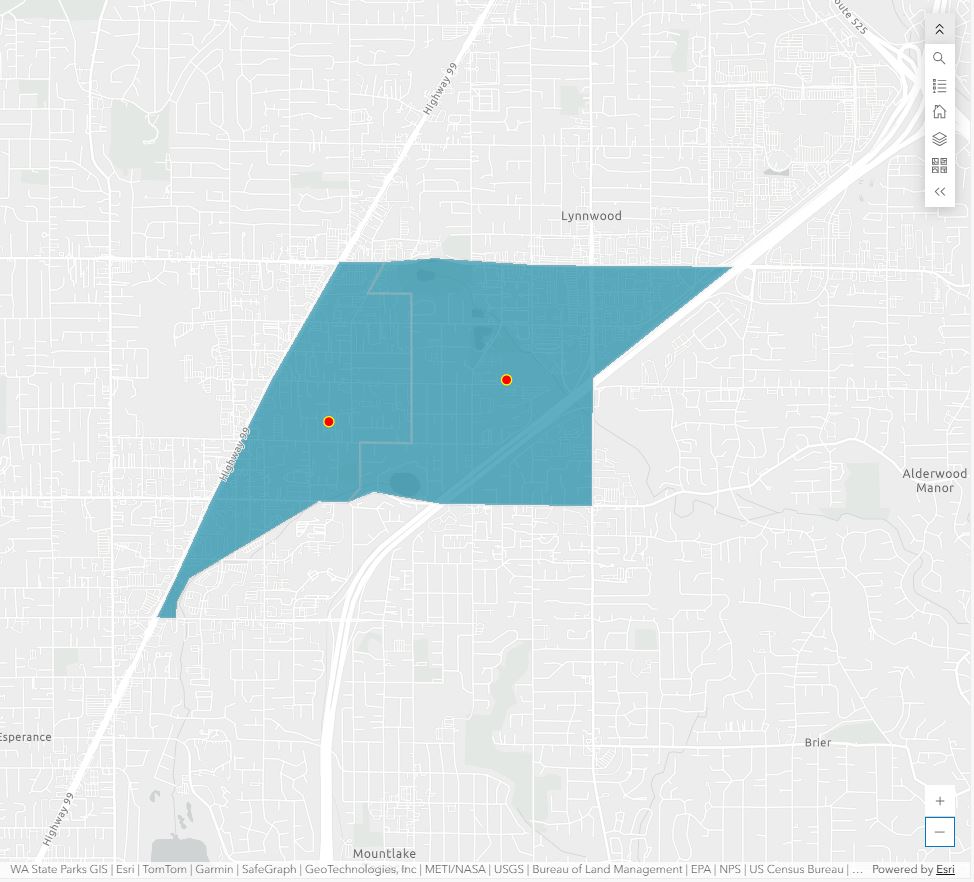
The dashboard case is that Opportunity Zone status, used with the multifamily tax exemption and tax increment financing, would speed redevelopment of underused property, add permanent jobs and housing, widen the local tax base, and make the center more walkable for residents and visitors.
Lynnwood — South Lynnwood
South Lynnwood was nominated to carry out the South Lynnwood Neighborhood Plan, which calls for better transportation access, new business, stronger neighborhood connections, and a more walkable center.
The tract has underused property that could support mixed-use and residential projects, but the nomination argues that private capital and public-private partnerships are still needed to move that plan from paper to construction.
A designation is presented as the tool that would help the city add housing, jobs, and connections between neighborhoods, transit, and commercial areas without waiting on public money alone.
How the program works
The 2018 program is credited with drawing more private investment into distressed communities over a comparable period than earlier federal place-based policies. Investments tied to that first round are estimated above $100 billion, across more than 5,600 neighborhoods.
Congress’s 2025 update added reporting requirements so long-term results can be measured. Funds still operating under the 2018 designations must meet the new compliance rules. Those original geographic designations stay active through December 31, 2028, overlapping the start of the new program.
Projects already underway in Washington are affected by that overlap. In Spokane, Peyton Lofts is converting a 135-year-old office building into a 96-unit mixed-use residential project, targeted for completion by the end of 2027. Completed examples from the first round include The Koz on MLK in Tacoma’s Hilltop, a 161-unit workforce and affordable project with ground-floor commercial space finished in 2022 by a woman-owned developer, and Marina Square in Bremerton, a 2023 waterfront project with 270 homes and nearly 13,000 square feet of retail on a former parking lot.
What is new in Opportunity Zones 2.0
The update adds stronger incentives for high-need rural areas:
- A five-year hold in a Qualified Rural Opportunity Fund reduces taxable value by 30 percent, compared with 10 percent in non-rural zones.
- Rural property needs capital improvements equal to only 50 percent of adjusted basis to qualify, versus the standard 100 percent.
- A certified 2.0 zone keeps its status through December 31, 2036.
- The program runs on a permanent 10-year cycle, with the next map taking effect January 1, 2037.
- New IRS reporting is meant to track jobs and investment more clearly than was possible under the first round.
What happens next
Treasury will review and certify nominations from the states. Designations are scheduled to take effect January 1, 2027.
Investors can register Qualified Opportunity Funds with the IRS and review realized 2026 capital gains at irs.gov/credits-deductions/businesses/invest-in-a-qualified-opportunity-fund. Commerce is encouraging investors to prepare strategies before the effective date so capital can move early in 2027.

Author: Mario Lotmore