

SEATTLE — A 64-year-old Kent man accused of converting at least $600,000 in federal food benefits into personal cash through a Tacoma grocery store was returned from India this week and is scheduled to appear in U.S. District Court in Tacoma after fleeing the country following his indictment.
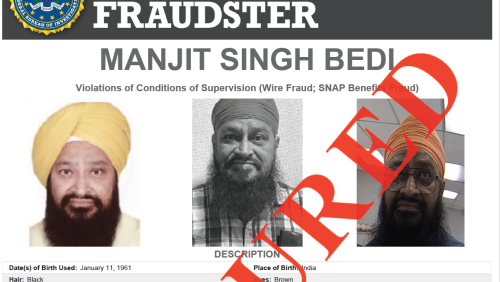
Manjit Bedi, who owned and operated the Asian Grocery Store, was indicted in April 2026 on six counts of wire fraud and five counts of SNAP benefits fraud. He pleaded not guilty on April 22 and left the United States within a week, traveling through Canada to his native India, according to the DOJ. On Sept. 3, he was added to the FBI’s Most Wanted Fraudsters list. Indian authorities took him into custody, and he arrived in the Western District of Washington on the night of Oct. 14.



“I commend the work of the FBI and international partners to get Mr. Bedi back to the U.S. to face justice,” Acting U.S. Attorney Charles Neil Floyd said. “We will ask the court to detain him pending trial as he has demonstrated he has the will and the means to flee. Those who take advantage of America’s generosity must be held accountable.”
According to the indictment, the Asian Grocery Store was authorized to accept Supplemental Nutrition Assistance Program (SNAP) benefits beginning in February 2024. Starting the following month and continuing through about June 2025, Bedi allegedly arranged with SNAP recipients to exchange the money loaded on their Electronic Benefit Transfer cards for cash at roughly 50 cents on the dollar.




In one example, according to prosecutors, Bendi would charge $200 against a recipient’s card, hand over $100 in cash, and keep the remaining $100. The transactions were processed as if eligible groceries had been sold, causing the SNAP program to transfer funds to the store’s bank account for food that was never provided. The indictment alleges this generated at least $600,000 in payouts for nonexistent sales.

Wire fraud counts involve specific interstate electronic transmissions of EBT transactions originating in the Western District of Washington. SNAP benefits fraud counts allege unauthorized use, transfer, acquisition or possession of benefits valued at $100 or more on particular dates and cards. Both offenses are punishable by up to 20 years in prison and a $250,000 fine. The charges are allegations, and Bedi is presumed innocent unless proven guilty beyond a reasonable doubt.

“The arrest and return of Manjit Singh Bedi marks yet another significant moment for the historic FBI’s Most Wanted Fraudsters program,” FBI Director Kash Patel said. “Bedi is one of six Most Wanted Fraudsters captured since the creation of the new list three months ago – and yet another high value target captured overseas – he is in a group responsible for more than a combined $2 billion in fraud and has been on the run for almost 4,000 days collectively prior to arrest. He is charged with defrauding the U.S. of at least $600k in SNAP funds from approximately 2024 to 2025 and now will face justice for his alleged crimes.”
Director Patel thanked the FBI Seattle Office, “as well our brilliant law enforcement partners” in India, for assisting in securing Bedi’s return.
“No matter how far someone may flee and no matter how long it may take, the FBI is committed to pursuing those who attempt to outrun the consequences of their criminal actions, even when they seek to evade the justice system by hiding overseas,” said W. Mike Herrington, special agent in charge of the FBI Seattle field office.
Bedi’s alleged scheme shares core features with street-level SNAP trafficking recently documented in Seattle’s Chinatown-International District.

In early October 2026, independent journalists Nick Shirley and Jonathan Choe, working with others, filmed undercover efforts near 12th Avenue and South Jackson Street, where people offered to sell or trade EBT balances for cash at steep discounts. A woman arranged a deal involving a roughly $120 balance and took Shirley to Lam’s Seafood Market at 1221 S. King St., where items were rung up for that amount on the card. The $120 transaction, described by Shirley as a single can of SPAM and a package of sushi, did not complete because Shirley intentionally entered an incorrect PIN.
Lam’s operations manager Teizi Mersai, in a video released on social media, disputed Shirely’s and Choe’s characterization of fraud, stating the items were a full case of 24 cans of Fortune luncheon meat plus spring rolls, that no sale occurred, and that the store cannot refuse service based solely on suspicion of fraud. The market has denied any collusion in trafficking, said it has reported suspected activity to authorities for years, banned known traffickers, and is considering legal action.
Lam’s Seafood Market is no stranger to SNAP fraud. The store had already been identified as a frequent location in a separate 2025 Seattle Police Department investigation into EBT trafficking in the same area. Officers observed traffickers buying cards and PINs from people experiencing homelessness or addiction for a fraction of their value, then using the benefits to purchase bulk resellable goods.
In the 2025 incidents, police identified 18 suspects and arrested 11. King County prosecutors charged Ha Son Thach, 54, and Lien My Khuu, 46, with multiple counts each of unlawful trafficking in food stamps. Both pleaded not guilty. The store was not charged; management said it cooperated and provided surveillance footage. Court orders prohibited the defendants from contacting Lam’s or the area.


Nationally, the SNAP program costs federal taxpayers more than $100 billion annually and serves more than 40 million people in an average month. USDA studies covering earlier periods estimated that trafficking — the exchange of benefits for cash or other ineligible items, typically at about 50 cents on the dollar — accounted for roughly 1.6% to 2% of benefits, or about $1 billion to $1.3 billion per year, with the large majority occurring at small retailers.
Separate electronic theft through skimming and cloning has also cost taxpayers hundreds of millions of dollars in recent years, according to federal and state reports and private data on replaced benefits. Improper payments, which include both intentional and unintentional errors, have been estimated in the billions annually in recent fiscal years.
In Washington state, the Department of Social and Health Services has tracked millions of dollars in benefits stolen through EBT card skimming and cloning since 2022, with a significant portion involving SNAP. The state’s payment error rate for the program has hovered around 6% to 7% in recent years, below the national average of 10% to 11% but high enough under recent federal law to trigger potential state cost-sharing for benefits.
The DOJ has established a National Fraud Enforcement Division focused on investigating and prosecuting the misuse of taxpayer dollars, supporting broader Trump administration efforts to address fraud in federal benefit programs.

Author: Mario Lotmore