

SEATTLE — On Sept. 28, the Washington Jobs Initiative celebrated the close of its four-year run, highlighting how flexible federal funding helped more than 3,150 state residents access training and jobs in high-demand fields.

The program, led by the Washington Student Achievement Council in partnership with Career Connect Washington, launched with a $23.5 million Good Jobs Challenge (GJC) grant from the U.S. Department of Commerce’s Economic Development Administration. It targeted five industries: construction, healthcare, advanced manufacturing and aerospace, clean technology and energy, and information technology and cybersecurity.

At the closing showcase, organizations from eight sectoral partnerships shared program results, participant stories and employer impacts. Organizers emphasized equity, prioritizing women, people of color, justice-involved individuals and those affected by the COVID-19 pandemic.
Nicole Miller of Construct a Career described one-on-one case management that reduced apprenticeship dropout rates. Since 2024, the program served more than 4,000 people seeking support, provided case management to 2,300 and funding to 1,300. Female participation reached 16-17 percent (above the typical 8-12 percent industry average), and about a quarter of participants were formerly incarcerated. Dropout rates fell below 10 percent, compared with an industry average of 36 percent.




“To see folks be able to succeed in these programs, especially if they’re coming from challenging barriers, has really been incredibly rewarding for us and our apprenticeship union and employer partners,” Miller said.


Peter Vargo of Computing for All recounted adapting after tech-sector layoffs flooded the market with experienced workers and raised entry-level requirements, including AI skills. The partnership updated curricula with industry input and offered workshops. Nearly 1,800 participants enrolled, with projections of 1,500 graduates and 850 job placements; 790 were already employed.


“We were set up for success. Everything was perfect,” Vargo said. “Our participants were preparing for entry-level jobs, while the definition of entry-level was changing beneath them.”
In healthcare, Peter Swanzy of the Healthcare Training Fund highlighted participant Elizabeth Napolean, a Substance Use Disorder Professional Apprentice at the Suquamish Tribal Wellness Center. The program designed earn-while-you-learn apprenticeships that allowed her to stay embedded in her community with support from tribal elders and mentors.
“As soon as I learned it was an opportunity to earn-while-you-learn and grow within my own community, I knew it was the path I wanted to take,” Napolean said.
“Her story demonstrates that apprenticeship, especially in Behavioral Health, is much more than technical instruction,” Swanzy said. “[Elizabeth’s] experience in this program reminds us that career development has real outcomes that extend far beyond one participant. They can strengthen families. They can strengthen communities. Our participant voices are really the most powerful demonstration of this impact.”
Sam Bradshaw of Manufacturing and Construction Works described removing small barriers such as tools or boots. A carpentry belt can cost up to $1,000. Flexible funding supported case management and a tool drive that raised more than $15,000 from employers. One participant said, “Tools are an investment towards a better future for me.”
Brian Doyle of the King County JumpStart Workforce Program, focused on clean energy and small-to-medium businesses, described paid work-based learning at $25 an hour for six weeks. Trainees earn about $6,000, employers get a trial period, and roughly half of participants are hired full time. The program prioritizes underrepresented groups, including young adults, people of color, women and LGBTQ+ individuals.
“It’s your attitude and your aptitude,” Doyle said. “Show up hungry, willing to learn, and take constructive criticism—that’s [what it takes to be] a successful person in the trades.”
The Washington Student Achievement Council (WSAC) is the state’s higher-education coordinating body. WJI built on the Career Connect Washington system to address a skills gap in which more than 70 percent of jobs require postsecondary credentials while only about 40 percent of young people hold them. Quality jobs under the program generally exceed prevailing wages, offer benefits or are union positions.
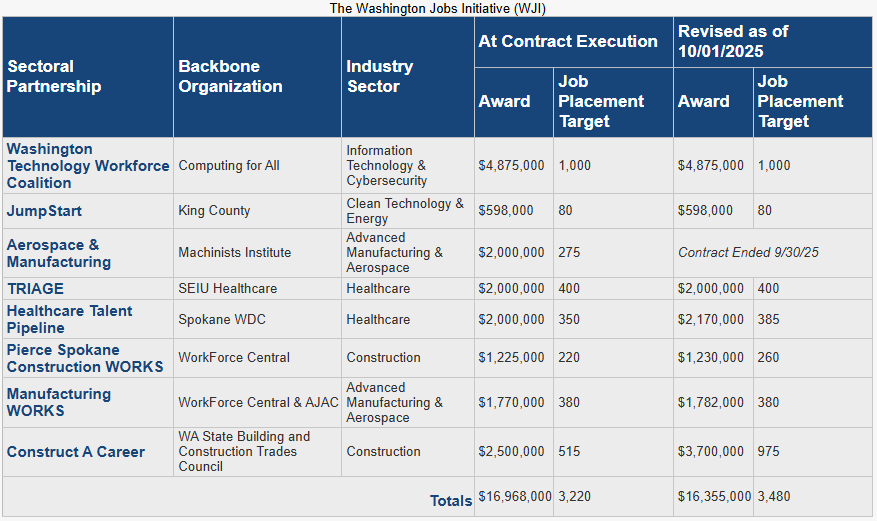
The initiative allocated nearly $17 million to eight partnerships. Original goals called for training 5,000 people and placing 3,150 in jobs by 2025; a no-cost extension ran through September 2026. As of mid-2026 updates, outcomes exceeded targets: 5,329 enrollments, 3,198 completions and 3,164 placements.

Author: Mario Lotmore